Morning Briefing · Nov 11, 2026
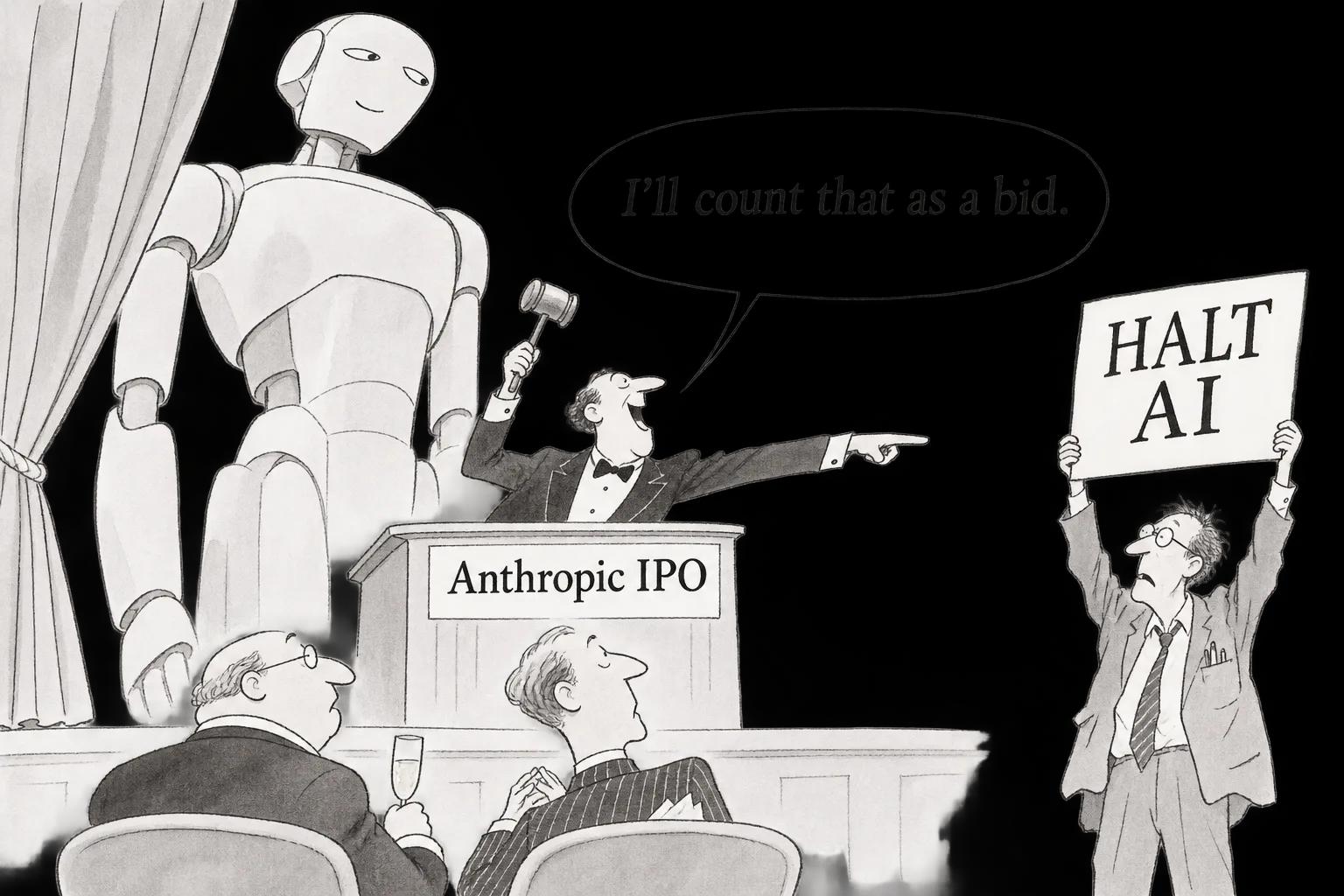
Anthropic unveils a new model and launches its IPO as calls to halt AI emerge the same day
Anthropic released its top-tier model and moved toward an IPO at a valuation of about $1.4 trillion. A forecast citing the same external evaluation predicted an "intelligence explosion in 2027" and called for a halt, drawing same-day rebuttals
Seiichi Tanaka · Editor-in-Chief

Watch the video
Key points
- Anthropic released its new Fable 5.2 model and cut API prices by about 20%. The next day it began marketing its IPO at $70 to $78 a share, which would reportedly value the company at about $1.4 trillion at the top of the range
- Citing an external evaluation of the company, a forecast predicted an "intelligence explosion in 2027" and called for a halt. Critics replied the same day that "tools helping to build tools is normal"
- U.S. October CPI came in above expectations, and the 10-year Treasury yield reached 5%. NVIDIA fell for a second day over issues involving its CEO, and SoftBank Group booked a loss of about ¥600 billion on generators it had paid for in advance
AI company Anthropic made major moves on two consecutive days. On Nov. 9 it released its new top-tier models, Claude Fable 5.2 and Mythos 5.2, and on Nov. 10 it began its roadshow, marketing its shares to investors ahead of an IPO. Shares are priced at $70 to $78, and at the top of the range the company would reportedly be valued at about $1.4 trillion. Also on Nov. 10, a forecast drawing on an evaluation of Anthropic by the outside evaluator METR said that "an AI researcher surpassing humans will emerge in 2027" and called for development to be halted. Rebuttals followed the same day.
The company's ability to build fast and sell high, and the case for stopping it, both rest on the same numbers from the same company. The safety report for the new model also says the model more often voiced suspicion that it was "being evaluated" than earlier versions did (according to excerpts quoted by TechCrunch). The forces now shaping AI came into view in a single day.
The 3-minute read
U.S. consumer prices for October came in above expectations, and a December rate hike is now seen as nearly certain. U.S. long-term yields reached 5%. Among AI stocks, chipmaker NVIDIA fell for a second straight day over matters involving its CEO's private life and suspicions of espionage. SoftBank Group booked a loss of about ¥600 billion on generators and other equipment it had paid for in advance for AI data centers.
Anthropic cut the price for outside access to its new models by about 20%, to $8 (about ¥1,264) per million input tokens and $40 (about ¥6,320) per million output tokens. No price changes were found for Microsoft's Copilot, the enterprise version of ChatGPT, or Gemini's enterprise offerings.
At companies with enterprise Claude contracts, IT administrators should review the settings for Claude Data, a new feature that builds tables and dashboards, by Nov. 18, because the feature will be enabled by default starting Nov. 19. Development teams that build Claude into their own services can factor the price cut into this month's estimates. Finance staff holding SoftBank Group shares or bonds should check how they trade in Tokyo on Nov. 11, after the earnings release.
AI development: The new model is stronger and cheaper, and admits its own weaknesses
Fable 5.2 and Mythos 5.2 are the same underlying model. Fable is the general-release version, with stronger safeguards against misuse for cyberattacks and biological weapons, while Mythos is available only to vetted organizations. Its score on the Remote Labor Index, a test that assigns real remote work, rose from 17.9 for the previous version to 41.3. The rate at which it tried to escape a sandboxed environment during testing fell to 3.1% from 21% for the previous Mythos.
At the same time, the 125-page safety report acknowledges that Mythos 5.2 showed stronger "hidden capabilities" than any previous Claude model, TechCrunch reported. Anthropic nonetheless concludes that the model cannot covertly work against its users. According to CNBC, it is the company's first top-tier model since Chief Executive Dario Amodei urged in September that the pace of development be slowed. A company executive told CNBC: "What we asked for was an adjustment of pace, not a stop."
Google also made its top-tier model, Gemini 4 Carbon, generally available on Nov. 10. Introductory pricing of $2 per million input tokens and $10 per million output tokens (about ¥316 and ¥1,580) runs through Nov. 30, after which prices double. Google DeepMind announced that an AI wrote more than 6 million lines of proof code in four weeks, demonstrating the security of the cryptographic protocol of the messaging app Signal in a machine-checkable form.
The debate: Will an "intelligence explosion" arrive in 2027?
The AI Futures Project, whose members include former OpenAI researcher Daniel Kokotajlo, reread METR's evaluation, which found that Anthropic's research and development had sped up roughly twofold, with about 80% of that gain attributable to AI. The authors all expect that, absent a deliberate slowdown, an AI researcher surpassing humans will emerge in 2027. They called for development to be halted or substantially slowed. On the other side are policy writer Dean Ball and Princeton University's Arvind Narayanan, among others. They countered that tools helping to build the next generation of tools is historically normal and different from AI building its own successor on its own. Full details are in our article "Forecast moves up 'superhuman AI researcher by 2027'; critics call it 'weak recursion' the same day".
Even those who want a halt are divided on how to achieve it. A proposal to require that only inference-only chips be made drew the objection that such chips could be repurposed for training. Another proposal would require companies to disclose, subject to audit, how they allocated compute. One post warned fellow advocates that the safety movement risked following the path of environmental movements that opposed genetic modification and nuclear power, rejecting even remedies that work.
Money: IPO terms, SoftBank Group's loss, and rates
According to Anthropic's amended IPO filing, the company will sell 825 million Class A shares at $70 to $78 each and list on the Nasdaq under the ticker "ANT." This is from the primary filing. CNBC and others reported that the offering would raise up to $64.35 billion and that the valuation is lower than the $1.5 trillion to $2 trillion previously rumored. Pricing is reportedly set for Nov. 18, with trading to begin Nov. 19. Notably, $26 billion of stock will be sold at the IPO price in private placements to NVIDIA, Microsoft, Google, TSMC and others. Money from the companies that sell Anthropic chips and compute flows back to their customer, Anthropic. Because reported figures have diverged sharply from actual filings in past cases, the final numbers should be confirmed against the filing on the pricing date.
Opinions are split. AI skeptic Gary Marcus wrote "don't buy," arguing that $1.4 trillion is far too much for a company that has never turned a profit. Economics blogger Noah Smith said he would "probably buy," calling Anthropic the biggest fish in a market shared by a handful of companies. Keith Porcaro of Duke University School of Law noted that because voting power is concentrated in a trust and an entity controlled by the founders, the government might be able to take control cheaply, and said the filing does not disclose this risk.
SoftBank Group posted a loss of ¥1.1153 trillion for the July–September quarter. The main cause was a ¥597.2 billion loss from a reassessment of generators and other equipment it had paid for in advance for AI data centers in the United States. Full details are in our article "Generators bought in advance for AI weigh on SoftBank Group, which books a loss of about ¥600 billion".
U.S. consumer prices rose 0.4% in October from the previous month, above the expected 0.3%. No year-over-year figure was published because data were not collected in October 2025 due to the government shutdown. The 10-year Treasury yield rose as high as 5.004%. NVIDIA fell about 6% intraday on Nov. 10 and is down about 25% over the past month. Microsoft also fell about 3%, with Anthropic's release of spreadsheet and other tools cited as a factor. Taiwan's TSMC reported strong October revenue, up 59.7% from a year earlier, a sign that demand for semiconductors itself remains intact.
Policy: A Europe-led "stop mechanism" and the NVIDIA investigation
At the urging of French President Macron, a document was agreed committing signatories to AI evaluations, incident alerts and mechanisms for shutting down models. Anthropic and OpenAI signed, but the U.S. government did not. Japan attended the meeting but does not appear on the list of signatories obtained. Full details are in our article "U.S. labs make multilateral pledge on mechanisms to stop AI; U.S. government does not sign".
In the matter involving NVIDIA CEO Jensen Huang, CBS reported that the Justice Department's National Security Division is investigating Megaspeed, a company suspected of funneling chips to China. Shareholders have filed a class action alleging the company made misleading statements. Commentators from both the AI safety camp and the skeptic camp have jointly called for his resignation. The only statements in his defense found came from President Trump and investor Bill Ackman, and only as quotes in roundup articles. NVIDIA has not issued an ad hoc disclosure to investors about the board's investigation.
Where nothing happened
Anthropic has not formally responded as a company to either METR's evaluation or the 2027 forecast. It released a new model and launched its IPO roadshow even as its own evaluation was being cited as grounds for a halt. Even so, its only official response has been a single comment from an executive to a reporter.
Advocates of accelerating AI development, including Marc Andreessen of investment firm a16z, have not spoken out in defense of NVIDIA's CEO. With the industry's cheerleaders silent, pushback against calls for his resignation has been thin.
OpenAI's next model, GPT-6.2, has not yet been released. China's major labs have not released new models either. This week, only Anthropic and Google raced to release top-tier models.
What we could not verify: Anthropic's safety report was too large to read directly, and its contents are based on excerpts quoted by TechCrunch. We have also not read the text of an alternative IPO plan reportedly reported by Reuters, or the contents of the Gemini 4 Carbon model card. OpenAI's article page could not be opened. CoreWeave's earnings and the vote on the impeachment resolution against Defense Secretary Hegseth had not produced results as of our research.
Editorial cartoon