Money · Oct 31, 2026
Intel's outlook plunge reportedly wipes $1 trillion off chip stocks
Intel shares fell about 30% after an October–December outlook it blamed on the Fab 28 explosion. Even memory makers that beat earnings expectations were sold, as strong AI demand alone was no longer enough to hold up share prices
Koji Yamamoto · Economics Analyst

Key points
- In its July–September quarter earnings release filed with the SEC, Intel issued an October–December quarter outlook far below market expectations, citing an explosion at Fab 28
- Intel shares fell about 30%, reportedly the worst drop since 1974. The SOX fell 7.2%, about $1 trillion was reportedly wiped from the market value of chip stocks, and the Nasdaq fell 3.6%
- Even memory makers whose earnings beat expectations were sold. Strong AI demand on its own can no longer hold up share prices
AI and semiconductor stocks sold off sharply on October 30. The trigger was the October–December quarter outlook Intel issued after the close the previous day. Intel cited an explosion at Fab 28, its plant in Israel, and gave figures far below market expectations. Intel shares fell about 30%, reportedly their worst one-day drop since 1974. The selling did not stop at Intel. The Philadelphia Semiconductor Index (SOX) fell 7.2%, and about $1 trillion was reportedly wiped from the market value of chip stocks. The Nasdaq Composite fell 3.6%. Even memory makers whose earnings beat expectations were sold. Strong AI demand on its own is no longer enough to hold up share prices.
Intel's outlook: a plant accident drags down the numbers
Intel issued its July–September quarter earnings release as a filing with the SEC (Primary source). In it, the company built the impact of the Fab 28 explosion into its October–December quarter outlook. The outlook came in far below market expectations.
The weak outlook does not signal that AI demand has dried up. It reflects a drop in how much Intel can actually produce after the plant accident. Even so, the market did not dismiss the downgrade as a problem confined to Intel. Damage this large on the production floor turned attention to how fragile the AI supply chain may be.
Market reaction: SOX down 7.2%, about $1 trillion in market value reportedly lost
Intel shares fell about 30%, reportedly their worst drop since 1974 (CNBC). The selling spread across the semiconductor sector. Benzinga reported that chip stocks, including NVIDIA, AMD, TSMC and Broadcom, lost about $1 trillion in market value (Benzinga). The SOX fell 7.2%.
The tech-heavy Nasdaq also fell 3.6% (NBC News). NBC reported that fears about the AI boom had deepened. The CNBC article covered concerns about big tech companies' AI spending, alongside Amazon's earnings released the same day. The roughly $1 trillion figure is a tally compiled by the media, and it could vary depending on which stocks are included and how they are added up.
Even memory stocks that beat expectations were sold
The most striking part of the day's selloff was that even memory makers whose earnings beat expectations were sold. AI memory such as HBM has led this year's AI rally. Until now, the pattern had held: strong earnings meant the stock went up.
That pattern broke down on this day. Strong results were outweighed by worries about the sector as a whole. Investors are no longer asking whether AI demand exists. They are asking whether share prices that already price in high expectations can withstand risks such as supply chain accidents and the direction of capital spending. Strong AI demand is no longer enough of a floor under share prices.
What to watch next
Upcoming earnings will show whether this drop is temporary or marks a change in the market's direction. Results from CoreWeave (November 9) and Nebius (November 10), which sell external GPU capacity, will help gauge how long the wave of AI capital spending can last. The price range in Anthropic's S-1/A, expected around November 10, will also show how much market enthusiasm for AI-related stocks remains.
For Intel, the focus will be on how long it takes to restore Fab 28 and how much the supply after the October–December quarter will be affected. The fact that even strong earnings could not hold up share prices will weigh heavily on the next earnings season as well.
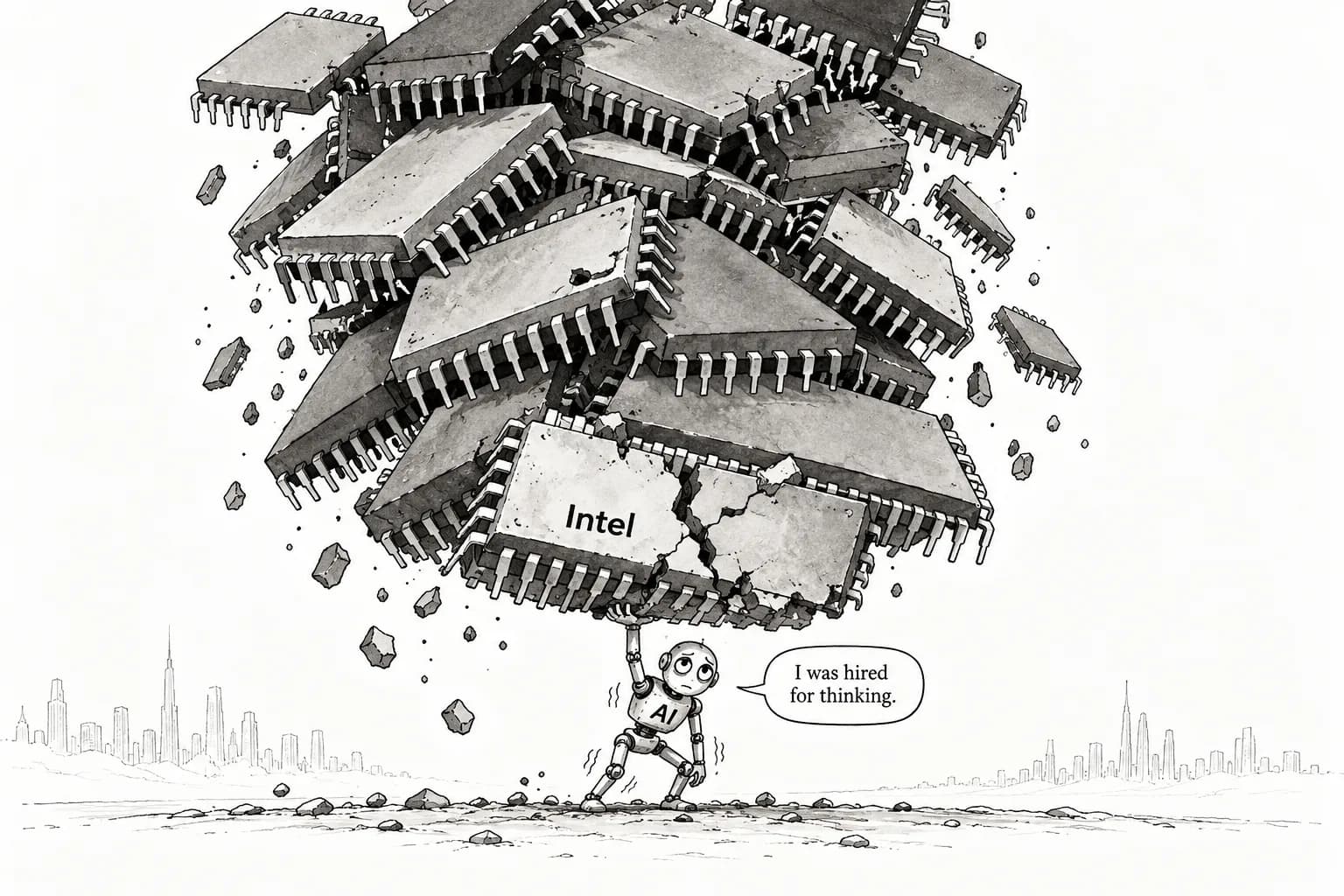
Editorial cartoon
Sources
- https://www.sec.gov/Archives/edgar/data/0000050863/000005086326000188/q326earningsrelease.htm
- https://www.cnbc.com/2026/10/30/amazon-intel-earnings-big-tech-ai-spending-concerns.html
- https://www.benzinga.com/markets/tech/26/10/62749985/chip-stocks-1-trillion-wipeout-intel-nvidia-amd-tsmc-broadcom
- https://www.nbcnews.com/business/markets/tech-stocks-nasdaq-ai-boom-fears-deepen-rcna606512