Products & Models · Oct 14, 2026
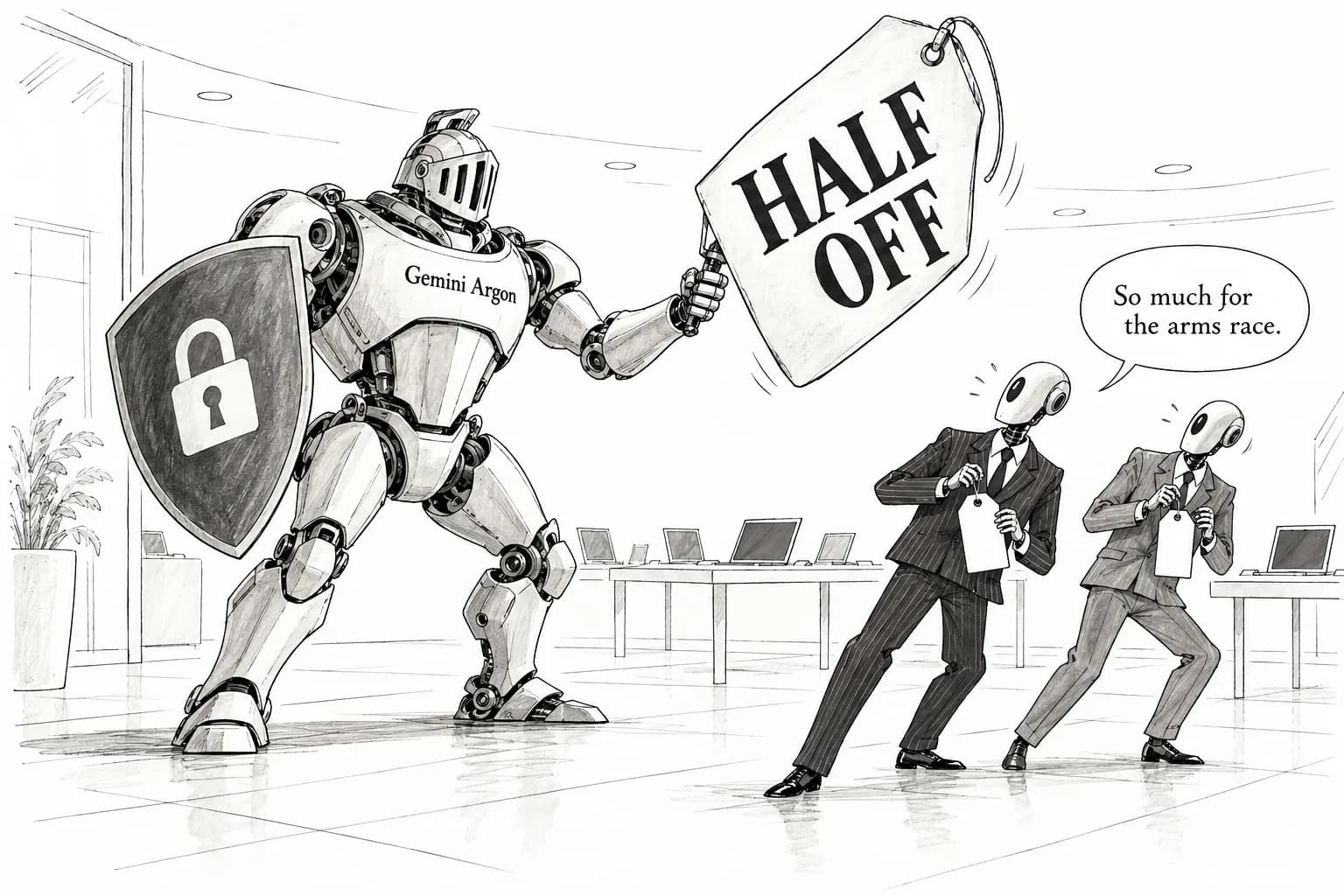
Gemini 4 Argon goes to general availability at Opus 5.5 and Muse Wonder's list price, half off through November as Google answers on cost
Google has released its top model to the market the day after Meta's Muse Wonder, after two weeks of limiting it to Fairwind defenders. It trails Opus 5.5 by five points on the intelligence index, but costs a third less per task
Rie Suzuki · Technology Editor
Key points
- The list price of $4 input and $20 output (per million tokens) is identical to Opus 5.5 and to Muse Wonder, released the day before. The introductory price of $2 and $10 through the end of November matches the list prices of Sonnet 5.5 and GPT-6.1 Sol
- Artificial Analysis's Intelligence Index puts it at 53, short of Opus 5.5's 58 and Wonder Full's 56. But the cost per task is about $1.99 at the introductory price and about $3.98 at list, below Opus 5.5's $5.98
- For two weeks after its September 30 release, access was limited to Fairwind Program defenders and US government agencies. Switching to general availability the day after Muse Wonder is a decision to respond on price, not performance
- It uses more than twice the output tokens of GPT-6 Astra, and at list price costs about 22% more per task than Astra. The real comparison comes after the price doubles at the end of November
Google made Gemini 4 Argon, the first model in the Gemini 4 family, generally available on October 13 (Google's blog and the Gemini API changelog, primary sources). The list price is $4 per million input tokens and $20 per million output tokens, exactly the same figures as Anthropic's Claude Opus 5.5 and Meta's Muse Wonder, which launched the previous day, October 12. Through the end of November, Google is offering it at an introductory price of half that: $2 input and $10 output.
Argon had been released on September 30, but access was limited to participants in the Fairwind Program, which is restricted to cyber defense specialists, and to US government agencies. Availability for paying API customers was listed as "as soon as possible" with no date attached. After two weeks in that state, Google switched to general availability the day after Meta released Muse Wonder. The weapon Google chose is not a new performance number but price.
The price lineup: list price one shelf up, introductory price one shelf down
Frontier pricing today falls roughly into three shelves. At the top is GPT-6 Astra at $10 input and $50 output. Below that sits the $4 input and $20 output shelf occupied by Opus 5.5 (September 22) and Muse Wonder (October 12). Below that again is the $2 input and $10 output shelf, home to Claude Sonnet 5.5 (September 28) and GPT-6.1 Sol (September 29).
Argon's list price lands on the second shelf. Google has placed it level with Opus 5.5 and Wonder, without so much as a dollar of difference. The introductory price through the end of November, meanwhile, is the exact figure from the third shelf. In effect, Google is telling Opus 5.5 and Wonder that "we sit on the same shelf as each company's top model, at the same price," and telling Sonnet 5.5 and Sol that "for seven weeks, you can have a model above yours at the same price."
Fairwind participants had already been paying $2 input and $10 output since September 30. The general availability introductory price simply extends that Fairwind rate to the whole market, and is not a new price cut. What is new is the explicit list price, with the end of November set as the deadline after which the rate doubles.
Below Opus 5.5 on the index, a third less per task
Third-party evaluations of Argon already appeared during the Fairwind period (Artificial Analysis, compiled October 1, secondary source). Its Intelligence Index is 53, tied with GPT-6 Astra. That is five points short of Opus 5.5's 58 and also below Wonder Full's 56. It does beat the 52 of Muse Wonder (the non-Full version). By category, it leads AutomationBench at 78% and has the lowest hallucination rate at 15% (other frontier models range from 51% to 54%).
Combining price with performance changes the picture. Artificial Analysis estimates the cost per task at about $1.99 at the introductory price and about $3.98 at list, below Opus 5.5's $5.98. The reason it comes out cheaper than Opus 5.5 at the same list price is not that Argon uses fewer tokens per task. It is the opposite. Argon outputs about 62,000 tokens per task, more than twice Astra's 27,000. Even so, because Astra's list price is $10 input and $50 output, Argon ends up only about 22% more expensive per task than Astra at list, and comes in under Opus 5.5.
Google could set its list price level with Opus 5.5 because this arithmetic holds. Five points lower on the index, but cheaper per task, is enough material for an enterprise buyer. These figures, however, were measured on the Fairwind version between September 30 and October 1. Whether the general availability version performs the same will not be known until third parties measure it again.
What has reached the market after two weeks of Fairwind
What mattered about the September 30 release was that Google restricted the first recipients on the grounds of cyber capability. Anthropic described Opus 5.5's cyber capability as "stronger than any model we have released," and OpenAI rated GPT-6.1 Sol as Critical on cyber. Handing highly capable models first only to a limited set of defenders was a pattern shared by all three frontier companies.
Google has unwound that pattern in two weeks. Opus 5.5 has been generally available since September 22, with safeguards attached. The same is true of GPT-6.1 Sol. Keeping Argon locked inside Fairwind would have left Google as the only one absent from the market. Then Meta released Wonder. Wonder, one point below Argon on the index, became generally available through the Meta Model API at the same price as Argon's list rate. That gave Google all the reasons it needed to unwind Fairwind.
On the other hand, how Google changed its handling of cyber capability for general availability, and whether it retained a vetted tier like Fairwind, could not be confirmed as of this writing. Anthropic has formalized three tiers, defense, red team, and special, under its Cyber Verification Program, and OpenAI runs an application-based tier through Daybreak. How Google has attached an equivalent mechanism to Argon's general availability remains to be confirmed.
What the date, the day after Meta, means
When Opus 5.5 and GPT-6 Sol and Luna launched on September 22 and the price war began, Google did not join. What it released instead were announcements on voice and privacy, and the following day Koray Kavukcuoglu said only that "Gemini 4 will come well before the end of the year." Argon on September 30 fulfilled that promise, but did not reach the market.
Meta released Muse Wonder around 17:00 UTC on October 12, and Google made Argon generally available the next day. The natural reading is that the one-day gap is no coincidence. Meta returned to the vicinity of the frontier in about six weeks and priced its model the same as Opus 5.5. The answer Google could give to Wonder was a model one point higher on the index at the same list price, and at half price for seven weeks.
In the same week, Google began on October 9 a change that limits Gemini's free tier to Flash-Lite only (secondary source). It is lowering the model available for free while bringing its top model to the paid market. Taken together, Google's moves point toward steering users to the paid API and contracts.
The open question: after the price doubles at the end of November
The introductory price expires at the end of November. After that, Argon returns to the same list price as Opus 5.5. Whether a model five points lower on the index keeps getting chosen at the same price depends on whether the per-task cost gap of about $3.98 versus $5.98 holds up under real workloads. Since Argon uses more than twice the tokens of Astra, long-context agent loops will generate costs that unit prices alone do not reveal.
There are other things to verify. Whether Artificial Analysis will re-measure the general availability version. Whether the LMArena text ranking (1,525 and first place according to search excerpts, but not yet retrieved) holds after general availability. Muse Wonder's safety report is still "coming soon," and whether Meta and Anthropic respond on price to Argon's general availability. And what vetting tier Google has kept in place after Fairwind.
One thing is clear. As of September 30, all three companies shared the pattern of handing their top frontier model only to defenders. On October 13, Google, as one of those three, unwound that pattern in two weeks and entered the market with price as its weapon.
Editorial cartoon