Products & Models · Oct 18, 2026
DeepSeek releases V4.1-Flash-1017 weights under MIT license and opens its own Search API — self-reported Terminal-Bench gain from 31 to 42, no third-party evaluation yet
In a small update that leaves pricing unchanged, DeepSeek says it has lifted its coding-agent score by 11 points. The same day, it began selling search and fetch APIs, moving from selling only models to selling infrastructure for agents
Rie Suzuki · Technology Editor

Key points
- DeepSeek published the V4.1-Flash-1017 weights on Hugging Face under the MIT license. It is a minor update, and API pricing has not changed
- By the company's own account, its Terminal-Bench score rose 11 points, from 31 to 42. Secondary reports put its DeepSWE score at 77.0. No third-party evaluation has been published yet
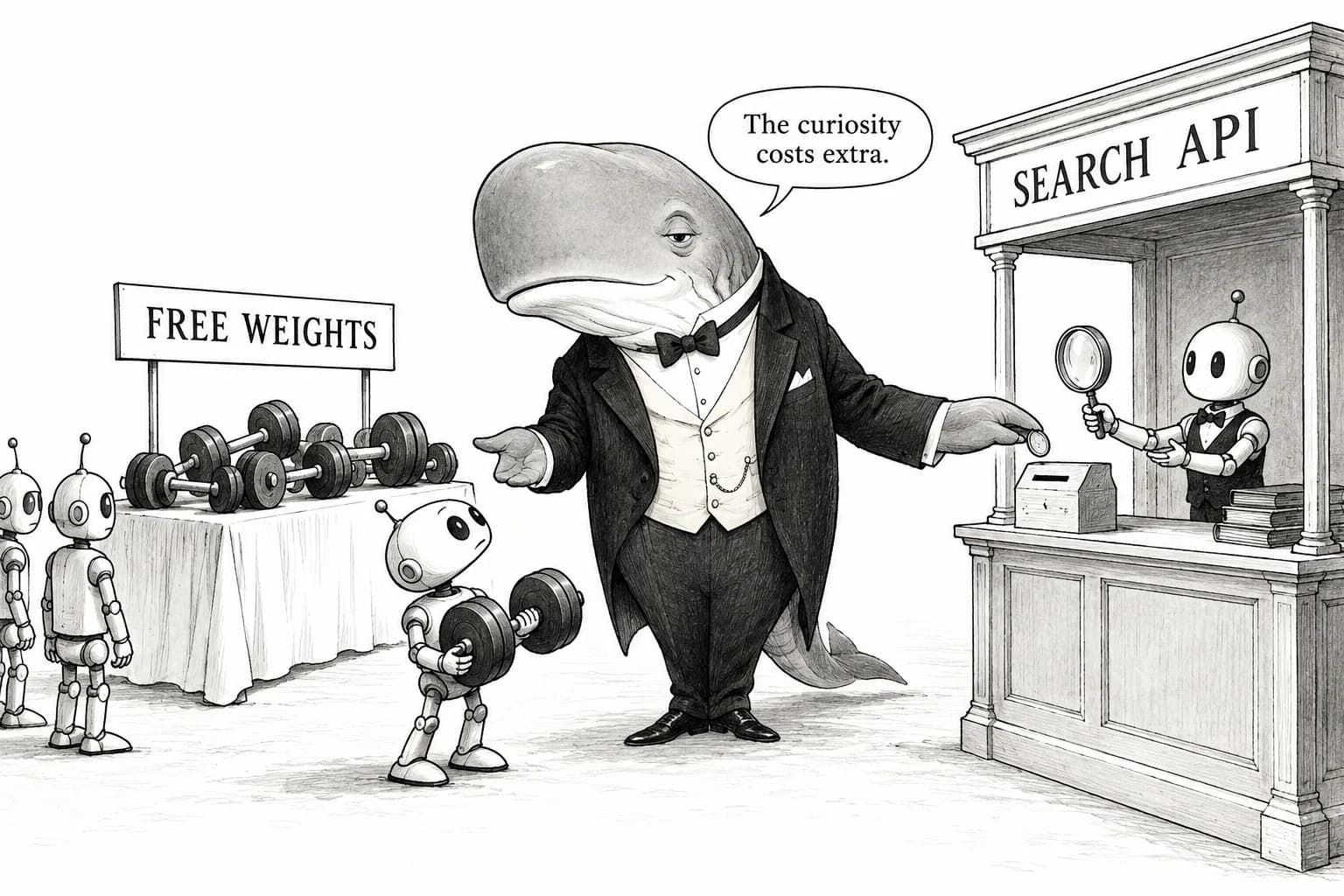
- On the same day, DeepSeek launched search and fetch APIs for agents. The model is to give the weights away free and charge for the infrastructure agents call on every step
DeepSeek on October 17 released the weights of "DeepSeek-V4.1-Flash-1017", an updated version of V4.1-Flash, on Hugging Face under the MIT license. According to the API changelog, pricing is unchanged. This is not a new generation of model but a small update that adds a date to the same model name. Even so, DeepSeek says its score on Terminal-Bench, a coding-agent benchmark, rose from 31 to 42. On the same day, the company also began selling search and fetch APIs for agents. DeepSeek, until now a lab that gives away its weights, has stepped into selling the foundations that agents run on. All the figures come from DeepSeek itself, and no third-party evaluation is available yet.
What was released: same price, MIT-licensed weights
V4.1-Flash has been on Hugging Face since September 10. It was updated once on October 12, but that update was not given a new version name. The API changelog had also not moved since September 10. The 1017 release updates both for the first time in about five weeks.
The license is MIT. Compare that with other models whose weights came out the previous week. Meta's Muse Spark Open comes with its own Muse Model License. Businesses with more than $20 million in revenue over 12 months need a separate agreement with Meta to offer it as a service. StepFun's Step 5 Preview also uses a custom license with attribution requirements and commercial conditions. Under MIT, a company that receives the model faces almost no restrictions on modifying it and building it into its own services.
The unchanged price also matters to users. V4.1-Flash reportedly ranked first in OpenRouter's weekly tally in mid-September, processing 15.8 trillion tokens. It is also one of the open models available on "SAIR Open Math OS", a platform for academics highlighted by Terence Tao. A model this widely used is now claimed to be stronger at agent tasks, at the same price.
How to read the numbers: 31→42 is self-reported, with nothing yet to compare it against
The headline figure from DeepSeek is the Terminal-Bench gain from 31 to 42. MarkTechPost reported a DeepSWE score of 77.0 (secondary report). Taken at face value, DeepSeek raised its coding-agent score by more than 30% through agentic RL post-training alone, without changing the weights or the price.
There are three reasons to treat the figures with caution, however.
First, all the scores are DeepSeek's own measurements. Artificial Analysis gave the original V4.1-Flash an Intelligence Index of 39, but has not yet scored 1017. No evaluations from Epoch, LMArena or Vals AI have appeared either. The previous week, Haiku 5.5's Terminal-Bench 4.0 result showed a gap: Anthropic reported 39.2%, while Artificial Analysis measured 33%. Self-reported and third-party results can diverge even on the same benchmark.
Second, Terminal-Bench comes in several versions. Reflection AI reported 80.1% for Beam on Terminal-Bench 2.1, and Meta reported 76.4 for Muse Spark Open. On Artificial Analysis's Terminal-Bench 4.0, by contrast, Beam scored 3.0%. Different versions and grading setups produce entirely different numbers. It is too early to rank the 42 against other models' figures.
Third, there is the question of which harness was used for the measurement. DeepSeek updates its own coding-agent harness, "deepseek-harness", almost daily. It shipped v0.2.1-alpha.3 on October 14 and v0.2.1-alpha.5 on the 16th. ARC Prize recently showed that Gemini 4 Argon's score differed by nearly a factor of two between Google's own adapter and the standard harness. Whether the model's gains can be separated from the harness's gains will not be clear until a third party tests it under standard conditions.
The real news is the Search API: selling the part agents call every time
The search API does more than the model update to change DeepSeek's position. Agents repeatedly reason, act and observe (loop engineering), and at each step they search the web, then fetch and read pages. Search and fetch are among the most frequent tool calls in long-horizon tasks. DeepSeek has now begun selling this piece through its own platform. A headline from AI Weekly puts the price at $0.75, but what unit that price covers could not be confirmed (secondary report).
This flips the relationship between model and infrastructure. DeepSeek gives the weights to anyone under MIT. It releases the harness for free, and makes money from the search that runs every time an agent acts. DeepSeek has long open-sourced the lower layers of inference and training, including DeepGEMM, DeepEP, TileKernels and kernels for Ascend. In September it also published a paper on DSec, its agentic RL infrastructure that runs about 3 million sandboxes a day. The search API is the first time it is selling one of those internal tools to outside developers as a product.
Others are competing for the same layer. U.S. labs and the companies around them, with OpenAI's Agents API, Anthropic's web search and fetch tools, and Perplexity's SPACE, sell models bundled with sandboxes and search. Among Chinese players, Qwen, StepFun, Z.ai and Moonshot all released harnesses in September. Releasing weights is now something everyone can do, and the place to stand out is shifting to the infrastructure agents run on. DeepSeek's search API is the first clear case of a Chinese open-weight lab putting a business model on this layer.
What we don't know yet
There is no third-party evaluation. Until Artificial Analysis, Epoch, ARC Prize and LMArena score 1017, it is unknown whether the 31→42 gain holds up under standard conditions.
Details of the search API are also unclear. What the $0.75 is charged per, which search index it uses, and where fetched pages are processed and for how long they are stored. These are the conditions that will decide whether companies outside China use it. On October 12, Anthropic tightened its defenses against attacks that extract reasoning traces for distillation, and named Chinese labs including Zhipu. Scrutiny of data flows between the U.S. and China is growing. A system that sends records of what an agent searched for to a Chinese provider could see its adoption swayed by factors other than performance and price.
V4.1 Pro has not been released either. Chinese media reported in late September that it was being tested with some accounts, and some expect a release between late October and November, but none of this has been confirmed. This time, DeepSeek shipped not a higher-end model but a small Flash update and a search service on the same day. The most reasonable reading is that it has begun testing a model of giving weights away free while earning money from agent infrastructure, starting at the low-cost end of the market.
Editorial cartoon
Sources
- https://huggingface.co/deepseek-ai/DeepSeek-V4.1-Flash-1017
- https://api-docs.deepseek.com/updates/
- https://github.com/deepseek-ai/deepseek-harness/releases
- https://www.marktechpost.com/2026/10/17/deepseek-just-released-v4-1-flash-1017-scores-77-0-on-deepswe-opens-search-api/
- https://aiweekly.co/alerts/deepseek-opens-v41-flash-1017-weights-and-075-search-api