Money · Oct 17, 2026
CoreWeave's CDS hits a record high as its shares give back the Huang-driven rebound in a day, and AI credit starts to be priced as a separate risk class
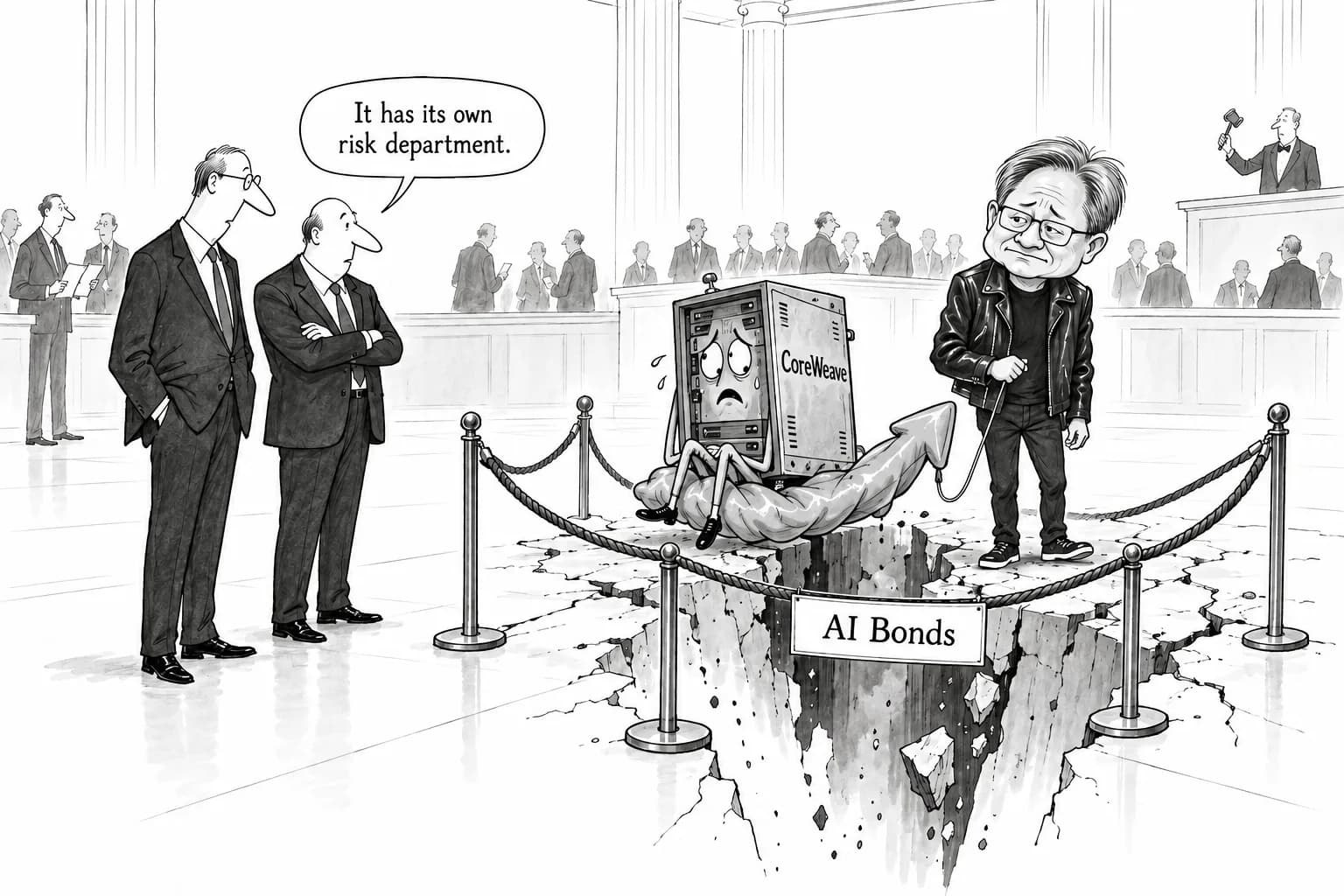
The stock market reacted to an executive's words for a single day. The bond and CDS markets are reportedly repricing neocloud debt as something distinct from non-AI corporate bonds
Koji Yamamoto · Economics Analyst

Key points
- CoreWeave's shares rebounded for one day after NVIDIA's Jensen Huang defended the company, then reportedly gave back that rebound within a day
- The five-year CDS is at a record high, a level said to imply a default probability of roughly 60%. What shareholders see and what creditors are pricing in no longer line up
- Goldman Sachs has reportedly explained the selloff in neocloud stocks, and AI-related corporate bonds have reportedly begun to be treated as a separate risk class. ARK reportedly bought the stock two days in a row as the bonds plunged
Stock and credit markets have reportedly split in their view of CoreWeave, the best-known of the neoclouds that rent out data center capacity for AI. Shares rebounded for a single day after NVIDIA's Jensen Huang defended the company, but reportedly gave back that gain the following day. In the same week, CoreWeave's five-year credit default swaps (CDS) reportedly hit a record high. Converted into a probability of default, that level works out to roughly 60%. This article is based on media reports; we were unable to consult primary sources from CoreWeave, NVIDIA or Goldman Sachs.
A one-day rebound, lost in one day
The Motley Fool reported on October 16 that CoreWeave's shares were falling again. The stock had just recovered on Huang's supportive remarks, but reportedly lost that gain within a day.
Huang's company is CoreWeave's largest GPU supplier as well as an investor in it. Support from that quarter gave shareholders something to trade on, but the effect lasted only a day. The market appeared to conclude that reassurance from the company's biggest business partner does not answer the question of whether it can repay its debt.
CDS put a different price on it
Even on the day the stock rebounded, the credit market reportedly did not budge. CoreWeave's five-year CDS reportedly climbed to a record level, which is said to imply a default probability of roughly 60%.
Converting a CDS premium into a probability requires an assumption about how much creditors would recover in a default (the recovery rate). The "roughly 60%" figure is therefore a rough guide, and should be read as the cumulative probability of default over five years. Even so, it is orders of magnitude away from what CDS on investment-grade companies imply. Creditors are pricing the debt as though a missed payment within five years is more likely than not.
24/7 Wall St. reported that CoreWeave's bonds plunged over the same period. Stocks and bonds are, in effect, pricing two different futures for the same company. Shareholders stand to gain a great deal if AI demand holds up. Creditors are satisfied if interest and principal come back on schedule, and they get no share of the upside. The spike in CDS shows creditors reassessing how heavy the downside could be.
"AI credit" as a category
The move reportedly extends beyond CoreWeave. An article republished on Yahoo Finance reports that Goldman Sachs has explained why CoreWeave, Nebius and other neocloud stocks are being sold off together.
According to the reports, AI-related corporate bonds have begun to be sold as a risk class separate from bonds with no connection to AI. Until now, corporate bond prices have been set largely by credit rating, sector and maturity: bonds with the same rating and similar maturities trade at similar yields. But if bonds tied to data center construction and the borrowing behind it are being repriced together as "AI credit," regardless of rating, then the market has begun to treat the bet on AI itself as a single, shared risk.
Many neocloud businesses buy GPUs with borrowed money and rent them out to AI labs and large companies, using the proceeds to service the debt. If borrowers depend on a small number of large customers, a single customer switching where it sources compute could shake the repayment outlook for several companies at once. Creditors appear to have started thinking it makes more sense to price this not on each company's individual circumstances, but as a bundle of debt leaning on the same source of demand.
ARK added to its stake
According to 24/7 Wall St., Cathie Wood's ARK Invest bought CoreWeave shares two days in a row as the company's bonds plunged. On the equity side, there are still investors who see the decline as a buying opportunity.
But shareholders and creditors are looking at different time horizons. Shareholders can bet on demand growth several years out. Creditors are watching whether the company can refinance and keep up interest payments in the meantime. Even if Huang's support and ARK's buying prop up the share price, refinancing costs will stay elevated unless CDS spreads come down. Because neocloud growth runs on borrowing, higher borrowing costs make the next GPU order itself harder to carry.
What to watch
Share prices swing day to day on executives' comments and the trades of high-profile investors. At this stage, CoreWeave's bond yields and CDS levels are the better gauge of where things stand. The next questions are whether the selling of AI-related bonds as a separate category spreads to other neoclouds such as Nebius, and whether it reaches the bonds of their customers, the AI labs and hyperscalers.
The share price moves, CDS levels and the substance of Goldman Sachs's analysis discussed in this article are all based on media reports, and the specific figures and statements have not been verified against primary sources.
Editorial cartoon
Sources
- https://www.fool.com/investing/2026/10/16/why-is-coreweave-stock-falling-today/
- https://247wallst.com/investing/2026/10/16/cathie-wood-bought-coreweave-two-days-in-a-row-as-its-bonds-cratered/
- https://finance.yahoo.com/markets/stocks/article/why-coreweave-nebius-and-other-neocloud-stocks-are-being-pounded-goldman-sachs-explains-125730269.html