Rules & Policy · Nov 1, 2026
UK's CMA investigates Meta's terms over conditions for using publisher content in AI
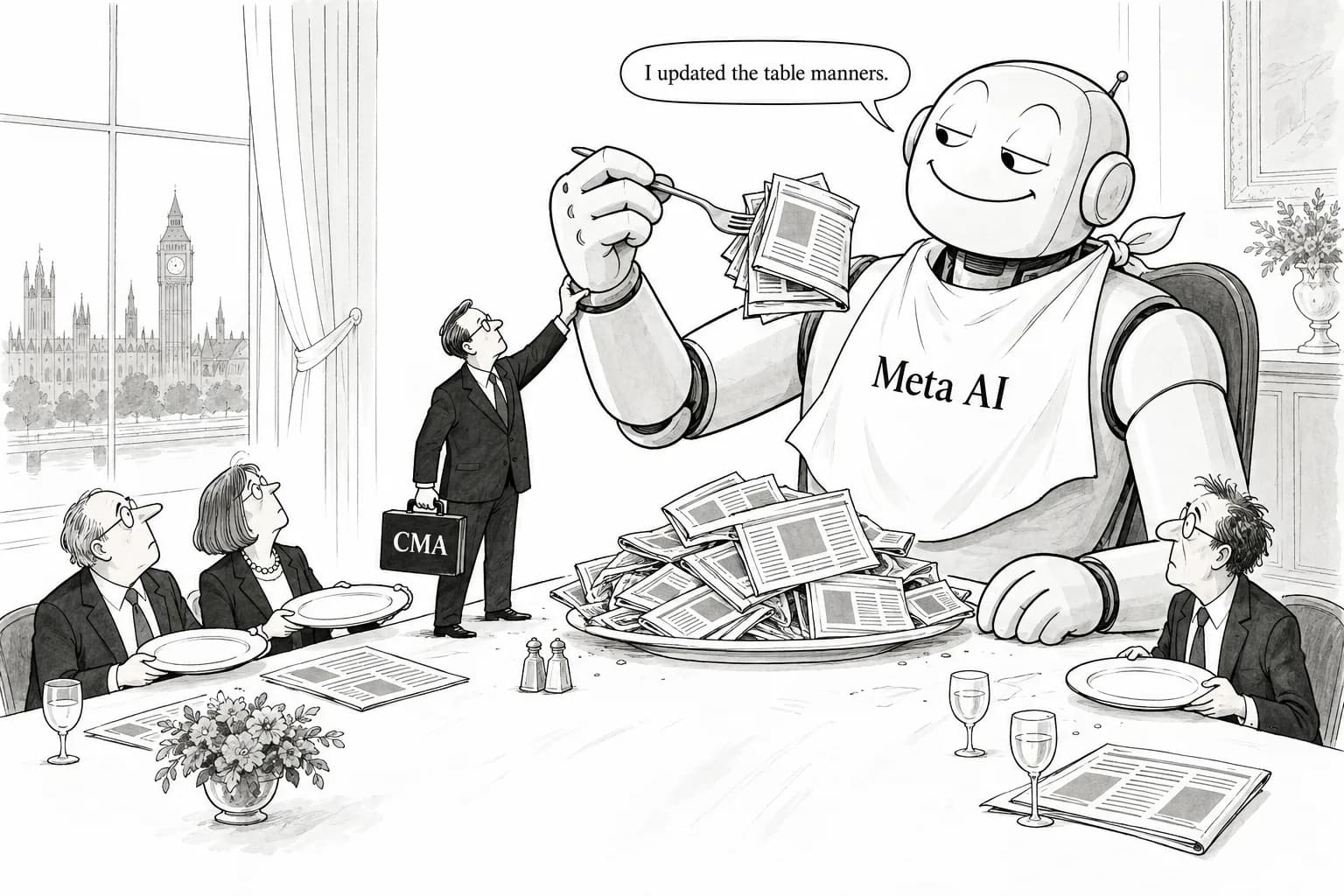
According to Reuters, the regulator is examining whether terms that let Meta's AI use publishers' web content without their consent amount to abuse of a dominant position. The case is described as the first to take on AI's use of content through competition law, and Meta has reportedly paused a change to its terms that was scheduled for November 20
Koji Yamamoto · Economics Analyst

Key points
- Reuters reports that the CMA is examining whether terms that let Meta's AI use publishers' content without their consent amount to abuse of a dominant position
- The case is reportedly the first to take on AI's use of content through competition law. Until now, disputes have taken the form of copyright lawsuits, licensing negotiations, or voluntary signals such as robots.txt
- Meta has reportedly paused a change to its terms that was scheduled for November 20. The CMA's announcement, the wording of the terms, and any official explanation from Meta have not yet been verified against primary sources
The UK's Competition and Markets Authority (CMA) has begun examining Meta's terms, Reuters reported. At issue are the conditions under which publishers' web content can be used by Meta's AI without their consent. The CMA will reportedly examine whether these terms amount to abuse of a dominant position. The case is described as the first in which competition law has been used to take on AI's use of content. Meta has reportedly paused a change to its terms that was scheduled for November 20.
This article is based on a Reuters report. We have not yet been able to review the CMA's announcement or the original text of Meta's terms.
What was reported
According to the report, the investigation targets the part of Meta's terms that sets the conditions for using publishers' web content in AI. The point in question is that the terms make publishers' content available to Meta's AI even when the publishers have not consented.
The CMA is not asking whether copyright was infringed. Its question is one of competition: whether Meta is using its strong market position to impose terms on publishers that are hard for them to refuse. For publishers that depend on distribution through Meta, rejecting the terms could mean losing a route to their readers. That imbalance of power appears to be the focus of the investigation.
Meta reportedly paused the change to its terms that had been scheduled for November 20. The report does not make clear whether the pause was a response to the investigation or a temporary measure.
Why it is a "first"
Until now, disputes over AI's use of publishers' content have mainly taken three forms: copyright lawsuits, individual licensing negotiations, and signals that publishers put out themselves, such as robots.txt.
All three depend either on publishers acting one by one or on AI companies choosing to comply. A competition investigation is different. The regulator challenges the terms themselves, which the platform sets unilaterally. If the reports are accurate, the conditions for using content in AI training and answers would be treated as a question of market power for the first time.
How it relates to voluntary signals
On October 30, OpenAI, Google, Microsoft and Anthropic were reported to have accepted a common robots.txt marker, "__usage_ai-training", for opting out of AI training. It builds on the work of the IETF's AI Preferences working group and treats use for training separately from use as grounding for answers. Meta was also reported to be involved in the effort, but it did not join the four companies in announcing that it would accept the marker.
The marker gives publishers a common way to opt out. Whether to honor it, however, is left to the AI companies. A separate problem also remains: publishers that opt out risk being disadvantaged in distribution or search. This is where the CMA's investigation comes in. If opting out is possible but brings a penalty, consent becomes a formality. The reported focus of the investigation overlaps with this point.
What is still unknown
Many points have not been verified against primary sources.
The CMA's announcement: Under which legal framework is it investigating? Is this a formal investigation or a preliminary inquiry? When will it reach a conclusion?
The content of the terms: Which publishers, on which services, would have provided content for which AI uses (training or answers)?
Meta's explanation: Was the change paused only in the UK, or worldwide? For how long?
Other countries: Will authorities outside the UK, such as in Europe, act on the same issue?
The conditions for using publishers' content in AI, the subject of this story, may no longer be settled only through contracts signed with publishers one at a time. If regulators start challenging platforms' terms, that would become a third safeguard alongside opt-out markers and individual licenses. When the CMA issues a formal announcement, we will check its scope.
Editorial cartoon