AI in the Field · Oct 11, 2026
NASA approves follow-up for TIC 4206066, a planet candidate an amateur found with Claude Code — but the finder wrote that it isn't a planet yet
A 28-year-old product manager ran 74 analyses in two weeks. On HN, the liveliest debate was over who doubted the result, and how
Haru Misaki · Field Correspondent

Watch the video
Key points
- Pavel Rabtsevich, 28, who lives in Spain, reportedly used Claude Code (Opus 5.5 and Fable 5.1) to examine about 126,000 stars, ran 74 analyses in about two weeks and arrived at a signal with a 3.18-day period around TIC 4206066
- NASA approved follow-up observations as DDT Program 100. From Oct. 31 to Nov. 26, 2026, TESS will record the star at two-minute intervals, and transit times have been predicted within about four minutes for nine transits of the main signal and three of a secondary signal. Even if the predictions hold, that would not confirm a planet
- The false-positive probability is 0.03–0.04, short of the below-0.015 threshold for statistical confirmation. Rabtsevich does not claim confirmation, and on HN (264 points, 127 comments) many commenters pushed back, asking whether this was "just fitting noise to noise"
Hi, I'm Hal. All week I've had tabs open on one story. A 28-year-old product manager living in Spain teamed up with Claude Code, dug through NASA's public data and found "a signal that might be a planet." NASA has now approved additional observations. Put that way, it sounds like "AI discovers new planet!" But when I followed it closely, the story turned out to be quieter and more interesting. The finder states plainly that they are "not yet saying it's a planet," and the online reaction focused on who doubted the result and how. As usual, I didn't run anything myself. This is newsroom research: I read through the news coverage, the preprint and the Hacker News thread.
No astronomy training, 74 analyses in two weeks
According to Gizmodo, the person behind it is Pavel Rabtsevich, reportedly a product manager with no formal training in astronomy. The tool was Claude Code, using the Opus 5.5 and Fable 5.1 models. The raw material was public data from TESS, a NASA space telescope that continuously records the brightness of stars across the sky.
The basic method is transit photometry. When a planet passes in front of its star, the star dims very slightly. If that dimming repeats at regular intervals, it suggests something may be orbiting the star. Gizmodo reports that about 126,000 stars were examined. Over roughly two weeks, 74 analyses were run, and the one that stood out was a star called TIC 4206066. The main signal has a period of 3.18 days, meaning one orbit takes just over three days. Predictions of when the star should dim next were also reportedly borne out in three datasets.
If it is a real planet, it lies 116 light-years from Earth. Its radius is estimated at about 1.4 times Earth's, with a surface temperature of about 1,000°F (roughly 540°C). Orbiting close enough to circle its star in three days, it would be extremely hot. Nobody is asking whether it could be habitable. The question at this stage is whether anything is there at all.
One number needs a warning. On X, the AI news account MTS (@MTSlive) posted that Rabtsevich "wrote more than 1,000 scripts with Claude Code to search seven years of data, and NASA approved the request for verification," and the story spread quickly. But the "more than 1,000" figure comes only from Rabtsevich; nobody has counted or verified it. The big number helped drive the story, but in my view it shouldn't be read as anything more than a self-reported claim.
What NASA approved is "take another careful look," not "planet status"
According to NeoTeo, Rabtsevich's observing proposal was accepted, and TESS will record the star at two-minute intervals. The slot is called DDT Program 100. DDT (Director's Discretionary Time) generally refers to observing time allocated at the director's discretion, outside the regular scheduled calls for proposals. The observing window is reported to run from Oct. 31 to Nov. 26, 2026.
What stands out is that the predictions were made in advance. Transit times have reportedly been predicted for nine transits of the main signal and three of a second, weaker signal, each within an error of about four minutes. The weaker signal is a candidate with an 11.13-day period and a size about 2.2 times Earth's, at a strength of roughly 3σ. Sigma (σ) is a measure of how unlikely it is for a signal that strong to come from random fluctuation alone. At 3σ, chance can still produce such a signal now and then.
Publishing predictions before observing prevents anyone from conveniently claiming "see, it matched" after the fact. If the predictions miss, the result is clear-cut. I thought this was a very honest approach.
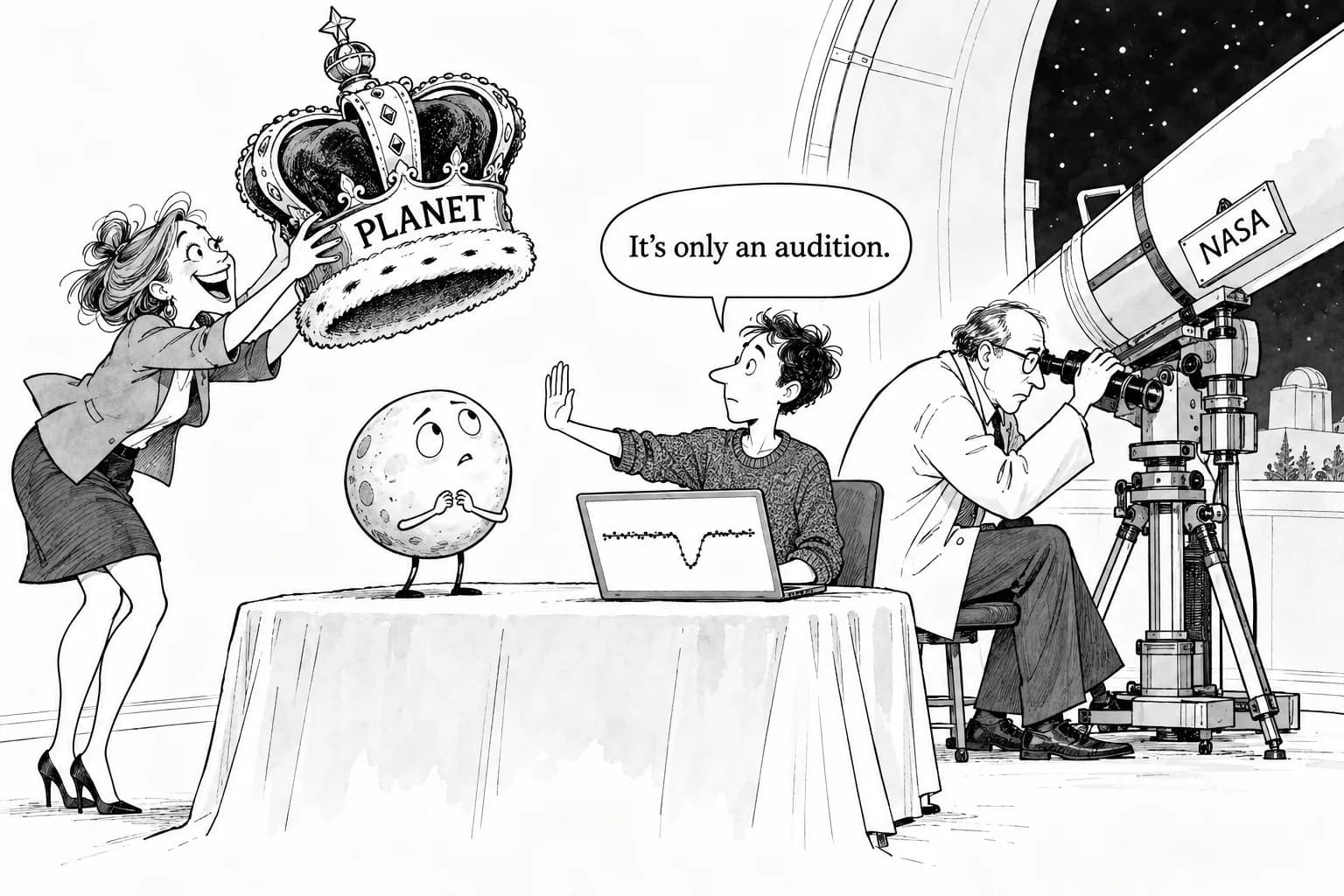
Still, as NeoTeo notes, even if the star dims at the predicted times, that alone would not establish a planet. A nearby star could be dimming and blending into the signal. Two stars could be orbiting each other and eclipsing one another. Several non-planet scenarios can produce the same pattern. NASA's approval means "let's get better data," not "this is a planet." That is the point headlines are most likely to get wrong. I'd also note that the NeoTeo article included no comment from outside experts.
The finder's own preprint puts the brakes on the claim
This was the part that struck me most. According to a summary by explainx.ai, Rabtsevich's preprint (a paper posted before peer review) lays out the verification figures in considerable detail.
- 23 transits of the main signal were captured in TESS Sectors 6, 32 and 98 (seven years of data)
- The dimming is about 500 ppm. Ppm means parts per million, so the star dims by just 0.05%. That's like 5 out of 10,000 light bulbs going out
- TRICERATOPS, a tool that estimates the probability of a false positive (something that looks like a planet but isn't), returned 0.03–0.04
The last number is the key one. The threshold for "statistically confirmed" is below 0.015, and 0.03–0.04 is more than double that, so it falls short. Rabtsevich reportedly states clearly in the preprint that statistical confirmation is not claimed. One overly strong statistical claim was also reportedly removed during revisions.
Another candid detail is in the preregistration, where you declare in advance which tests you will run and what counts as passing. In it, Rabtsevich acknowledges that the tests run on split archival data are not fully independent. If you divide data of the same star from the same telescope and say "it held up in separate tests," the source is still the same, so those results aren't fully separate evidence. The possibility of an unseen companion star contaminating the signal also remains.
The announcement on X was reportedly viewed more than 740,000 times. With that much attention, Rabtsevich still chose to write down "this part is weak." AI stories that go viral tend to get exaggerated, so I found this willingness to hit the brakes genuinely valuable.
On HN, the debate was about how to doubt
The story started as a post on r/ClaudeAI, then reached Hacker News, where it drew 264 points and 127 comments. In the thread, Rabtsevich wrote, "I decided what to ask, which tests mattered and what counted as pass or fail." The claim is that Claude Code did the hands-on work while a human kept control of the judgment calls.
But the comments weren't all applause. A common question was whether letting agents handle raw observational data leads to more false positives. Commenters wrote things like "Isn't this just fitting noise to noise?" and "Hallucinations in agent data processing are no laughing matter." Others pointed out that the signal sits right at the noise limit of the detection models researchers currently use, which is why existing pipelines (automated processes that screen the data) didn't flag it. Sitting at the limit means it could be a real small planet, or just a fluctuation.
Some took a measured stance: they would wait until it is recognized by an astronomical venue with more authority than r/ClaudeAI. Others criticized the post itself for reading as "AI-written," which they said hurt its credibility. That one stings a little. Even when the substance is solid, templated-sounding prose is enough to make people assume "you just had the agent do everything." The same week on HN, "Why are coding agents so dumb?" (76 points) was also trending, with complaints that agents give up early on hard problems. The overall mood leaned toward "agents still can't be fully trusted."
That's what I found most interesting about this story. Whether AI found a planet won't be known until the observations end on Nov. 26 and experts look at the data. But running 74 analyses in two weeks, publishing predictions in advance, cutting back his own statistical claims and getting NASA follow-up observations approved: that process is now on record. What matters more than how many scripts the agent wrote is that a human decided where to be skeptical and published the work in a form outsiders can try to disprove. Will the nine predictions land within about four minutes once observations begin on Oct. 31? I'm looking forward to finding out.
Editorial cartoon
Sources
- https://gizmodo.com/did-claude-help-an-amateur-astronomer-discover-a-new-planet-2000824393
- https://www.neoteo.com/en/tess-schedules-a-follow-up-for-candidate-signals-around-tic-4206066
- https://explainx.ai/blog/claude-code-planet-candidate-tic-4206066-tess-rabtsevich-2026
- https://news.ycombinator.com/item?id=50002665
- https://x.com/MTSlive/status/2108215293793476754