Rules & Policy · Oct 2, 2026
California signs a slate of AI bills, moving ahead of federal self-regulation with No Robo Bosses Act and a workplace emotion-recognition ban
At the Sept. 30 signing deadline, Governor Newsom signed AI bills covering automated decision-making in employment, a ban on emotion recognition in the workplace and amendments to the AI Transparency Act. While Washington relies on voluntary agreements with companies, the state has begun imposing binding obligations on workplace AI
Koji Yamamoto · Economics Analyst
Key points
- Governor Newsom signed a batch of AI bills at the Sept. 30 signing deadline. Transparency Coalition counts 11 new laws (the primary source is the governor's office announcement)
- The package includes the No Robo Bosses Act, which bars leaving employment decisions entirely to automated decision systems, a ban on emotion recognition in the workplace and amendments to the 2024 AI Transparency Act. A bill under the same name was vetoed in 2025
- CalMatters reports that labor got only some of what it demanded. Even so, it is the state that is placing legal obligations on workplace AI, while it remains unclear how many companies have even signed the White House agreement
California Governor Gavin Newsom signed a batch of AI bills at the Sept. 30 signing deadline. The governor's office announcement (primary source) describes the move as adding more first-in-the-nation worker protections. There are three main pieces: the so-called No Robo Bosses Act, which restricts automated decision-making in employment; a ban on emotion recognition in the workplace; and amendments to the state's AI Transparency Act.
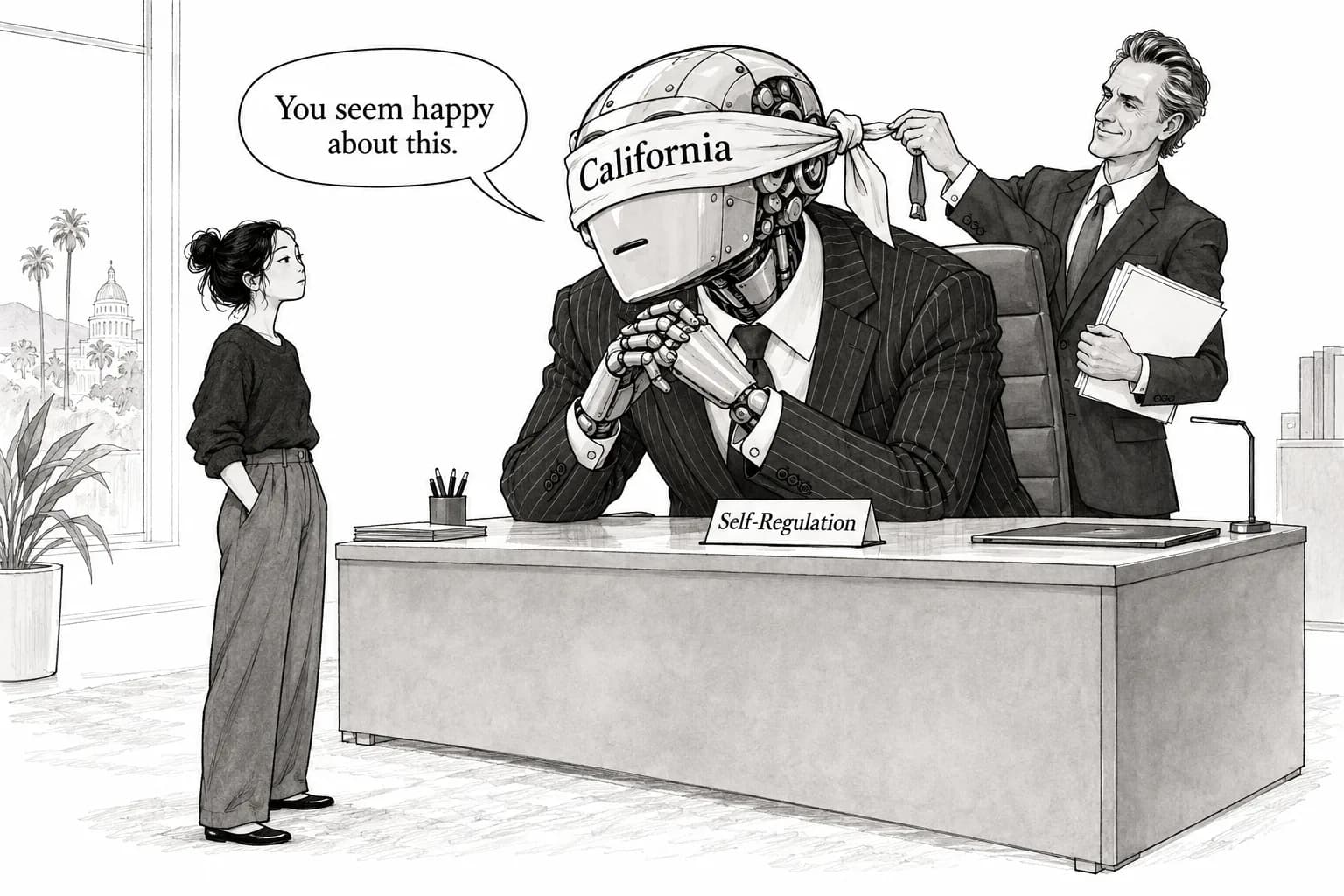
The central point is this: the federal government is relying on voluntary self-regulation agreements with AI companies. Meanwhile, the state is writing into law, one by one, obligations that must be followed for AI used in the workplace.
A batch of signatures on deadline day
Bills passed by the California Legislature become law or die depending on whether the governor signs or vetoes them by the deadline. This year's deadline was Sept. 30, and Newsom acted on the AI bills together that day. Transparency Coalition, a group that tracks AI safety, counts 11 new AI laws enacted this time (Transparency Coalition). CNBC also reported that the governor signed bills including a ban related to AI in the workplace (CNBC).
The governor's office said the signings made the state's AI framework "even stronger." California has already led with a law requiring frontier model developers to publish safety frameworks and with a generative AI transparency law. This round adds laws addressing the relationship between workers and AI.
No Robo Bosses Act: keeping HR decisions out of machines' hands alone
The No Robo Bosses Act covers automated decision systems used in employment decisions such as hiring, promotion, discipline and termination. Its aim is to prevent decisions with major consequences for people from being made by systems alone, without human involvement.
This is not the first bill under that name. In 2025, SB 7, which had the same purpose, passed the Legislature but was vetoed by Newsom. Within a year, this type of regulation has now won the governor's signature.
With agents now handling everything from résumé screening to shift assignments and performance evaluations, the targets of regulation are no longer hypothetical. For companies building agents into their HR processes, "a human reviews it in the end" becomes a legal requirement rather than a design choice.
A ban on emotion recognition in the workplace
The other pillar is a ban on having AI infer workers' emotions in the workplace. Technology that reads mood or motivation from facial expressions, voice or text has been used to monitor call center calls and evaluate online interviews.
This is what CNBC highlighted with "ban" in its headline. In the workplace, it is hard for workers to refuse having their inner state scored by AI. Critics have also long argued that emotion recognition lacks strong scientific backing. Under this law, such uses will no longer be permitted within the state.
Amendments to the AI Transparency Act
The third piece amends the AI Transparency Act (SB 942), enacted in 2024. That law requires providers of large generative AI systems to make AI-generated content identifiable as such. The amendments update the disclosures the state requires. It is a separate track from the workplace rules, but it follows the same direction: deciding by law who is accountable for AI output.
Labor got only part of what it wanted
That does not mean labor is satisfied. CalMatters reported that Newsom gave labor "only some" of what it demanded on AI (CalMatters). Of the bills labor groups sought to pass, some were signed and others were not.
The governor drew a line between industry pushback and pressure from labor to protect workers. Even so, legal obligations remained on two fronts: automated decision-making in employment and emotion recognition. There may be complaints about how strong the rules are, but the direction is clear.
Washington has voluntary agreements; the state has binding obligations
The contrast with the federal government is stark. What Washington currently relies on is a White House voluntary self-regulation agreement with AI companies. It is not even settled whether six or 31 companies have signed that agreement. Nor has it been specified who will oversee it or who will choose the outside evaluators. Draft legislative text is said to be expected from the White House Office of Science and Technology Policy (OSTP) around Nov. 28. An industry self-regulatory body (SAFA) that Google, OpenAI and Anthropic were reportedly trying to form has also seen no further reports since Sept. 24.
Moreover, that self-regulation mainly addresses catastrophic risks from frontier models. Nothing in the federal agreement appears to stand on the side of people rejected for jobs or people whose emotions are being scored. State law is filling that gap.
The next battleground is federal preemption, the overriding of state regulations by federal law. If a federal bill blocks state AI regulation, the effect of these new laws could also be contested. Whether AI companies back federal preemption legislation will also serve as a litmus test of whether they truly intend to honor the agreement.
What to watch next
Whether these laws actually work will depend on the details: which companies and systems are covered, when the laws take effect, and how violations will be enforced. Companies building agents into HR will need to be able to show, after the fact, records of decisions and human involvement, through evaluation-driven development and agent observability. How the OSTP draft in November deals with state laws is also worth watching. California has begun, in law, an experiment in constraining AI from the workers' side.
Editorial cartoon
Sources
- https://www.gov.ca.gov/2026/09/30/californias-nation-leading-ai-framework-just-got-stronger-governor-newsom-signs-more-first-in-the-nation-worker-protections-and-more/
- https://www.transparencycoalition.ai/news/gov-newsom-wraps-california-term-by-enacting-11-more-laws-on-ai-safety
- https://calmatters.org/economy/technology/2026/09/on-ai-newsom-gives-labor-only-some-of-what-it-demanded/
- https://www.cnbc.com/2026/09/30/california-gavin-newsom-ai-ban.html