Money · Oct 29, 2026
Broadcom guarantees up to $43 billion against price declines on Anthropic chips
An 8-K sets out which part of the $63 billion rack deal leaves the seller holding the depreciation risk. If sale proceeds fall short of 72.5% of the remaining lease payments, Broadcom pays the difference
Koji Yamamoto · Economics Analyst
Key points
- Broadcom's 8-K, a primary source, sets the financing structure of the $63 billion rack deal with Anthropic
- If a lease ends early and the racks are sold for less than 72.5% of the remaining lease payments, Broadcom pays the difference, up to about $43 billion
- The seller carries chip-depreciation risk off its balance sheet; combined with the SpaceX-Apollo and Argentum deals, this adds to the contagion risk Moody's has flagged
An 8-K that Broadcom filed with the US Securities and Exchange Commission (SEC) sets the financing structure of its chip deal with Anthropic. The deal has previously been reported at about $63 billion. At its center is a guarantee: Broadcom will cover the gap between 72.5% of the remaining lease payments and the price the racks fetch when sold, up to about $43 billion.
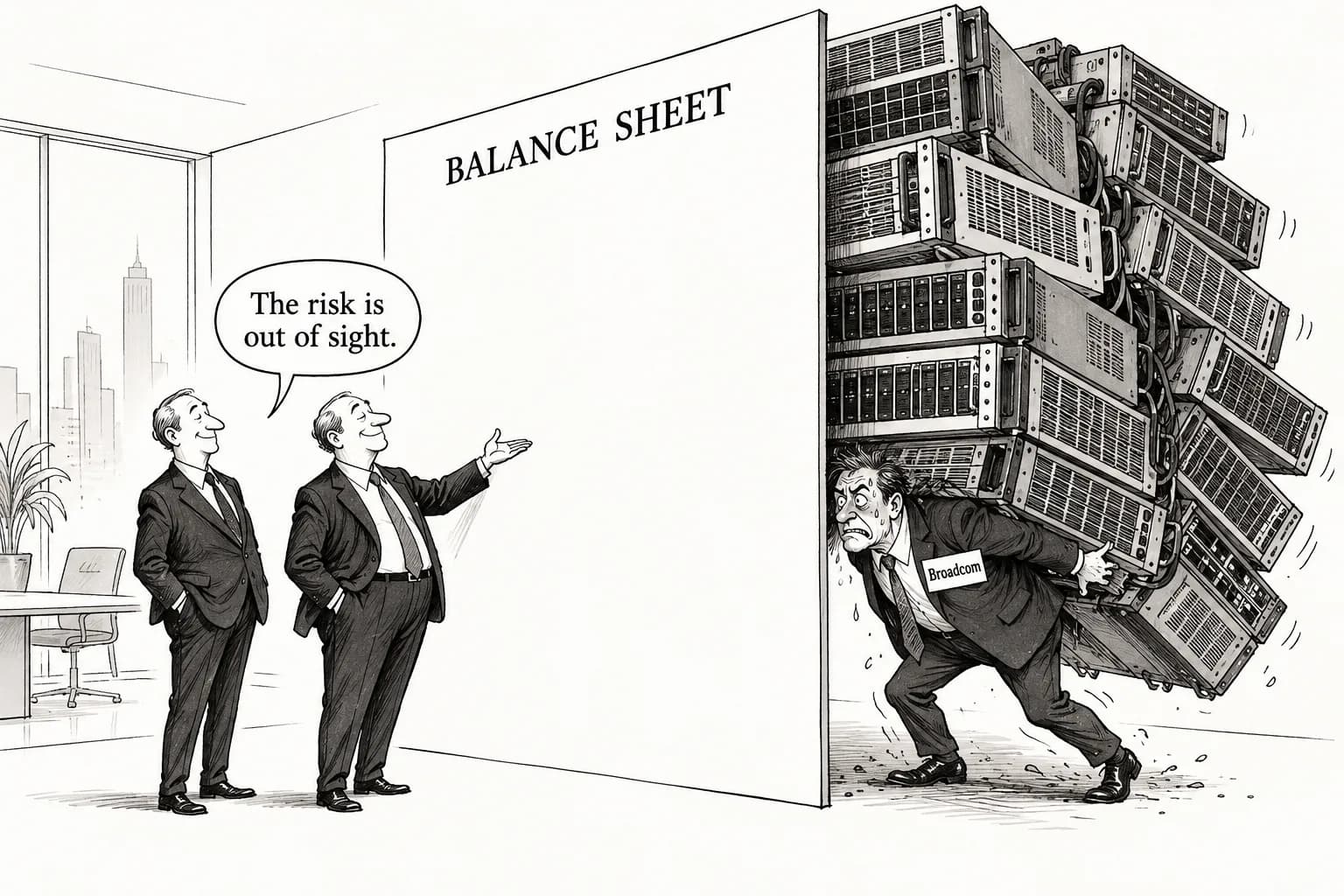
This means that if AI chips lose value, the loss falls on the company that sold the chips, not on Anthropic, which uses them, or on the lenders putting up the money. The commitment also does not appear as debt on Broadcom's balance sheet.
What the 8-K settles
An 8-K is a filing that discloses material corporate events, and it counts as a primary source. This filing establishes who carries the risk in the deal.
The structure works like this. Anthropic does not buy the racks loaded with Broadcom chips. It leases them. If the contract ends before the lease runs out and the racks are sold, and the sale price falls short of 72.5% of the remaining lease payments, Broadcom pays the shortfall. Its payments are capped at about $43 billion.
The figure also shows the minimum the lenders can expect to get back. They are covered up to 72.5% of the remaining lease payments by the sale proceeds plus Broadcom's guarantee. On the remaining 27.5%, if the sale price falls short, the loss lands on the lenders or on the special purpose vehicle (SPV) set up for the deal. This article has not been able to confirm the detailed conditions under which the guarantee is triggered.
Financial news outlet FinanceFeeds reported that Broadcom's shares rose after the deal moved forward. The market's first reaction was to welcome the locked-in revenue.
Why the seller is taking on the risk
AI racks are expensive, and they lose value fast. When a new generation of chips arrives every one to two years, the resale price of older racks drops. For lenders writing multi-year leases, the biggest fear is how much the racks pledged as collateral would sell for if the borrower walked away.
That is where the seller comes in. If Broadcom promises a floor on the sale price, lenders can commit large sums with confidence. Anthropic avoids buying tens of billions of dollars of equipment with its own debt. Broadcom secures a large order. All three parties' interests line up.
In return, Broadcom is effectively betting on where chip prices go. If demand for AI computing stays strong and used racks sell well, the guarantee will barely be used. If demand cools, or cheaper and faster chips arrive, Broadcom could pay up to about $43 billion.
Risk off the balance sheet
The guarantee is a promise to pay that may or may not come due. In accounting terms, it will not necessarily appear on the balance sheet the way borrowings do. The debt figures investors watch stay flat, while the obligation to pay if prices fall keeps growing.
The $43 billion cap is about 70% of the deal's reported $63 billion size. Most of what Broadcom receives for the chips could, in effect, have to be paid back if their value falls. Even if it is booked as revenue, part of it comes with what amounts to insurance on chip prices.
Vendor financing is piling up
This deal is not a one-off. Anthropic has lined up a string of compute deals in which sellers or parties close to them help with the financing. A $40 billion SpaceX-Apollo deal is targeting signing before year-end, and there is also a $5 billion deal with Argentum. Ratings agency Moody's has warned that the risk grows as such deals pile up.
All of them assume Anthropic's demand for computing keeps up. If that assumption breaks, several sellers and lenders would be hit by the same kind of loss at the same time. This 8-K is the first to put a number on Broadcom's share of that exposure.
Anthropic is moving ahead with its IPO, with the roadshow reportedly set for the week of November 9 and the listing for the week of November 16. Ahead of the listing, regulatory filings are starting to show who carries how much risk behind its compute deals.
What is still unknown
Three questions remain. The first is the detailed conditions under which the guarantee is triggered. The second is how Broadcom will present this commitment in its earnings materials. The third is how Anthropic's amended S-1 (S-1/A) will describe the lease and the guarantee.
Until now, falling AI chip prices have mostly been discussed as a problem for the cloud companies that own the chips. This 8-K puts in writing that the seller is taking on part of that risk.
Editorial cartoon