Infrastructure & Security · Oct 31, 2026
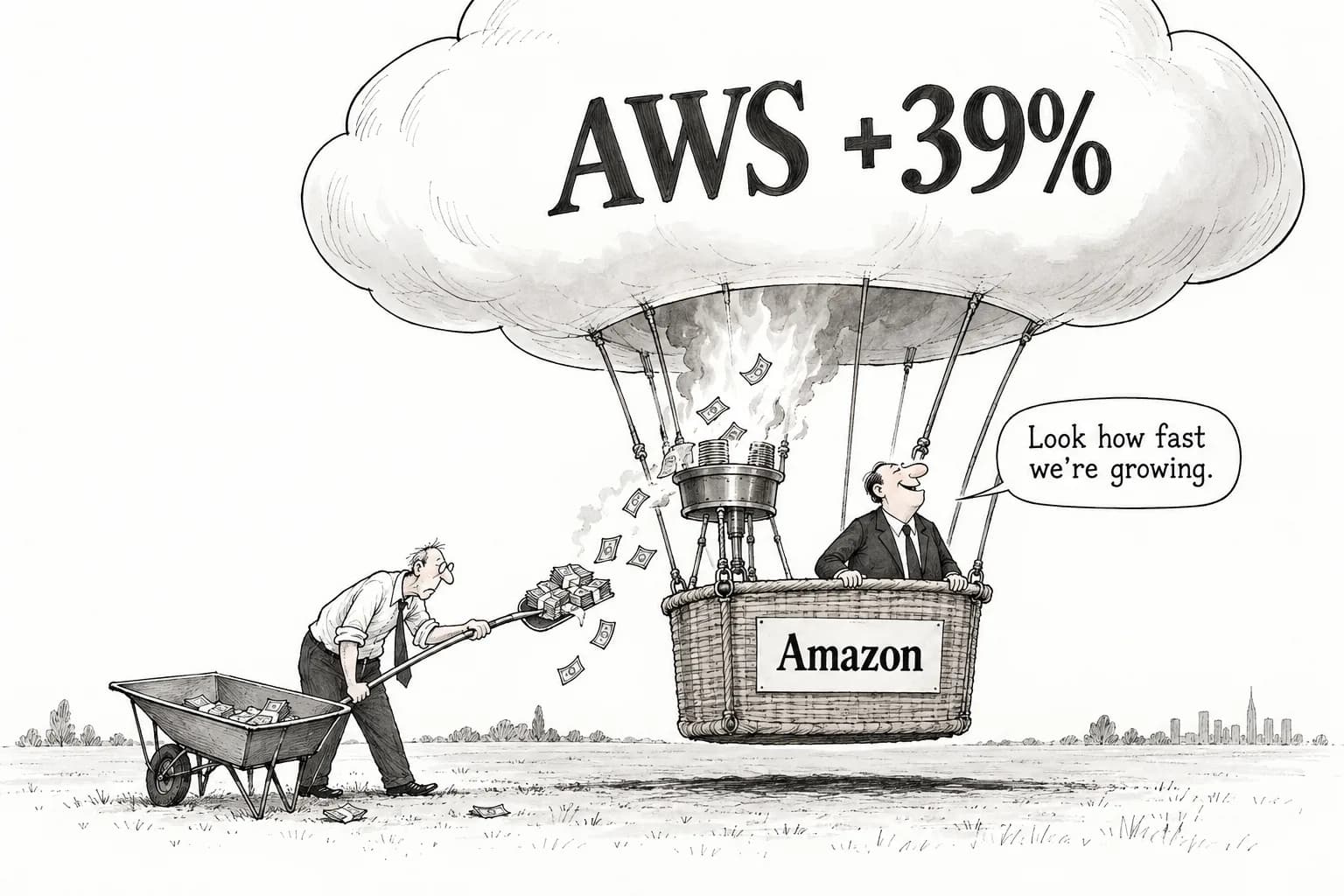
AWS grows 39% as Amazon's cash outflow hits $42.4 billion
Amazon's 10-Q for July–September shows a $140.3 billion valuation gain on its Anthropic investment, $164.9 billion in leases that have not yet commenced, and about $47.5 billion in new borrowing. Paper profits, debt and off-balance-sheet commitments are all growing together
Seiichi Tanaka · Editor-in-Chief
Key points
- AWS revenue rose 39% year over year, its fastest growth in about five years. Purchases of property and equipment reached $77.26 billion in a single quarter, well above expectations
- Trailing twelve-month free cash flow was −$42.4 billion. The stronger the demand for AI, the faster cash goes out the door ahead of it
- The 10-Q lists a $140.3 billion valuation gain on Anthropic convertible notes, $164.9 billion in leases not yet commenced, and about $47.5 billion in new borrowing in July–September. Non-cash profits, debt and commitments not yet on the balance sheet are all rising at the same time
Amazon's July–September results, released after the close on October 29, showed two sides at once. According to the earnings release, revenue at its AWS cloud business rose 39% from a year earlier, the fastest growth in about five years. In the same quarter, the company spent $77.26 billion on purchases of property and equipment. That figure was well above market expectations, and trailing twelve-month free cash flow came to −$42.4 billion.
The quarterly report (10-Q) filed the same day contains three more figures: a $140.3 billion valuation gain on Anthropic convertible notes, $164.9 billion in leases that have not yet commenced, and about $47.5 billion in new borrowing in July–September. Paper profits from an investment in an AI lab, debt, and off-balance-sheet commitments are all growing at the same time.
AWS posts its fastest growth in about five years
AWS's 39% growth shows that demand for AI compute has turned into actual revenue. Since the generative AI wave began, AWS has repeatedly been described as growing more slowly than Microsoft's Azure and Google Cloud. This quarter's growth weakens that view.
According to TechCrunch, CEO Andy Jassy said AWS will eventually become a $1 trillion business. But as the headline of the same article indicates, it comes with the caveat that getting there first requires heavy spending. Revenue growth and spending growth are two sides of the same bet.
$77.26 billion on equipment, $42.4 billion in cash out the door
Spending $77.26 billion on property and equipment in a single quarter means Amazon is building out data centers, AI chips and power infrastructure ahead of revenue. As a result, cash from operations could not cover capital spending, and trailing twelve-month free cash flow fell to −$42.4 billion.
It is not unusual for a growing business to invest ahead of demand. But when cash flows out on this scale, the shortfall has to come from somewhere. The answer shows up in the rest of the 10-Q's figures.
Three figures in the 10-Q
Valuation gain on Anthropic convertible notes: $140.3 billion
Amazon has invested in Anthropic in the form of convertible notes. When Anthropic's valuation rises, so does the fair value of those notes, and Amazon books a valuation gain. The gain recorded in the 10-Q amounts to $140.3 billion.
This is not cash. Until the notes are sold, or converted into shares and the shares sold, it remains a paper profit. Anthropic filed its registration statement (S-1) for a listing on October 26, and an amended filing (S-1/A) setting out a price range and share count is expected around November 10. The IPO price will determine how close this $140.3 billion is to real cash.
Leases not yet commenced: $164.9 billion
Amazon has $164.9 billion in leases that have been signed but not yet put into use. Under accounting rules, neither an asset nor a liability is recorded on the balance sheet until a lease commences. Each time a data center building or equipment is handed over, part of this commitment surfaces as a liability. On top of the $77.26 billion in equipment purchases, this much in payments has already been committed in advance.
New borrowing in July–September: about $47.5 billion
Amazon took on about $47.5 billion in new borrowing during the quarter. The funds appear intended to cover the free cash flow deficit and keep equipment purchases going. For a long time, Amazon was a company that invested out of its own cash rather than relying on debt. That changed this quarter.
What it means when all three grow together
The three figures are not separate stories. Amazon invests in Anthropic, an AI lab, and books a gain as Anthropic's valuation rises. Anthropic needs compute, and AWS builds and leases data centers to provide it. To pay for that construction and leasing, Amazon takes on more debt and piles up leases that have not yet commenced.
As long as this loop keeps turning, both AWS revenue and the investment gain keep growing. But the investment gain is on paper, while debt and lease payments go out in cash. If either AI demand or AI lab valuations falter, the profits can vanish while the payment commitments remain. This quarter's results showed both that AWS's growth is real and that this growth rests on value not yet turned into cash and on promises of future payments.
What to watch next
First, the price range in Anthropic's S-1/A. The IPO price will underpin the $140.3 billion valuation gain. Second, how much further capital spending and free cash flow deteriorate in October–December. Third, how much of the $164.9 billion in leases not yet commenced begins next year and shows up as liabilities. Finally, results from other cloud companies. Figures from CoreWeave on November 9 and Nebius on November 10 will show whether demand for AI compute extends beyond Amazon.
Editorial cartoon