Infrastructure & Security · Oct 15, 2026
ASML posts record €11.7 billion quarter but says 2027-28 supply "will not fully meet customer demand" — China share falls from 42% to 23%, ADR slips 2.5% on CPI selloff
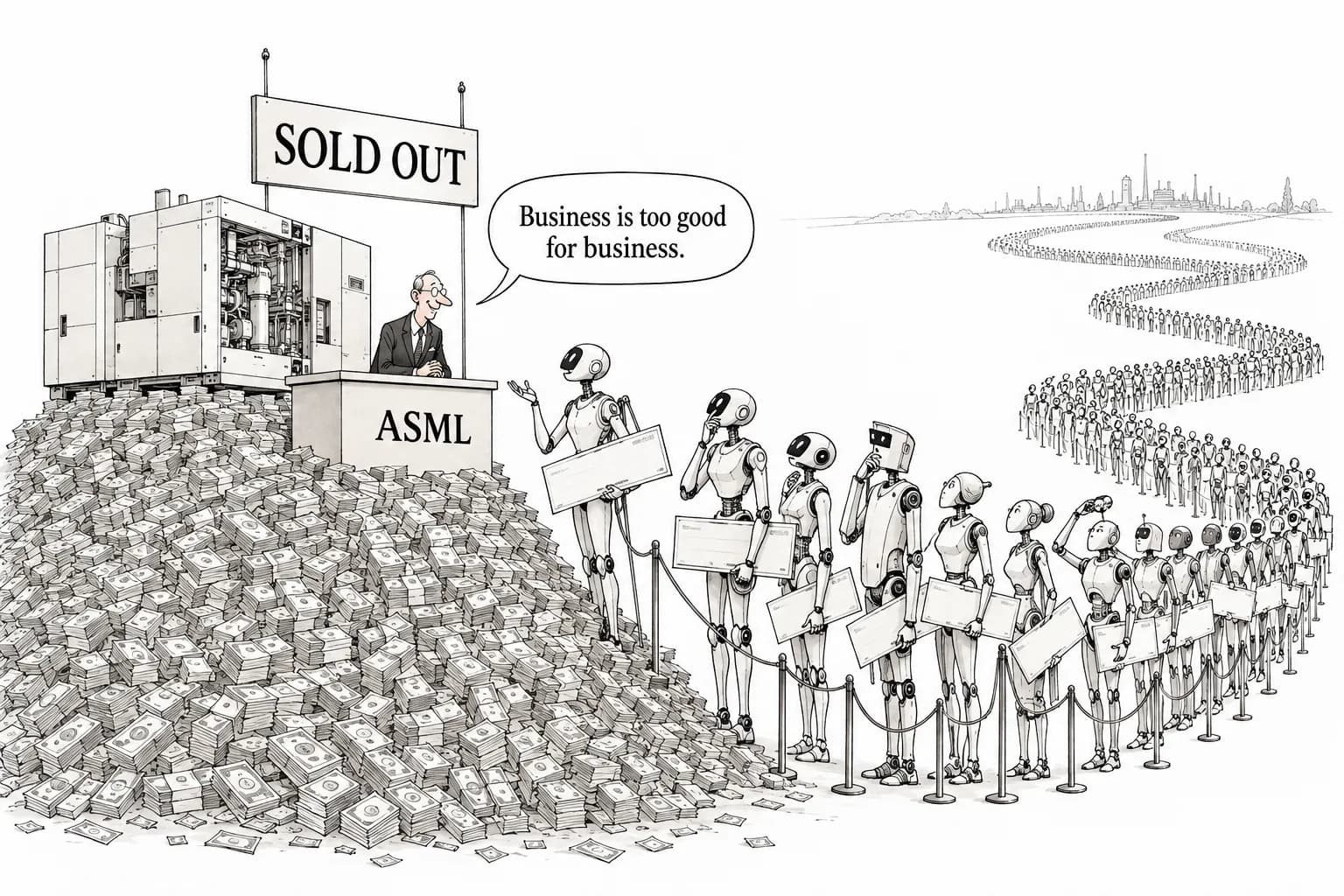
The sole supplier of EUV lithography tools has itself confirmed that the ceiling on AI chip capex is machine output, not customer budgets
Seiichi Tanaka · Editor-in-Chief

Key points
- ASML's July-September revenue was €11.7 billion, a record. Even so, the company wrote in its earnings documents that its supply plans for 2027 and 2028 "will not fully meet customer demand"
- China's share of sales fell from 42% to 23%, yet revenue still hit a new high. Demand for AI-related logic and memory more than offset the contraction in China
- The constraint on AI capex lies on the supply side, in EUV lithography tool output, rather than on the demand side, as confirmed by the monopoly supplier itself
- The ADR fell 2.5% on earnings day, but this tracked a market-wide selloff following US CPI data. ASML's own outlook remains bullish
ASML's results for the July-September 2026 quarter, released on October 14, rewrite the picture of AI capital spending in two ways. First, revenue came in at €11.7 billion, a quarterly record. Second, on top of that, the company itself wrote in its earnings documents that supply in 2027 and 2028 will not meet customer demand. China's share of sales has fallen from 42% to 23%, and AI-related demand has more than filled the hole left by that decline. The source is the 6-K press release filed with EDGAR, a primary document.
A record quarter, and supply that falls short
The €11.7 billion in revenue reflects investment in advanced logic and memory for AI flowing through into lithography tool orders. But the heaviest sentence in this report is not the revenue figure. ASML wrote, on its own initiative, that the production capacity it is currently planning for 2027 and 2028 will not be enough to work through customer orders.
It is rare for a supply-side company to acknowledge in an official document that demand will exceed supply two years out. If demand were weak, the sentence could not be written at all.
The supply we are currently planning for 2027 and 2028 will not fully meet customer demand.
This sentence inverts the usual read on the capex cycle. Semiconductor equipment makers normally issue cautious guidance for fear of orders tapering off. For one to declare two years of supply shortfall means orders are already stacked up through 2028. CEO Christophe Fouquet put it bluntly.
We have a lot of orders coming in for 2028.
Orders for tools to be delivered in 2028 are already in hand as of October 2026. A single EUV lithography system takes more than a year to build, and once fab ramp-up is factored in, customers place orders two to three years ahead. In other words, hyperscalers and chipmakers are locking in their 2028 AI production capacity right now.
China share from 42% to 23% — AI filled the gap
The drop in China's share of sales from 42% to 23% can be read as a negative. Tighter export controls, combined with the hangover from Chinese chipmakers' rush to stockpile mature-node equipment, shrank the China business. The 42% figure dates from the period when China was buying mature-process tools in bulk, and it has now fallen by nearly half.
Revenue still set a record regardless. That means demand from elsewhere exceeded the contraction in China. The substance of it is investment in advanced logic for AI and in memory for producing HBM. The former corresponds to TSMC's 2-nanometer generation, the latter to HBM capacity expansion at Samsung, SK hynix, and Micron.
This pattern is consistent with the estimate Epoch AI published on October 6 that China's exposure to a chip supply shock is 2.7 times that of the United States. China prepared by stockpiling mature-node equipment, but advanced EUV tools are blocked by regulation. The movement within ASML's revenue, with China falling and AI rising, shows directly where the supply constraint bites.
The constraint is on the supply side, in lithography tools, not on demand
Lay this report over the past few weeks of AI capex news and the subject of the sentence becomes clear. Meta's Zuckerberg and Alexandr Wang reportedly said on October 12 that capital spending would run $50 billion to $60 billion a year. Anthropic is reported to be rushing roughly $530 billion worth of data center leases, and Microsoft is said to be deploying its in-house inference chip, the Maia 300, at gigawatt scale from 2027, having secured more than 300,000 units of TSMC production capacity. All of these are stories about the demand side.
Whether these plans actually turn into chips depends on how many advanced wafers TSMC and Samsung can run, and that is determined by how many EUV lithography tools ASML can deliver. ASML is the only supplier of EUV. Now that ASML has said it cannot catch up with demand through 2028, the ceiling on AI capital spending is set not by the funds of labs and hyperscalers but by the number of lithography tools produced.
The view among US banks that "capital will be the constraint" also needs rereading in light of this report. Even with capital to spare, wafer output cannot grow without tools. Microsoft's reported move to lock in TSMC capacity ahead of time can be read as anticipating exactly this constraint.
The 2.5% drop in the ADR is not an ASML problem
Despite the bullish substance of the report, the US-listed ADR fell 2.5% on earnings day. Judging from the price history, the day's decline tracked a market-wide selloff following US CPI data released the same day, with no sign that the market was disappointed by ASML's outlook. Coverage of the results likewise centers on demand for AI-related tools.
Attention now shifts to TSMC's results on October 15, the following day. If ASML is sitting on orders for 2028, TSMC will be the one raising its 2027 capital spending. How the capacity figures for the 2-nanometer generation come out there will show which customers, and which years of AI chips, ASML's "supply will not meet demand" actually hits.
Editorial cartoon