Opinion · Oct 29, 2026
Three readers of Anthropic's S-1 reach opposite conclusions
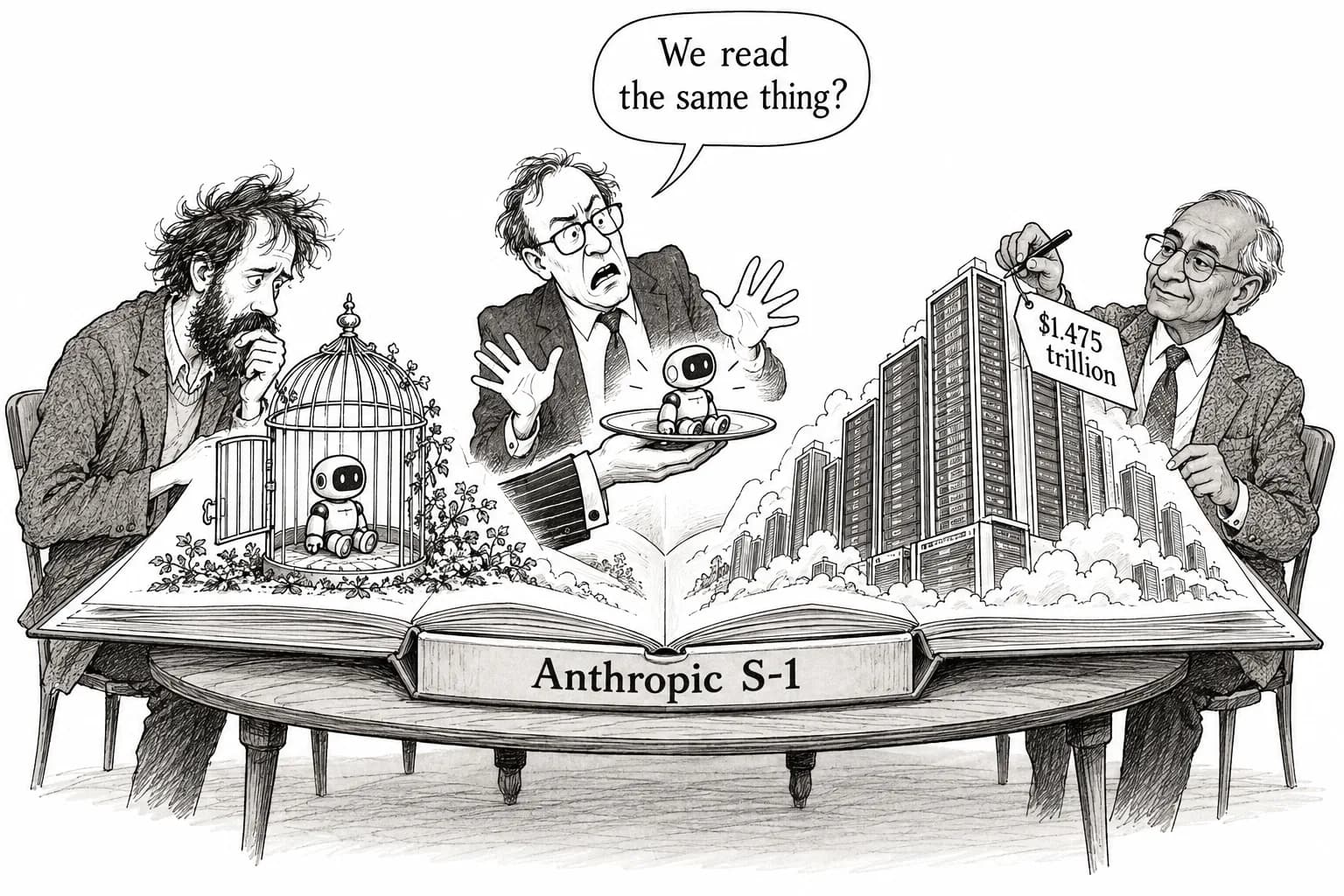
Zvi says the finances are effectively profitable and governance is the worry. Zitron calls it an IPO to sell out to retail investors. Damodaran will step aside if the price tops $1.475 trillion. The split comes down to how the compute commitments are counted and how well the LTBT protects the company.
Koji Yamamoto · Economics Analyst

Key points
- Zvi read the finances as effectively profitable and said the real concern is governance. Zitron read the IPO as a sell-out to retail investors, timed after a well-chosen quarter
- Damodaran valued Anthropic at $1.475 trillion. If the IPO price goes above that, he will step away from the frenzy
- The readings split in two places. One is whether the compute commitments are liabilities that must eventually be paid or investments in growth. The other is how much weight to give the path by which shareholders could remove the LTBT's protections
On October 26, Anthropic filed an S-1 registration statement with the SEC for its initial public offering. Three writers read the same document and reached opposite conclusions. Zvi Mowshowitz wrote that "financially, it is effectively profitable, and what we should worry about is governance." Ed Zitron wrote that it is "an IPO timed after a good quarter so insiders can sell out to retail investors." Aswath Damodaran drew a line at his own valuation of $1.475 trillion. If the IPO price goes above it, he says, he will step away from the frenzy.
All three looked at the same numbers. Their conclusions split because they read the filing differently in two places. The first is how to count the company's huge compute commitments. The second is whether the protections of the Long-Term Benefit Trust (LTBT) will still work after the company goes public.
Zvi: The money is fine; the worry is who can hit the brakes
In Zvi's reading, the business can already make money. Most of the current losses are simply up-front spending on the next model, so he sees the finances as "effectively profitable." That led him to focus his concern on governance.
This concern matches other parts of the S-1. According to the filing, Anthropic delayed pre-training of a new frontier foundation model by more than a month so it could strengthen protections against theft of the model weights. The filing also says the company may slow or pause training if it is not confident in its safety measures. It adds that its models are getting better at "evading some safety techniques, including by hiding their goals." Zvi's question is this: once a company that puts on its own brakes has shareholders who want results every quarter, who will hold the power to hit those brakes?
Zitron: Pick a good quarter, sell to retail
Zitron read the filing from the opposite side. In his view, the IPO was timed to come right after a strong-looking quarter. Using that quarter as a showcase, the company would sell shares to retail investors at an inflated valuation, giving early investors a way out. The title of his piece, "exit liquidity," sums up this view.
Zitron puts heavy weight on commitments that sit partly outside the filing. The Information reported that Anthropic is pushing partners to speed up roughly $530 billion in data center leases. There are also reports of vendor-financed compute deals, including $63 billion with Broadcom and $40 billion with SpaceX and Apollo. None of these has yet been confirmed in an 8-K or a similar filing. To Zitron, the commitments the company will be paying for years to come look bigger than its revenue growth.
Damodaran: Drawing the line at $1.475 trillion
Damodaran bought into neither story. He made assumptions about revenue growth, long-run profit margins and the cost of capital, and arrived at a value of $1.475 trillion. That figure already treats Anthropic as one of the largest companies ever. Even so, he says he will not buy if the IPO price goes above that line.
For Damodaran, whether a company is good and whether its stock is a good buy are two different questions. He built both the strength of the business and the weight of its compute commitments into his numbers, and then let the price alone decide his answer.
Split one: Are the compute commitments liabilities or investments?
This is where the three first part ways. If the compute commitments, worth hundreds of billions of dollars, are investments that will bring in revenue from next year on, then today's losses are temporary, and you get Zvi's "effectively profitable." If the same commitments are fixed costs that must be paid even when revenue growth slows, you get Zitron's "sell-out." Damodaran chose neither label. He turned the commitments into cash flows in his valuation. That is why his answer came out as a price line, not a verdict of good or bad.
The way the deals are structured makes the commitments hard to count. Moody's has pointed to the risks that pile up when vendor-financed deals stack on top of one another. No matter how much harness engineering lowers the cost per token, commitments signed in gigawatts cannot be rewritten.
Split two: How far do the LTBT's protections go?
The second split is about governance. The LTBT is an independent body that elects a majority of the board. Physicist Christopher Stubbs joined it on October 21. Its four members are Shah (chair), Fontaine, Bernanke and Stubbs. Anthropic is also asking shareholders to approve a plan to place 5% of the company's equity in a Public Benefit Fund.
The problem is that there is still a way to remove these protections. Frazier pointed out that shareholders have a path to strip away the LTBT's protections. On October 28, Fortune wrote that the costly question hanging over the filing is "who gets to say no." Zvi sees the existence of that path as the frightening part. Zitron's view is that even with the protections in place, buyers' money is not protected. In Damodaran's model, governance barely moves the valuation. The same clause is the central issue for one reader and only a footnote for another.
What to watch next
The evidence to test these views is coming soon. Once an S-1/A sets out a price range and share count, it can be compared directly with Damodaran's $1.475 trillion line. The split between new shares and shares sold by existing holders will help test Zitron's "sell-out" thesis. The roadshow is reportedly set for the week of November 9, with the listing reportedly in the week of November 16. How the conditions for removing the LTBT's protections are rewritten will show how far Zvi's worries are justified.
It is still too early to say which of the three is right. What is clear is that they did not disagree because anyone misread the numbers. They disagreed because each saw differently the commitments piled up outside the filing and the escape hatch left inside it.
Editorial cartoon