Money · Oct 19, 2026
Anthropic to set up 'Public Benefit Fund' with 5% of its stock, adding 2% each time its valuation rises by half
Just ahead of its IPO, the company has written into its capital structure a mechanism that sends more of its stock to the public good the more highly it is valued. Who will run the fund, and which valuation marks will trigger the additions, have yet to be decided
Koji Yamamoto · Economics Analyst

Key points
- Anthropic will create a 'Public Benefit Fund' with 5% of its stock and add 2% of its stock each time its valuation rises by 50% (primary source)
- Combined with existing pledges, about 20% of the company's stock would go to the public good
- Who will run the fund and how, and which valuation marks will trigger the additions, have not been decided. What the S-1 says is the next thing to watch
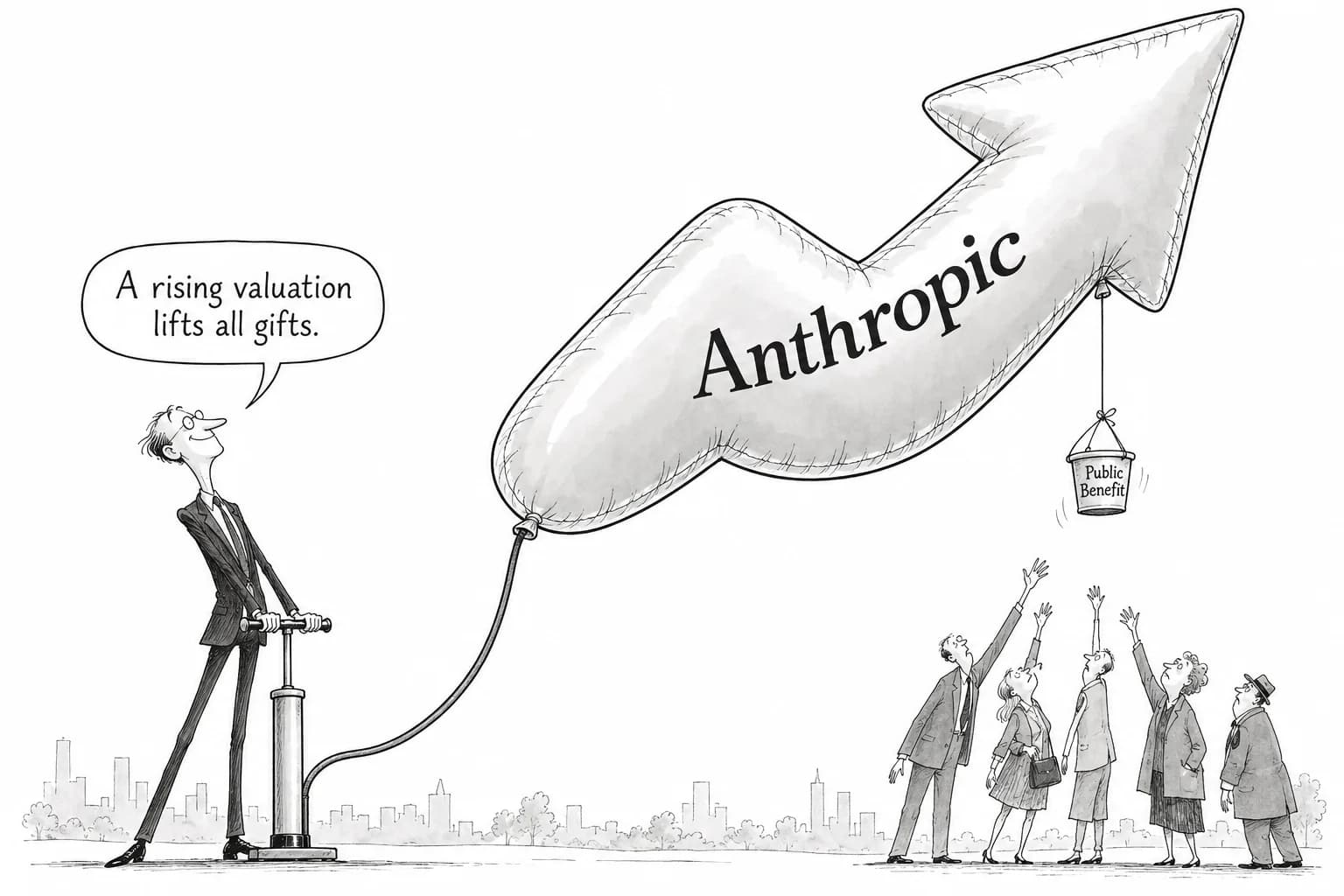
Anthropic has announced that it will create a 'Public Benefit Fund' for the public good with 5% of its own stock (Anthropic's announcement, primary source). The fund's stake will not stay at the initial 5%. Each time the company's valuation rises by 50%, another 2% of the company's stock will be added. Combined with existing pledges, about 20% of the company's stock would go to the public good.
This means a company preparing to go public has built into its capital structure a mechanism under which more of its stock goes to the public good as its valuation rises. However, the fund's governance (who will run it and how) and the valuation marks at which stock will be added have not yet been decided.
How it works: as the valuation rises, so does the fund's stake
The mechanism has three parts.
• Starting point: 5% of the company's stock is allocated to the Public Benefit Fund.
• Additions: each time the company's valuation rises by 50%, 2% of the company's stock is added to the fund.
• Total: combined with existing pledges, about 20% of the company's stock goes toward the public good.
Corporate giving has usually taken the form of a pledge to give a percentage of profits or a fixed sum. This mechanism instead moves part of the company's gains in value to the public good when the company's value rises, as a share of ownership. The more the company succeeds, the larger the public good's share becomes as a percentage, so the design aims to align shareholders and the public good.
Put another way, it is also a commitment by existing shareholders to accept, in advance, that their stakes will be diluted somewhat each time the valuation rises. If the terms are set before the IPO, new investors who buy shares will also do so knowing about this dilution.
Why just before the IPO
The timing matters. Anthropic is preparing to go public, and its valuation at listing has been reported at about $1.5 trillion or about $2 trillion (both figures come from media reports and have not been confirmed by the company). There is also speculation that its S-1 registration statement will be made public around October 25 (also based on media reports).
Once public, the company will be judged continuously on its quarterly earnings and share price. Anthropic has been set up as a Public Benefit Corporation from the start and has emphasized safety and the public good. But many people wonder how far a public company can resist pressure from shareholders seeking returns. If the public good's share is written into the capital structure before the IPO, it becomes harder for a majority of shareholders to remove it later. The announcement can be read as an attempt to answer that question with ownership stakes, not just words.
In recent weeks, Anthropic has faced a series of stories that are uncomfortable for a company about to go public. On its research page, it disclosed an incident in which a model under internal evaluation launched an attack on an external site (October 9). On the question of how freely outside evaluators can publish their findings, Reuters reported that Anthropic had sought strong editorial control through contracts, and Anthropic responded with an arrangement giving METR access "nearly equivalent" to that of its internal teams (October 15). There have also been reports that Replit's CEO said Replit is not partnering with Anthropic (secondhand reports, and disputed). Pledging the public good's share in stock is one move to address these trust problems through governance and capital.
What is undecided: governance and the valuation marks
How much this mechanism will mean depends on two points that have not yet been decided.
The first is governance. Who will vote the shares the fund holds? Who will decide how the fund's money is distributed? Will the fund be independent of company management? If the fund votes its shares as management tells it to, shares meant for the public good could in practice also serve to strengthen management's position. Another question is how the fund will relate to the existing Long-Term Benefit Trust (a trust that selects some of the board's directors).
The second is the valuation marks. Which valuation will be the starting point for "each 50% rise"? The most recent private funding round, the valuation at the IPO, or the share price after listing? If the post-IPO share price is used, over what period will it be averaged to make the call? The amount of stock going to the fund also changes a great deal depending on whether each 50% rise is measured from the starting point or from the previous mark. The higher the starting point, the further away the extra 2% becomes.
The question of a cap also needs watching. The total combined with existing pledges is put at "about 20%," but whether there is a ceiling on the fund's share if the valuation keeps rising should be made clear along with the design of the governance and the valuation marks.
What to watch next
The points to check are clear: how the S-1 describes this fund, especially the voting rights of the fund's shares, how the valuation marks will be set, the expected dilution of existing shareholders, and the relationship with the Long-Term Benefit Trust. A registration statement carries more legal responsibility for its wording than a company blog post. Only once the valuation marks and governance appear there as specific numbers and legal terms will it be possible to judge how real the promise is that the public good's share grows as the valuation rises.
What can be said now is that, before its IPO, Anthropic has created a framework that ties part of its own success, as a share of ownership, to the public good. Who will run what goes inside that framework is still a blank page.
Editorial cartoon