Infrastructure & Security · Nov 5, 2026
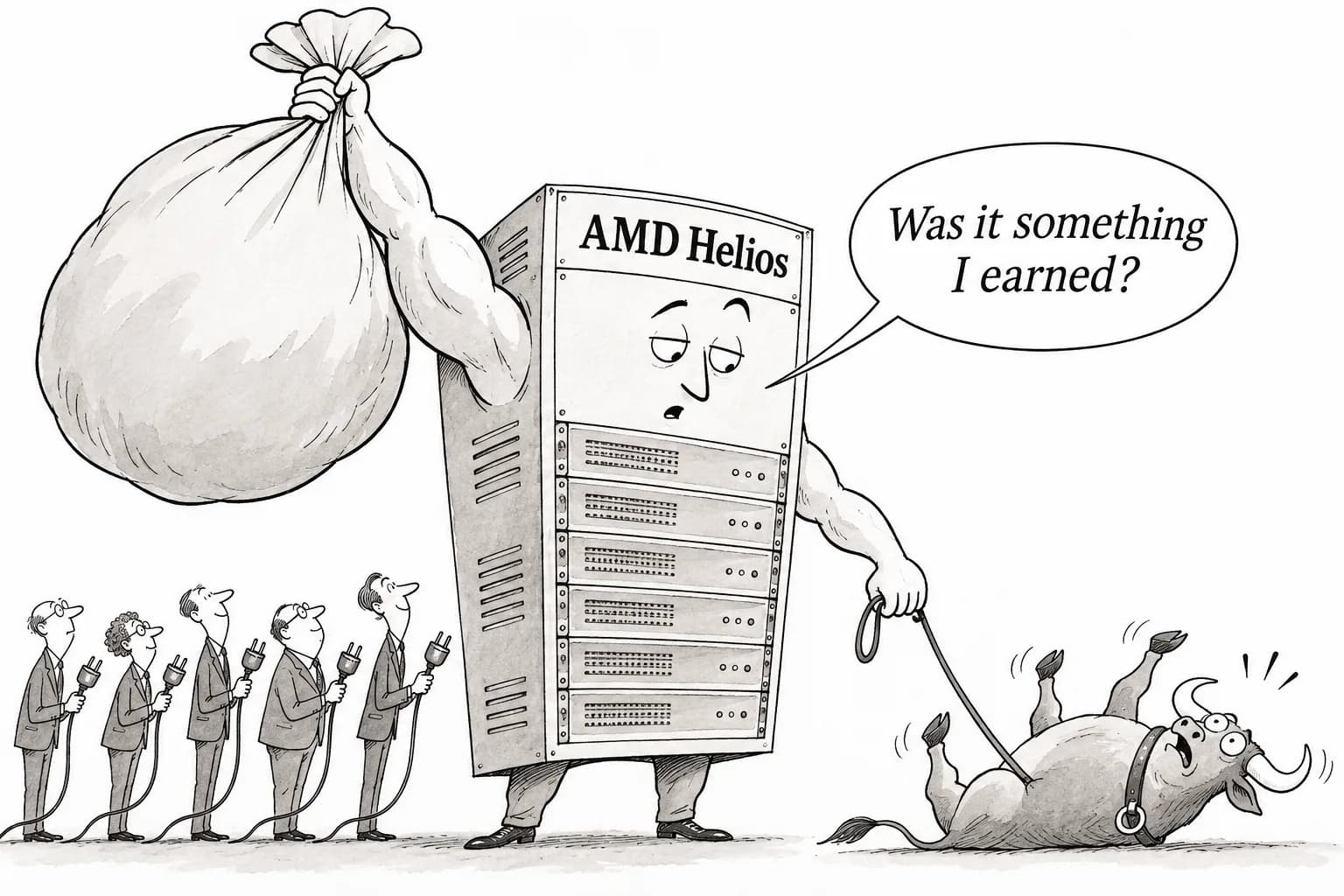
AMD's data center revenue doubles as five companies begin deploying Helios
Data center now makes up 64% of revenue, and Anthropic, Meta, Microsoft, OpenAI and Oracle have begun deploying MI450 racks. Even so, a roughly 8% after-hours gain was gone by midday the next day amid an election-driven sell-off in AI stocks
Seiichi Tanaka · Editor-in-Chief

Key points
- AMD's data center revenue roughly doubled in a year to $8.5 billion, or 64% of total revenue. AMD today is less a PC chip company than an AI data center company
- Five companies (Anthropic, Meta, Microsoft, OpenAI and Oracle) have begun deploying Helios, a rack built around the MI450. The buyers include Microsoft, which makes its own chips, and Anthropic, which uses Google's TPUs
- The stock rose about 8% after hours on the results but gave up the gain by midday the next day amid a sell-off in AI stocks after the midterm elections, CNBC reported. AI stocks are currently moving on politics and market sentiment more than on earnings
U.S. chipmaker AMD reported results for the July–September 2026 quarter after the market closed on November 3 (U.S. time). Data center revenue roughly doubled from a year earlier to $8.5 billion, accounting for 64% of total revenue. The company also disclosed that five companies, Anthropic, Meta, Microsoft, OpenAI and Oracle, have begun deploying Helios, a rack built around its next-generation AI chip, the MI450. On substance, it was a strong quarter. But the stock, which rose about 8% in after-hours trading, was pushed down by a sell-off in AI-related shares following the midterm election results and had given up almost all of the gain by midday on November 4, CNBC reported.
For Japanese companies: Few Japanese companies buy AMD products directly, so the impact will not be immediate. Companies using AI through Microsoft's Azure or Oracle's cloud, however, will feel it. If cloud providers can buy AI compute from vendors other than NVIDIA, AI usage fees and the scramble for available capacity may ease somewhat. For companies and individuals holding U.S. chip stocks, the quarter showed that strong earnings do not always lift the share price.
Two-thirds of revenue now comes from the data center
The figures come from AMD's own website and its filing with the U.S. Securities and Exchange Commission (SEC), making them primary sources.
The data center segment led the way, with revenue of $8.5 billion, roughly double the year-earlier figure. At 64% of total revenue, it accounts for nearly two-thirds. A simple back-calculation puts total revenue at a little over $13 billion. AMD was once best known for chips in PCs and game consoles. Today, chips for AI data centers and server processors make up most of its revenue.
The data center segment includes GPUs, the processors used for AI computing, along with server CPUs. Demand for AI training, and for inference (running trained models), has converged here.
The five companies deploying Helios
The other big development in the quarter was that Helios has begun reaching customers. Helios bundles dozens of AMD's new MI450 AI chips and sells an entire rack (the frame that houses servers) as a single large computer. It is aimed squarely at NVIDIA's rack-scale systems. Until now, AMD could compete with NVIDIA chip for chip but lagged in complete rack-level products.
AMD said the following five companies have begun deployment:
・Anthropic (the AI company behind Claude)
・Meta
・Microsoft
・OpenAI
・Oracle
The lineup is telling. In October, Microsoft unveiled Maia 300, its own chip for inference, and said it would deploy it at gigawatt scale starting in 2027. Anthropic was named as a major customer of Google's TPU AI chips on Alphabet's October 28 earnings call. Buyers that have their own chips, or chips from another vendor, are still installing AMD's racks. AI compute remains in short supply, and no company wants to depend on a single supplier.
As for Anthropic, its filings ahead of a planned November IPO have drawn attention to the scale of its compute purchase commitments (a figure of about $895.4 billion has been discussed). AMD's racks will be one of the places those commitments land.
The 8% after-hours gain vanished by the next day's midday
Right after the results came out, AMD shares rose about 8% in after-hours trading. But on November 4, AI-related stocks sold off across the board following the U.S. midterm election results, and AMD had given up almost all of its gain by midday, CNBC reported. The share price movement is based on CNBC's reporting, and the reason for the sell-off is the outlet's assessment.
The takeaway is that AI stocks are currently moving on politics and overall market sentiment more than on the details of any single company's results. The midterms also included state ballot measures over data center electricity costs and construction, as well as elections for public utility commissions. Investors increasingly see how many AI data centers can be built from here as dependent on political outcomes. Even a company whose revenue had doubled could not push against that mood.
What to watch
First, how much Helios contributes to revenue. The five companies have only "begun deploying," and volumes have yet to build. Second, whether more buyers follow the five. Third, how the election results affect data center construction and electricity regulation. Results of data center ballot measures and state races are not yet all in. However strong AMD's numbers are, racks cannot be installed without sites to build on and the power to run them.
Sources: AMD earnings release, SEC filing, CNBC
Editorial cartoon