Infrastructure & Security · Nov 1, 2026
Amazon lines up as much as $80 billion in equipment-backed borrowing, 10-Q shows
Funding for AI capital spending is spreading from cash on hand to debt secured by the very equipment being bought, in an arrangement that resembles borrowing from the seller
Seiichi Tanaka · Editor-in-Chief
Key points
- Amazon's 10-Q for the July–September quarter discloses a facility to borrow up to about $80 billion, secured by the equipment it acquires (primary source)
- Bloomberg reported it as a "supplier loan facility." Money would come from the equipment sellers' side, which makes the arrangement close to vendor financing
- Capital expenditure for the July–September quarter was $75.9 billion. That doesn't square with the October–December figure implied by the company's roughly $220 billion outlook for 2026, which raises questions about how the spending is funded and how it is counted
Amazon's quarterly report for July–September 2026 (10-Q), filed with the SEC in late October, includes a borrowing facility. It allows the company to borrow up to about $80 billion, secured by the equipment it buys. In an October 30 article, Bloomberg called it a "supplier loan facility" to help fund AI.
Amazon is one of the world's most profitable companies. Until now it has paid for its AI data centers mainly with cash generated from operations. Now it has set up a way to borrow against servers and other equipment. AI capital spending is starting to rely on more than cash on hand, including debt that looks a lot like borrowing from the seller.
What the 10-Q shows
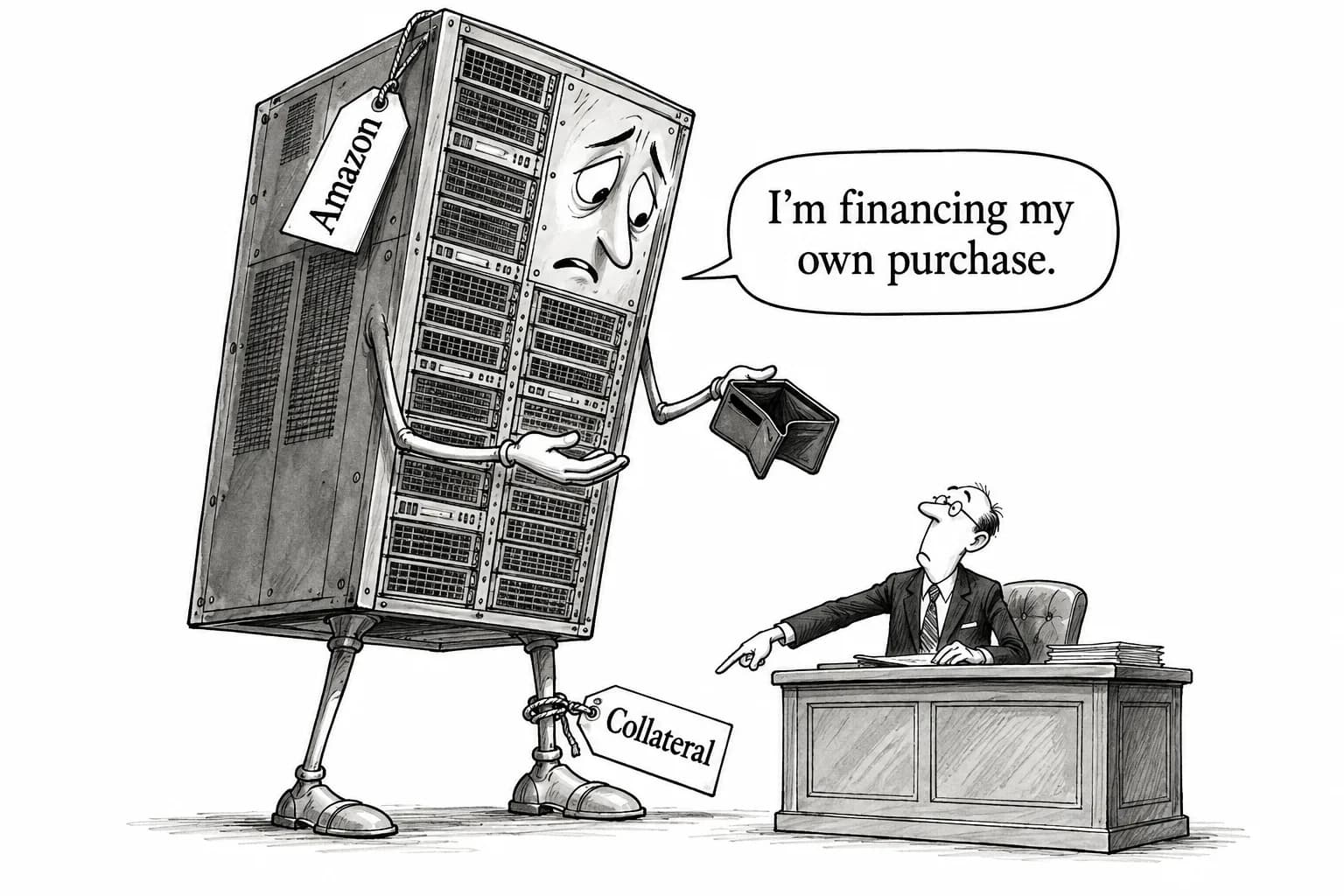
The 10-Q shows that the facility is capped at about $80 billion and that the collateral is the equipment acquired with it. The company borrows the money to buy the equipment, using that same equipment as security. It works like a mortgage, applied to the machines inside a data center.
Bloomberg's headline calls it a "supplier loan facility," which indicates that the equipment sellers' side is involved in the flow of money. At the time of writing, however, we had not been able to confirm the following in the filing or in the body of the report: how much has already been drawn, the interest rate and repayment terms, which companies are the lenders and sellers, and what counts as "equipment." This part rests on the report and will be updated once confirmed.
Why it resembles borrowing from the seller
With an ordinary corporate bond, the buyer borrows from the market and buys from whichever seller it chooses. In vendor financing, the seller (or a financial institution working with the seller) puts up money so that its products get bought. The seller books revenue sooner, and the buyer gets equipment without paying cash. Because the equipment is the collateral, the lender relies on the value of the machines as well as the company's credit.
That is also where the risk lies. GPUs and the equipment around them lose value with each new generation. If the collateral loses value faster than the loan is paid down, lenders are left relying on the company's credit alone. Sellers end up having their products bought with money they lent, which makes it harder to tell how much of the demand is real. Amazon's credit is strong, so this isn't an immediate problem. Even so, part of the money behind AI demand is now coming from the equipment sellers.
Capital spending figures that don't add up
The facility came to light while Amazon's capital spending figures were still unexplained. Amazon's capital expenditure for the July–September quarter was $75.9 billion. The company's outlook for 2026 capital spending is about $220 billion, which implies October–December spending falling to about $48 billion. Given the July–September level, a drop that steep looks implausible.
There are two possible explanations. One is that the roughly $220 billion outlook is out of date. The other is that the two numbers cover different things. Whether equipment obtained through leases or financing counts toward cash capital expenditure, for example, can change the figure a great deal. When equipment is acquired with equipment-backed borrowing like this facility, capital spending and borrowing may show up on separate lines of the cash flow statement. Amazon has not yet said clearly which explanation is right. This is an issue to follow alongside the earnings call transcript, including the size of 2027 capital spending.
Not just Amazon
Over the past few weeks, other large companies have also been using debt to help fund equipment. Microsoft issued $25 billion in bonds. There are also questions about whether NVIDIA will guarantee debt for Nscale, which is building compute for Anthropic. More deals use vendor guarantees or special purpose vehicles (SPVs) to keep debt off the buyer's balance sheet, such as guarantees from Broadcom or the $40 billion involving SpaceX and Apollo. All of these show capital spending starting to outrun what companies can pay in cash.
Amazon's facility is one of the largest. At up to about $80 billion, it exceeds Amazon's capital expenditure for the whole July–September quarter. That one of the most cash-rich companies has disclosed a facility this large is significant.
Markets are nervous about how long the money for AI capital spending will keep flowing. The Nasdaq fell 1.4% and 3.6% over the last two sessions. Seller financing supports demand in the short term, but when demand slows, the impact falls on both the sellers and the lenders.
What remains unknown
Four points still need confirming. How much of the facility has been drawn. Which companies are the lenders and the sellers involved. The interest rate, the term, and how the collateral is valued. And how Amazon will count equipment bought with this borrowing in its capital expenditure figures. That last point bears directly on the gap between the roughly $220 billion outlook for 2026 and the October–December figure.
Editorial cartoon
Sources
- https://www.sec.gov/Archives/edgar/data/0001018724/000101872426000040/amzn-20260930.htm
- https://www.bloomberg.com/news/articles/2026-10-30/amazon-taps-80-billion-supplier-loan-facility-to-help-fund-ai
- https://www.fool.com/earnings/call-transcripts/2026/10/30/amazon-amzn-q3-2026-earnings-call-transcript/