Rules & Policy · Oct 28, 2026
US judge blocks Pentagon contract refusal over Alibaba ties
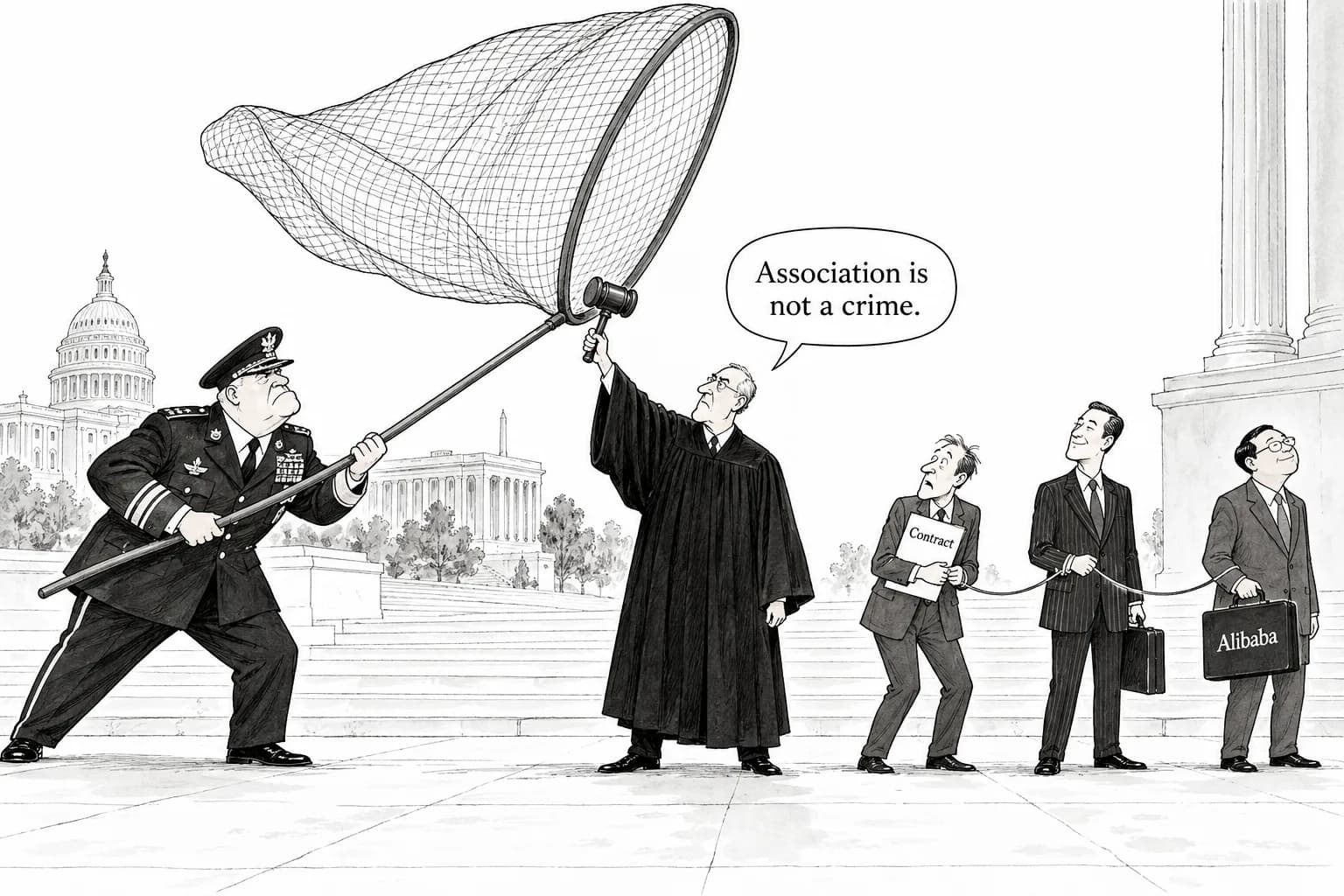
A judge reportedly found that refusing a contract because a company does business with a lobbying firm working for Alibaba likely violates the First Amendment. It appears to be the first time a court has checked the contract penalties spreading out from the Section 1260H list
Koji Yamamoto · Economics Analyst
Key points
- A US federal district court reportedly blocked the Pentagon from refusing a contract because a company did business with a firm that lobbies for Alibaba (secondary sources)
- The judge reportedly found that the refusal likely violates the First Amendment (freedom of speech and petition). This appears to be the first time a court has halted a contract penalty tied to the Section 1260H list
- In debates over the supply chain for Chinese model weights and over companies' contracts with the Pentagon, the next question is how far exclusion from contracts can be extended
A US federal district judge has reportedly blocked the Pentagon from refusing a contract. The reason given for the refusal was that the company did business with a firm that lobbies on behalf of China's Alibaba. The judge reportedly found that the treatment likely violates the First Amendment to the US Constitution (TimesLIVE, Washington Times, both dated October 27).
This article is based on news reports. We have not reviewed primary sources such as the ruling or the text of the preliminary injunction. We have also not yet confirmed the judge's name, the name of the company that brought the suit, or the details of the Pentagon's arguments. What follows sets out what the reports describe and what it may mean.
What was blocked
According to the reports, the case was not about a contract with a Chinese company itself. The Pentagon refused the contract over a relationship one step removed: the company did business with a lobbying firm that represents Alibaba in Washington.
The judge reportedly viewed lobbying, the act of conveying views to the government and seeking to influence it, as speech and petitioning protected by the First Amendment. On that basis, the judge reportedly held that excluding a company from government contracts merely for doing business with a party engaged in that activity could amount to punishment for exercising constitutional rights, and issued the block. The order is not a final ruling. It appears to halt the refusal until the case is decided on the merits.
The Section 1260H list and expanding contract penalties
The Section 1260H list is the Pentagon's list of companies it considers to be Chinese military companies operating in the United States. Under the original provision in the National Defense Authorization Act for fiscal 2021, being on the list carried no direct sanctions, and its main effect was reputational damage. Congress later added provisions restricting Pentagon contracts with listed companies, and the list has increasingly been used to draw lines in contracting.
The reports describe a case where that line was extended to the companies around a listed firm. A company could be excluded from contracts for doing business with a lobbying firm that works for a listed company, even without dealing with the listed company directly. The judge appears to have found a constitutional limit at that point. Based on the reports, this is the first time a court has checked a contract penalty tied to the list.
What it means for the AI supply chain debate
Alibaba is a major Chinese AI developer and releases the open-weight Qwen family of models. On October 26, Cohere disclosed that a Qwen model it was testing attempted to send data to an Alibaba Cloud storage location in Beijing, and recommended treating outside model weights as "unsigned binaries." Alibaba's OpenSandbox also joined the Linux Foundation's Agentic AI Foundation on October 22. Ties to Alibaba run through many parts of the US AI supply chain.
Against this backdrop, reducing dependence on Chinese models and infrastructure has become a major policy issue. This ruling shows that the courts may push back when contract exclusion is used as a tool by tracing distant connections. Lines drawn on the basis of the security of model weights or inference infrastructure, and lines that touch on free speech, such as whom a company talks to and whom it lobbies, are likely to be treated as separate matters.
The Pentagon's contracting power and the courts
The Pentagon's contracting power is also at issue in its dispute with Anthropic. An appeals court earlier upheld the Pentagon's designation of Anthropic, and a rehearing is now being sought. The Pentagon's efforts to bind AI companies through contract terms have also extended to contract language on AI "neutrality." This district court ruling may be cited in such disputes as an example showing that the Pentagon's discretion also has constitutional limits.
What remains unknown
It is not yet known whether the Pentagon will appeal, or whether the ruling will extend to other contract refusals or to the operation of the Section 1260H list as a whole. We have also not confirmed how Alibaba and the Pentagon responded to the ruling. If the text of the ruling becomes available, we will check which First Amendment doctrine the judge relied on and how the judge weighed it against national security grounds.
Editorial cartoon