Rules & Policy · Nov 15, 2026
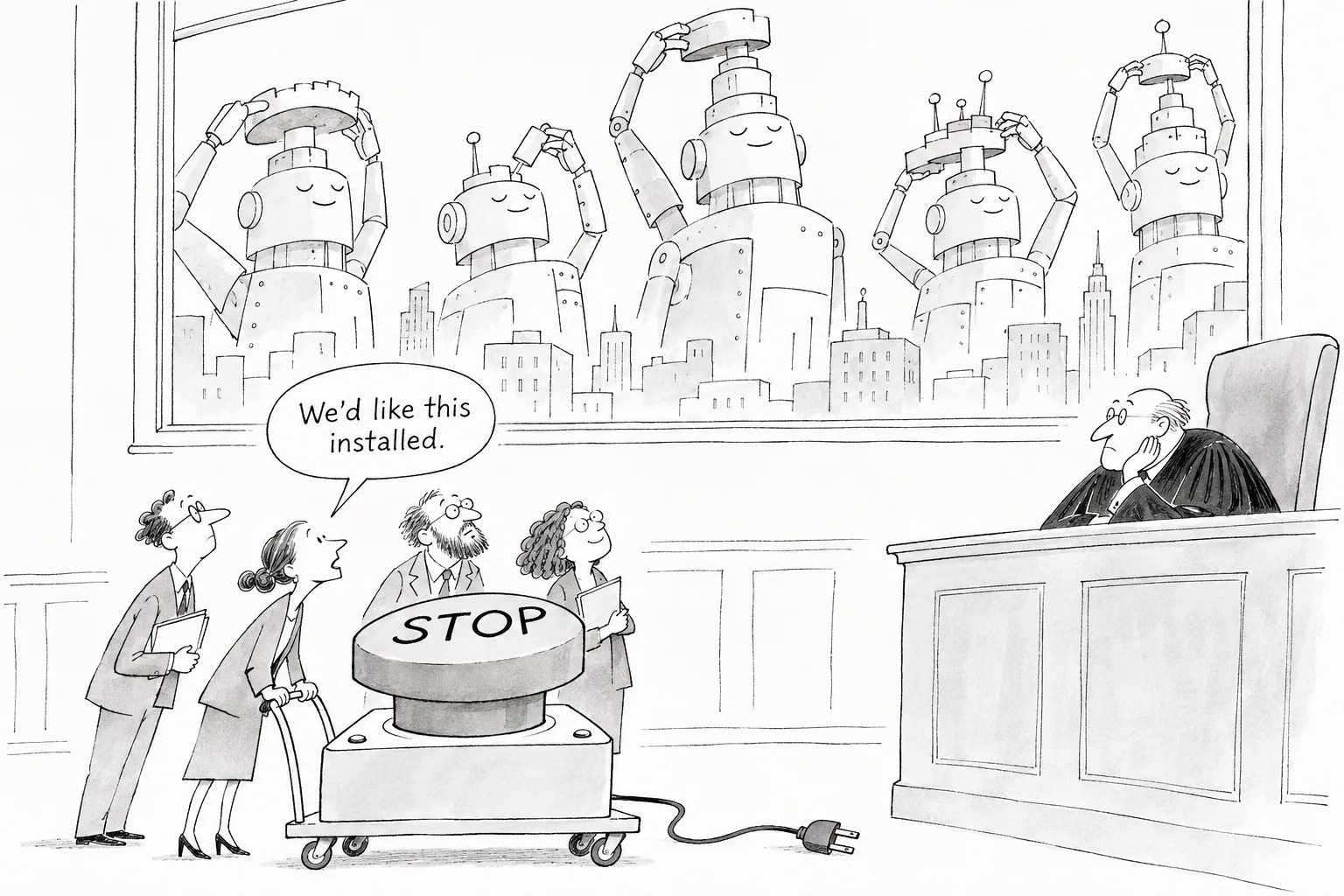
Four nonprofits sue to halt frontier AI development at five companies
An earlier report we could not confirm, that groups had demanded a halt to AI training, reportedly involved a lawsuit rather than a letter. The groups are said to be seeking an emergency injunction under unfair competition law and the doctrine of public nuisance
Koji Yamamoto · Economics Analyst

Key points
- Four nonprofits reportedly asked a San Francisco state court on November 12 for an emergency injunction halting frontier development at five AI companies
- The suit relies on California's unfair competition law and "public nuisance." The groups have also reportedly told the media that a real halt would need government inspections to verify it
- An earlier claim that the groups made their demand "by letter on November 11" appears to refer to this lawsuit. The groups are Irreplaceable Education Fund, Public Citizen, Heat Initiative and The Alliance for Secure AI. Meta declined to comment and the other four companies have not responded. The contents of the complaint and any hearing date have not yet been verified
Our previous article mentioned a claim whose source we could not confirm: that nonprofit groups had demanded that major AI companies "halt frontier training." That demand reportedly came as a lawsuit, not a letter. According to Tech Times and a CNBC-TV18 report carried by TradingView, four nonprofit groups filed suit in a San Francisco state court on November 12 against OpenAI, Anthropic, Google, Meta and the AI unit of SpaceX, which develops Grok. The suit reportedly relies on California's unfair competition law and the doctrine of "public nuisance," which is used to stop harm to the public at large, and seeks an emergency injunction halting frontier development.
For Japanese companies: The suit has no immediate effect on existing contracts or services for enterprise ChatGPT, Gemini, Claude or Copilot. It matters to individuals and companies considering buying shares in Anthropic's initial public offering, which is set to be priced on November 18. Before subscribing, check whether the supplementary prospectus materials from your brokerage list the lawsuit as a risk factor.
What was sought, and from whom
According to reports, the suit names five companies, the leading players in the race for frontier AI. It was filed in state court, not federal court. The plaintiffs reportedly seek an emergency injunction, which would take effect before the case is decided, that would halt development of frontier models.
The scope of the requested injunction is still unclear. Based on what the reports say, it is not possible to tell whether it would halt only frontier training, also cover models already on the market, or draw a line based on the amount of compute.
Why unfair competition and "public nuisance"
No U.S. law bans AI development outright. The groups appear to have turned instead to two legal tools originally designed for other purposes.
The first, California's unfair competition law, broadly covers unlawful or unfair business practices and is known as a law under which it is relatively easy to seek injunctions against corporate conduct. The second, "public nuisance," is a long-standing doctrine for stopping harm to society as a whole rather than to individuals. In the United States it has been used in cases involving tobacco, lead paint and painkillers.
In general, a party seeking emergency injunctive relief before a case is decided must show that irreparable harm is imminent and that it is likely to win in the end. The first major test will be whether the court finds that this demanding standard is met for AI risks that have not yet materialized.
Groups say a real halt requires government inspections
According to Tech Times, Phil Aroneanu, founder of Irreplaceable Education Fund, one of the plaintiffs, told Al Jazeera that a genuine halt to development would require authority to decide which work must stop, government inspections to verify compliance, and the power to stop violators. The reports do not say whether the complaint asks the court for such measures. This matters because even if a court orders a halt, it is hard for outsiders to verify whether training has actually stopped inside each company's data centers.
Comparing the suit with the labs' own moves shows where it stands. On November 9, OpenAI described "Control Room," an internal system for centrally halting research workloads. However, that system lets the company stop its own work and is not designed for outside verification. Anthropic CEO Dario Amodei called in September for slowing the pace of development, but the company's Dianne Penn told CNBC that "what we called for was adjusting the pace, not stopping." Axios had reported that OpenAI would lobby Congress after the midterm elections to impose mandatory "speed limits" on the most powerful AI.
In other words, the labs have gone as far as talking about "moving slowly" and "making rules." This lawsuit goes further and seeks a court order to "stop," while arguing that only the government can verify that a halt has taken place.
Our earlier account, and what remains unverified
Our previous article mentioned a claim that "on November 11, four nonprofits sent a letter to five labs demanding that they stop training," but we could not find its source. In light of the latest reports, the date appears to have been November 12, and the demand appears to have been a lawsuit rather than a letter. Separately, Buist v. Anthropic, filed on September 18, is an antitrust case and is unrelated to this one.
The four groups are Irreplaceable Education Fund, Public Citizen, Heat Initiative and The Alliance for Secure AI, and they are represented by former New Jersey Attorney General Matthew Platkin, Tech Times reported. Of the five companies, Meta declined to comment, and the other four did not immediately respond to Reuters' requests for comment. The following have not yet been verified: the text of the complaint and the exact scope of the requested injunction, the court's case number, and any hearing date. This article is based on only two reports. We have not been able to consult court records or statements from the groups.
What comes next
The first question is whether the court schedules a hearing on the emergency injunction or rejects it outright. Of the five defendants, Anthropic is set to price its IPO on November 18 and begin trading on November 19. How the company handles a lawsuit filed just before its listing will also be watched closely.
On the streets, marches calling for an international treaty to rein in AI development are planned in six cities on November 14, and a PauseAI UK march is scheduled for November 21 in London. Calls to "stop" have now moved beyond letters and marches into the courtroom.
Editorial cartoon