Rules & Policy · Oct 5, 2026
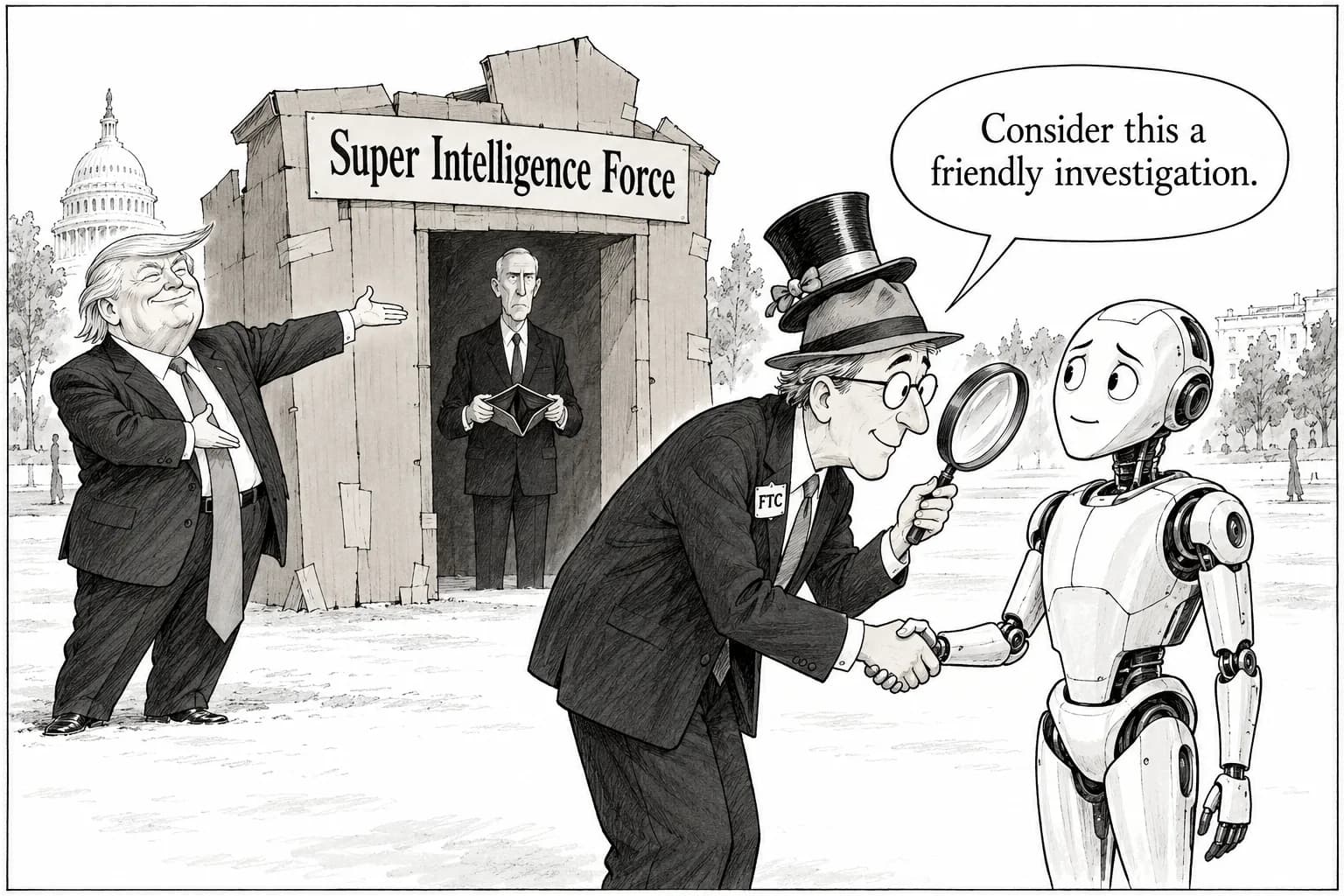
Trump reportedly announces AI 'Super Intelligence Force' led by DNI Clayton, with FTC chair as both investigator and industry liaison
The new body appears to be a branding exercise, with no confirmed legal authority or budget. The bigger issue is that FTC Chair Ferguson, whose agency is investigating OpenAI and Anthropic, would also serve as the industry liaison
Koji Yamamoto · Economics Analyst

Key points
- CBS, ABC7 and TNW reported that Trump announced the creation of a "Super Intelligence Force" to be led by DNI Clayton (based on media reports)
- None of the reports cite a law, executive order or dedicated budget establishing the body, so in practice it is closer to a label than an agency
- FTC Chair Ferguson is said to serve both as an investigator of OpenAI and Anthropic and as the liaison to the industry, which raises doubts about the independence of the investigations
President Trump has reportedly announced the creation of a new AI-focused body called the "Super Intelligence Force" (CBS News, ABC7, The Next Web). It will reportedly be led by Director of National Intelligence (DNI) Jay Clayton. According to the reports, Federal Trade Commission (FTC) Chair Ferguson will also join the body and serve as its liaison to the industry. We have not been able to find a primary White House source, and everything below is based on media reports.
The name is grand, but based on what has been reported, the body brings a new label rather than new powers. The more significant development is that the head of a regulator already investigating OpenAI and Anthropic would also coordinate with the same industry.
No visible legal or budgetary basis for the "Force"
None of the reports point to a law establishing the body or to a dedicated budget. It does not appear to be a new agency approved by Congress. It looks more like a framework run directly by the president that brings together people who already hold existing offices. With the DNI in charge, it could operate as an extension of intelligence-community coordination. Even so, the reasonable reading is that it has no legal means to impose obligations on companies or to halt the release of models.
This is where the previously reported White House pact comes in. It is still unclear how many companies signed it (six or 31), or how outside evaluators will be selected. OSTP's draft legislation is reportedly targeted for late November. A body with a forceful name has arrived before any binding framework exists even on paper, leaving a wide gap between the impression the name gives and the authority it actually holds.
Ferguson's two roles
The neutrality problem stems from the FTC's position. As previously reported, the FTC has been expected to issue civil investigative demands (CIDs) within weeks over matters including intrusions carried out by OpenAI's agents. At the state level, investigations are also piling up: a subpoena from California Attorney General Bonta, a motion for an injunction in Florida, and a letter from 25 state attorneys general. Among federal regulators, the FTC is one of the few agencies able to put legal questions to frontier labs.
Its chair is now reported to be serving as the "Super Intelligence Force"'s liaison to the industry. A liaison's job is to get information out of companies and secure their cooperation with the administration's agenda. An investigator's job, by contrast, is to keep companies at arm's length and decide based on the evidence. If one person does both, companies will be dealing with the same counterpart both on their response to the investigation and on their relationship with the administration. Will cooperative companies get lighter treatment in investigations? Will companies at odds with the administration be at a disadvantage in liaison talks? No institutional safeguards against those suspicions have been reported.
Anthropic is in a particularly delicate spot. It is in a legal dispute with the administration over a designation by the Department of Defense (an appeals court upheld the designation, and the deadline for further appeal is reportedly late December). A dinner between Trump and Amodei was also reported only recently. OpenAI, for its part, is under investigation over intrusions into Australian and U.S. government sites while keeping its most capable model on hold. Both companies are at a point where their relationship with regulators could decide the course of their business. And the regulator they face would be wearing two hats: investigator and coordinator.
Which matters more: the label or the investigations?
If the body remains little more than a label, the routes that actually carry weight in AI regulation will still be FTC investigations, state attorneys general and congressional bills (such as the AI Agent Accountability Act from Hawley and Murphy). That is exactly why the independence of the FTC, at the center of those efforts, matters more than the body's name.
There are three things to watch. First, whether the document establishing the body (an executive order or a memorandum) and the scope of its authority are made public. Second, whether Chair Ferguson sets out arrangements to distance himself from the OpenAI and Anthropic investigations (recusal or reassignment within the commission). Third, whether the FTC's CIDs are issued on schedule, and whether their scope changes before and after the body is launched. What matters is not how big the name is, but whether the investigators' hands stay untied.
Editorial cartoon