Products & Models · Nov 9, 2026
How well can AI read lab images? OpenAI's new benchmark tops out at 67%
The test measures the ability to read gel photos and microscope images, not textbook knowledge. But it gives no human scores and no scores for rival models, so it is still unclear whether AI can be relied on at the lab bench
Rie Suzuki · Technology Editor
Key points
- BioBasicsBench reportedly measures the ability to read raw experimental data such as gel photos and microscope images, rather than memorized knowledge
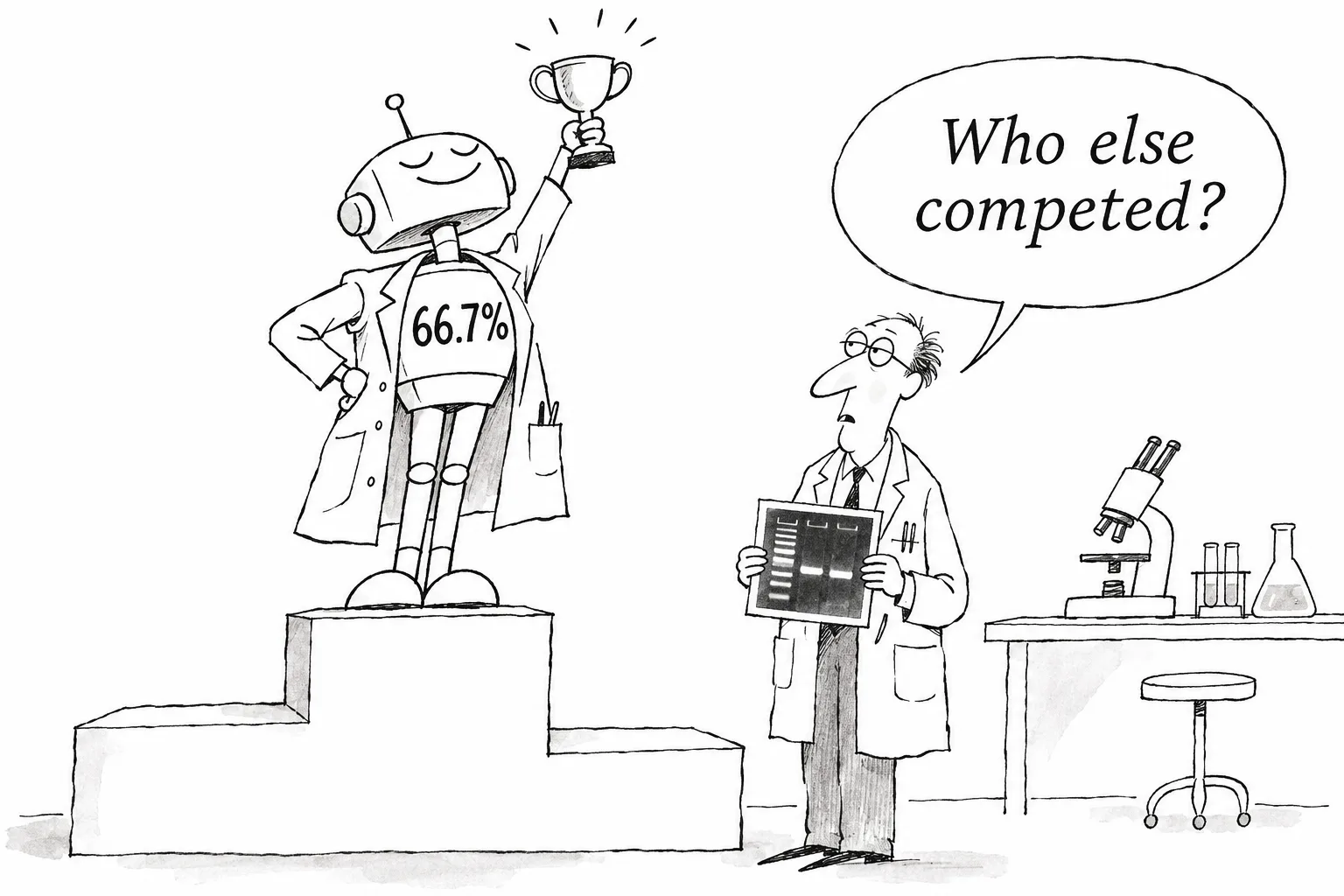
- Even the top performer, GPT-6 Astra, scored 66.7%, which means it got roughly one in three questions wrong
- No scores are given for human researchers or for other companies' models, so there is no yardstick for judging whether 66.7% is high or low
[Update, November 9, 2026, 4:38] The announcement is now known to have been made on November 6, so the date has been removed from the list of things not yet confirmed.
OpenAI has released BioBasicsBench, a new test of how well AI can read data from biology experiments, according to R&D World, a U.S. trade publication covering research and development. The test does not ask about textbook knowledge. It measures whether a model can look at the gel photos and microscope images that real experiments produce and work out what happened. The best performer was GPT-6 Astra, OpenAI's flagship model, which reportedly answered 66.7% of questions correctly. No scores are given for human researchers taking the same test, however, and none for models from other companies. The figure alone therefore cannot tell us how much lab work can be handed over to AI.
For Japanese companies: This does not affect most companies. It matters to R&D departments in pharmaceuticals, food, chemicals, contract testing and similar fields that plan to use AI to read experimental images and data. Departments considering adoption should not base their decision on the 67% figure. Instead, they should first compare the AI's readings with their own staff's readings on past images from their own experiments. If you plan to start this fiscal year, build that trial into the plan first. No changes have been announced to existing contracts such as the enterprise version of ChatGPT.
What the test measures
Until now, most tests of AI's scientific ability have asked about knowledge found in textbooks and papers. AI already scores highly on those questions. But day-to-day work in a wet lab, where researchers handle reagents and cells, is not about reciting knowledge. It is about reading the results in front of you.
In gel electrophoresis, for example, which separates DNA or proteins by size, researchers judge from the position and intensity of the bands in a photo whether they got the product they were aiming for. With microscope images, they read the shape, number and staining of cells. BioBasicsBench reportedly works by giving AI this kind of raw experimental data and checking whether it reads it correctly. According to the headline of the R&D World article, the test covers 100 routine lab tasks.
Put another way, the test does not ask AI "Do you know biology?" but "Can you look at results and make judgments as a lab assistant?" As talk of using AI in research grows, the value of the test lies in moving what is measured closer to real-world work.
How to read the 67% figure
A score of 66.7% for the best model, GPT-6 Astra, means it got roughly one in three questions wrong. Misreading an experimental result can waste everything that follows, from reagent orders to the plan for the next experiment. At this accuracy, it is hard to call the model reliable enough to work without human checks.
Still, the score cannot be dismissed as low either, because there is no yardstick for comparison. According to the report, the test has no baseline score from human researchers. There is no way to say how an inexperienced graduate student or a seasoned researcher would do. If even experts score in the 70s, AI is already quite close. If they score above 90%, a large gap remains. Which is the case is unknown.
OpenAI reportedly did not test other companies' models either. The test cannot tell us whether OpenAI's models are ahead of or behind Google's Gemini or Anthropic's Claude.
This is not the first time OpenAI has released a test it built itself and used only on its own models. On November 2 it released LifeVal, which measures everyday tasks such as parenting and household finances. That test also did not evaluate other companies' models, and its tasks and data were not made public. How much weight the BioBasicsBench figure carries will depend on how many of its tasks are published and whether outside researchers can verify the results for themselves.
Part of OpenAI's push into biology
OpenAI has been investing heavily in biology. On October 30 it released GPT-Rosalind-6, a model for biology, only to vetted organizations. It uses the same weights as GPT-6 Astra but refuses dual-use biology questions (those that can serve research or misuse) less often. Since the top score on this test also went to Astra, BioBasicsBench could also serve as evidence of how useful such research products are in practice.
At the same time, the ability to read experimental data calls for caution on safety. OpenAI itself rates the biological and chemical risk of GPT-Rosalind-6, which is built on GPT-6 Astra, as "High," the second-highest level on its internal scale. BioBasicsBench reportedly measures basic, routine tasks, which is separate from dangerous uses. But the more tests of AI's abilities in biology appear, the more decisions about how much to publish will come under scrutiny.
What could not be confirmed
This article is based on media reports. We were unable to read OpenAI's announcement page, and the following have not been confirmed: the time of the announcement, the exact number and types of tasks, the scoring method, scores for models other than GPT-6 Astra, and whether the tasks will be published. The figure of 100 tasks also comes from the headline of the R&D World article and could not be confirmed in its body.
What to watch next
There are three things to watch. The first is whether a baseline score from human researchers is released. Only then will it be clear how close 66.7% is to practical use. The second is whether models from Google and Anthropic are evaluated on the same test. If the tasks are published, third parties will be able to run it. The third is how much the score improves with GPT-6.2 Astra, OpenAI's next model, which is expected soon. For R&D departments, trials on their own experimental data remain the most reliable yardstick while they wait for such outside figures.
Editorial cartoon