Rules & Policy · Oct 21, 2026
Music publishers' body pushes back on Australia's AI training "opt-out" plan, saying firms are threatening "we won't invest" — and that Kylie Minogue's songs are already in datasets, with no other example among 62 countries
The International Confederation of Music Publishers (ICMP) reportedly argued against a proposal that would make rights holders register the works they want excluded, saying training has already happened and that no other country has set such a precedent. Ahead of a parliamentary committee report due November 30, the question is whether Australia puts AI investment or creators' rights first
Koji Yamamoto · Economics Analyst
Key points
- Australia is reportedly considering an "opt-out" approach, under which rights holders would have to register any works they do not want used to train AI. ICMP Director General John Phelan reportedly said AI companies are pressuring the government with the message "if you don't do this, we won't invest"
- ICMP said songs by Kylie Minogue and other artists are already in AI training datasets. The argument appears to be that if training happens before works can be registered, an opt-out only comes after the fact
- Among the 62 countries ICMP surveyed, no other country has reportedly introduced a new commercial text and data mining exception. The key question is whether the parliamentary committee's November 30 report gives more weight to a government keen to attract investment or to creators' rights
Australia's debate over AI training and copyright is nearing a turning point. Australia is reportedly considering an "opt-out" approach, under which rights holders would have to come forward and register any works they do not want used to train AI. The International Confederation of Music Publishers (ICMP), which represents the rights of songwriters and music publishers, has pushed back strongly, Music Business Worldwide and Digital Music News reported. ICMP gave two reasons. First, songs by Kylie Minogue, one of Australia's best-known singers, and other artists are already in AI training datasets. Second, among the 62 countries ICMP surveyed, no other country has created a commercial training exception. This article is based on those reports. We have not been able to review ICMP's survey or the material submitted to parliament ourselves.
Critics call it a "we won't invest" threat
ICMP Director General John Phelan's criticism is aimed less at what the policy would do than at how the debate is being run.
They're trying to strong-arm Australian policymakers into 'if you don't do this, we won't invest.'
As Phelan sees it, the opt-out proposal did not come out of any technical or legal reasoning. It came about because AI companies used investment as a bargaining chip. For a country that wants to attract data centers and AI hubs, the argument that "if the rules are too strict, we'll go elsewhere" carries real weight. ICMP called this out directly, warning that policy is close to being set by investment threats. The reports do not say which AI companies made such demands, or where. Nor do they give the AI companies' side in any detail.
What an opt-out would reverse
Under current copyright principles, anyone who wants to use a work has to get permission first (opt-in). An opt-out turns this around: works may be used for training unless the rights holder registers an objection. The burden of checking and filing shifts from AI companies to the huge number of people who create the works.
ICMP's mention of Kylie Minogue's songs looks aimed at the scheme's weak spot. If the songs are already in datasets and the models have already been trained, filing an objection afterward cannot remove a work's influence from the trained weights. The argument is that creating an opt-out scheme could, in effect, approve all the unauthorized training done so far. By naming one of Australia's most famous singers, ICMP turned the issue from an abstract debate about rights into a story about national cultural assets that have already been used.
The music industry is not the only one with doubts. According to The Next Web, the public broadcaster ABC (Australian Broadcasting Corporation) also told a parliamentary inquiry into AI that its content had likely been scraped.
I do not think we have conclusive evidence that we have been scraped, but I expect that there is a likely possibility that we have been
It matters that the ABC executive said there was no "conclusive evidence." Rights holders find it hard to tell from the outside whether their work has been used for training. An opt-out scheme assumes that creators know how their work is being used. Yet even a major news organization has not been able to confirm it.
The claim that no other country among 62 has done this
ICMP's other argument compares Australia with other countries.
There isn't a single country among the other 61 [that] has introduced a new text and data mining exception for commercial purposes or reduced the idea of exclusive rights and copyright
The remark appears to refer to the 61 countries other than Australia among the 62 ICMP surveyed. If so, Australia would be the first country within ICMP's survey to create an opt-out exception for commercial training. To the AI companies' argument that they won't invest in countries with strict rules, ICMP is in effect replying that other countries haven't created such exceptions either. The countries are not yet racing to loosen copyright to attract investment, ICMP argues.
There is a caveat, however. The comparison comes from ICMP's own survey. The reports do not let us check which countries were chosen or what was counted as an "exception." It is also unclear how the survey treated regimes said to allow AI training broadly, such as Article 30-4 of Japan's Copyright Act or Singapore's computational data analysis exception. The 62-country figure should be read as one offered by a rights holders' group to support its own position.
The government is caught between its own words and investment
The Australian government is in a tough spot in this debate because the prime minister himself has already used strong language. Prime Minister Albanese said in July 2026:
No company should use Australian books, music, art or news to build or train AI without the artist's control...Anything less, is theft.
The position that training without the creator's control is "theft" is hard to square, as it stands, with an opt-out that allows training unless rights holders object. If the government adopts an opt-out, it will be accused of contradicting the prime minister's July remarks. If it doesn't, it will be told that AI investment will go to other countries. ICMP's criticism has brought this bind into the open. If the government accepts ICMP's argument, it can no longer use copyright as a tool to attract investment.
In short, the picture looks like this. AI companies use investment as a bargaining chip. The government wants to attract AI hubs. That produces an opt-out that puts the burden of filing on rights holders. Rights holders respond that "training has already happened" and "there is no precedent in other countries." They are trying to knock out the basis of the government's case on two points: an opt-out would only approve what has already happened, and the investment threat has no international backing.
What to watch in the November 30 report
The parliamentary committee is reportedly due to issue its report on November 30. There are three main things to watch.
First, whether it recommends an opt-out. If it does, the question is whether it spells out how objections would be filed, what happens to models that have already been trained, and how compliance would be checked. Second, whether it addresses transparency obligations for training data. As the ABC's testimony shows, creators cannot confirm whether their work has been used. Unless AI companies are required to disclose what data they trained on, rights will remain on paper only, whether under opt-in or opt-out. Third, whether AI companies' investment pledges appear in the report as concrete figures. If the "we won't invest" pressure was real, the report will show how much weight the committee gave it.
Australia's decision will matter beyond Australia. If, as ICMP says, there is no precedent, Australia could become the first country to create an exception for commercial training. If instead it rejects the opt-out and requires permission and transparency, it will be the first real test of how serious AI companies are about their "we won't invest" argument.
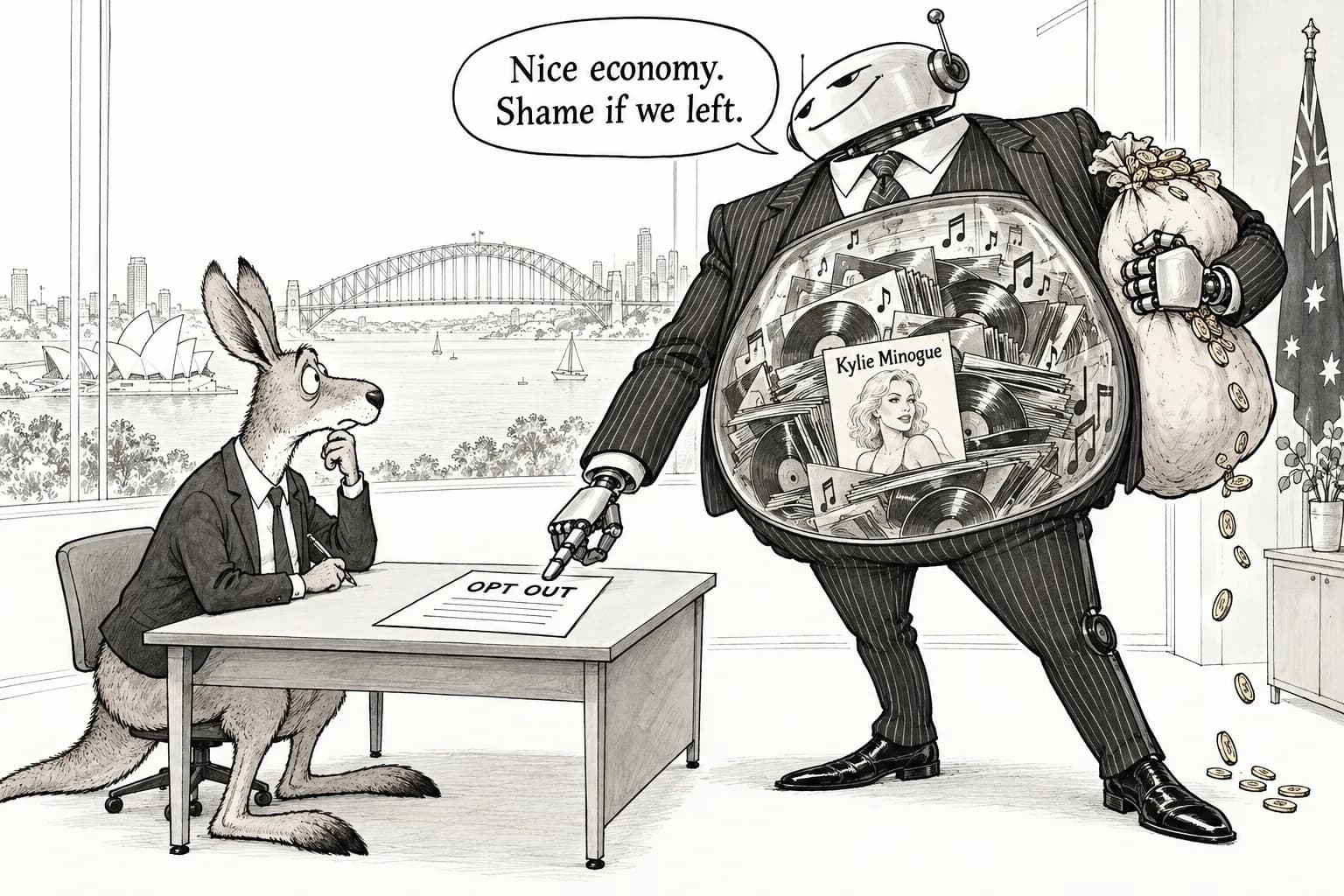
Editorial cartoon
Sources
- https://www.musicbusinessworldwide.com/icmp-says-ai-firms-are-trying-to-strong-arm-australia-on-copyright-and-that-kylie-minogues-songs-have-already-been-used-to-train-ai-report/
- https://www.digitalmusicnews.com/2026/10/19/icmp-kylie-minogue-songs-train-ai/
- https://mubert.com/blog/australia-ai-copyright-kylie-minogue-icmp
- https://thenextweb.com/news/abc-tells-australian-ai-inquiry-its-content-has-likely-been-scraped
- https://www.mlex.com/mlex/intellectual-property/articles/2535484
- https://letsdatascience.com/news/australia-weighs-opt-out-ai-training-copyright-rules-16aff807