Money · Oct 16, 2026
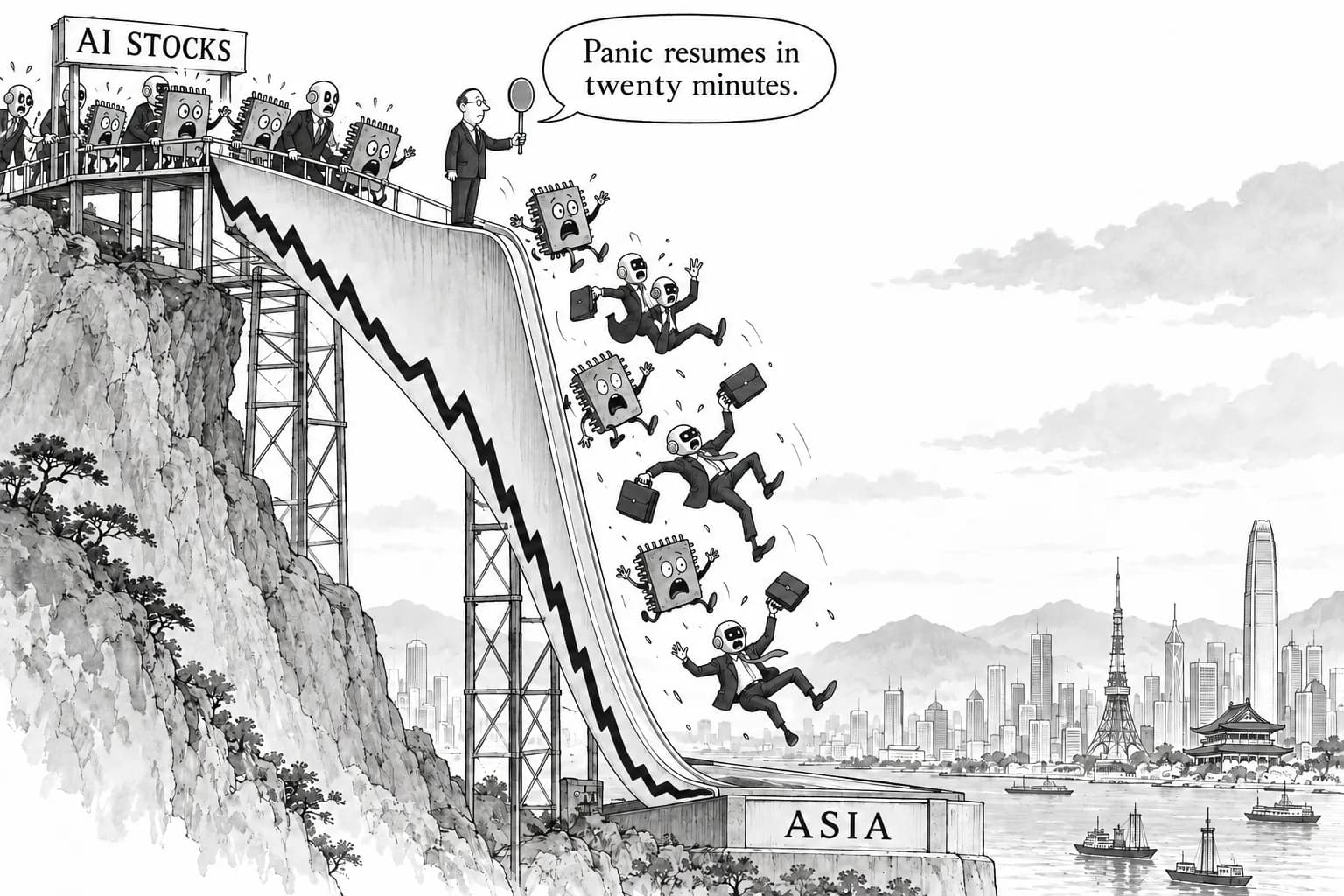
AI stock sell-off spreads to Asia: KOSPI falls 7.57% with a 20-minute trading halt, SK hynix drops 11%, Nikkei down about 4.8%
A six-day slide in memory stocks reportedly turned into a one-day rout on October 15, the same day TSMC reported earnings
Koji Yamamoto · Economics Analyst
Key points
- South Korea's KOSPI closed down 7.57%, and a circuit breaker halted trading for 20 minutes, the Korea Herald reported. SK hynix reportedly fell about 11%
- The Nikkei 225 closed down about 4.77%, according to Investing.com and the Japan Times. The selling reportedly moved from U.S. AI stocks to Tokyo, Seoul and Taipei
- Memory stocks had fallen for six days in a row, and this drop turned that slow decline into a one-day plunge. The next catalysts are TSMC's earnings and the Samsung and SK hynix results due in late October
The sell-off in AI-related stocks spread to Asian markets on October 15. South Korea's KOSPI closed 7.57% lower than the previous day, according to the Korea Herald, and a circuit breaker halted trading for 20 minutes during the session. SK hynix, a key supplier of memory for AI, reportedly fell about 11%. In Tokyo, the Nikkei 225 closed down about 4.77%, according to Investing.com and the Japan Times. Taiwan News reported that the selling also reached Taiwan's market. All figures below come from media reports. We have not yet checked them against final exchange data.
This article makes one argument. South Korean memory stocks had been falling a little each day for six days. On October 15 that slide became a sudden collapse, and the sell-off in AI stocks clearly spread beyond the United States.
Seoul: a 20-minute halt and SK hynix's 11% drop
Under Korea Exchange rules, a circuit breaker halts trading for 20 minutes if the KOSPI stays 8% or more below the previous close. If the breaker was triggered as reported, the index must have fallen more than 8% during the session and then recovered slightly toward the close to finish at −7.57%. The KOSPI circuit breaker is used only when the whole market falls sharply at once.
SK hynix reportedly led the decline. The company is a leading maker of HBM, the memory used in AI accelerators. When investors in the U.S. question whether AI infrastructure spending can last, SK hynix is one of the first stocks they sell. Two memory makers account for a large share of the KOSPI's market capitalization, so a drop of about 11% likely pulled the index down directly.
Why a six-day slide broke in a single day
We have been tracking the six-day decline in South Korean memory stocks. None of the factors during that period was decisive on its own. They included specifications reportedly released by China's CXMT, questions about SK hynix's 4F² architecture, and ASML's view that "supply will fall short of demand in 2027–28." ASML's view assumed that demand would keep going.
In the U.S., questions about how AI infrastructure is financed kept piling up. Yields on CoreWeave's bonds went above 15%. Investors watched how well Oracle's large construction debt sold. Gartner expects huge impairments, and a rate hike at the October FOMC is still possible. When it costs more to build AI data centers with borrowed money, the demand outlook for HBM and server components suffers right away. Media reports describe the October 15 Asian sell-off as a continuation of the drop in U.S. AI stocks. However, individual reports do not say clearly which single factor set it off.
The six days can also be seen as a period when sellers were slowly cutting their positions. On the seventh day, the decline suddenly widened until the index hit the market's built-in brake. Treating this as a one-day panic misses the trend of the six days before it.
Tokyo: Nikkei down about 4.8%
The Nikkei 225 closed 4.77% lower, according to Investing.com. The Japan Times also reported the day's steep fall. The Tokyo market has a heavy weighting in semiconductor manufacturing and testing equipment makers, and in holding companies with large AI investments, so U.S. AI stocks strongly influence it. The drop was smaller than South Korea's, but large for a single day on the Nikkei.
Taipei, and TSMC on the same day
Taiwan News also reported that the selling spread to Taiwan's market. The same day, TSMC reported earnings for the July–September quarter. We were watching for three things: how TSMC would respond to ASML's view that "supply will fall short of demand," its 2026 capital spending (in a range of $60 billion to $64 billion), and its outlook for 2027. The market sold before the results came out. Even if TSMC's numbers are strong, it is now a separate question whether the market will see them as a sign that AI investment will continue.
Numbers to watch next
First, whether South Korean memory stocks stop falling on the seventh day or fall further. Second, whether the HBM order and pricing outlook changes in the July–September quarter results from Samsung and SK hynix in late October. In the U.S., watch lending and bond yields for AI data centers, and the FOMC meeting on October 27–28.
Even as markets doubt AI infrastructure, frontier labs keep releasing models. In the previous week alone, Google made Gemini 4 Argon generally available and Meta released Muse Wonder. Still, the question of who will pay for compute, and at what price, showed up clearly in market prices on October 15. Memory likely broke first because it is the sector that has to answer that question first.
Editorial cartoon