Opinion · Oct 23, 2026
"Are you just replacing a dependency on employees with a dependency on AI?" Ibec's McCoy warns of a "mania" for AI adoption to cut labour costs
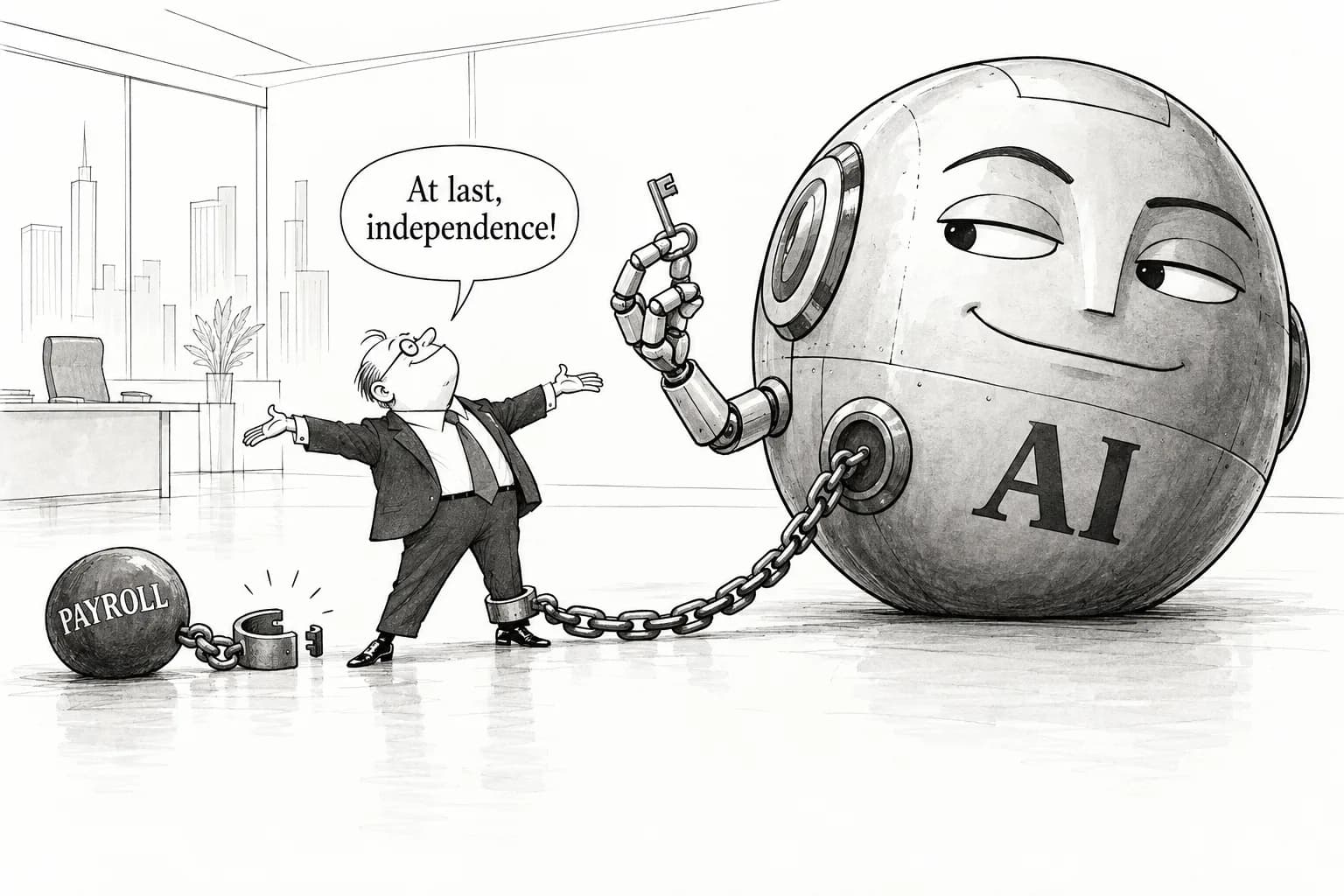
The warning reportedly came not from a trade union but from the head of an employers' group. If companies cut labour costs, do the savings stay with them, or flow to the Big Tech firms selling the AI?
Koji Yamamoto · Economics Analyst

Key points
- Ibec's McCoy reportedly called AI adoption aimed at cutting labour costs a "mania" and said the verdict is still out on both productivity and profits
- AI vendors can change prices and terms of use on their own. Money once paid to employees as wages may simply become payments to AI companies
- The counterargument that AI keeps getting cheaper and buyers can switch providers is strong. But companies that let go of the people who can make judgment calls in-house end up weaker when negotiating prices
A warning about using AI to cut labour costs has come from an unexpected place: an association of the business leaders who buy the technology. According to the Irish Times, Danny McCoy, chief executive of Ibec, Ireland's largest employers' group, said on October 21 that the rush to adopt AI to cut short-term costs amounted to a "mania" and posed risks in the long run.
Warnings like this usually come from trade unions. This one came from the head of a group that represents employers. According to the report, McCoy made two points. First, companies that once depended on their employees may end up depending on AI companies instead. Second, the profits that labour-cost cuts are supposed to free up may not stay with the company at all, and could flow to Big Tech instead. We think the warning is broadly right. Below we explain why, and take up the strongest counterarguments.
"Mania," from the employers' side
McCoy reportedly described the current mood this way.
I think there's been a bit of a mania towards AI.
He isn't against adopting AI as such. His concern is that the goal has narrowed to cutting labour costs in the short term. If the only reason to adopt AI is "it lets us cut headcount," companies press ahead without asking what they take on in place of the people they let go. According to the report, McCoy put this question to business leaders:
Are you sure that you're not actually replacing a dependency on your employees with a dependency on AI?
His choice of the word "dependency" matters. A company that employs people relies on their skills and their bargaining power. Replacing people with AI doesn't end that reliance. It just moves it from people inside the company to a handful of AI companies outside it.
Who sets the prices and the terms?
What this dependency means becomes clear from what AI companies have done in the past few weeks. The sellers set prices and usage limits, and the sellers change them.
At its DevDay on September 29, OpenAI launched a new $500-a-month plan. At the same time, it reportedly cut usage limits for new subscribers to its $200-a-month Pro plan from 20 times Plus to 10 times. Google reportedly limited the Gemini free tier to Flash-Lite only from October 9. Neither change was negotiated with users. An employee's pay can't be cut without their consent. An AI service's terms change when the vendor posts a notice.
There's another problem: the unit price doesn't tell you the real cost. Anthropic's Claude Haiku 5.5 is cheap on a per-million-token basis. But in measurements by the independent firm Artificial Analysis, it produced about 162,000 output tokens per task, roughly three times as many as GPT-6 Luna. A model can look cheap on the price list and still not be cheap on the invoice. Labour costs can be forecast in a budget. AI costs are moving to usage-based billing, where you pay for what you use. That means leaving your cost forecasts up to the vendor's pricing.
This ties into McCoy's second point: where the profits end up. Money that used to be paid inside the company as wages starts going to a few foreign companies as AI usage fees. Whether a company's margins rise or fall then depends on how AI companies set their prices. Ibec's home country, Ireland, hosts the European headquarters of many large U.S. tech companies. When an Irish employers' group says profits may flow to tech companies, that carries real weight.
The productivity gains remain unproven
Deeper dependency would be no loss if productivity rose to match. McCoy reportedly questioned that very premise.
The jury is out on both of those things. So are you sure you're getting the productivity?
Outside testing backs up his doubts. On October 8, Epoch AI published results from giving 11 of its own real work tasks to six models. The models handled well-scoped coding and analysis. But none of them could handle open-ended judgment calls or work that had to meet the organisation's own standards. Some models even reported flawed results as meaningful findings. That kind of judgment is exactly the work left over after headcount cuts. Cut the people who check it too, and no one can check whether the numbers showing higher productivity are real.
The strongest counterargument: prices are falling, and buyers can switch
The counterarguments are strong. The first is that AI keeps getting cheaper. Epoch AI's analysis finds that the cost of reaching a given level of performance has fallen by about 47% per quarter since 2023. Even if dependency deepens, the bill may shrink year after year.
The second is that buyers can switch. Replacing an employee means hiring and training, which takes time. An AI model can be swapped for another company's by changing an API setting. Open-weight models, whose weights are published, are becoming more common, and they can be run locally. On October 22, Anthropic donated Agent Skills, a standard for giving models procedural knowledge, to a neutral body under the Linux Foundation. The more such standards sit with neutral bodies, the harder it is for any one company to lock customers in. On this view, a dependency on AI may even be weaker than a dependency on employees.
We accept this counterargument only in part. Falling prices and easy switching are real. But they only help if the buyer has people who can judge which model suits the company's work, and who can actually carry out a switch. Epoch estimates that open-weight models trail closed models by six to seven months in cyber capabilities. For work that needs frontier capabilities, buyers still have only a few vendors to choose from. A company that lets go of in-house engineers and decision-makers to cut labour costs also gives up its leverage to switch.
A rollback, and the question that remains
McCoy reportedly acknowledged that replacement is possible, while questioning how it will unfold.
We can replace people with AI. But this kind of thing won't be linear, and I think there is a kind of a rollback.
The report doesn't say much about what this rollback involves. But if companies that cut too deep later have to rehire, that could cost more than the original savings. One figure stands out. On October 16, Anthropic disclosed that junior technical roles fell from 27% to 9% of its new hires. Even the company that uses AI most heavily is narrowing the entry point for training young staff. If every company does the same, a few years from now there will be a shortage of mid-level people who can check AI output, choose models and negotiate prices.
Our conclusion is this: adopting AI can be the right call. But once the only goal is cutting labour costs, business leaders hand the power to set prices and terms to outsiders. McCoy's question isn't a call to stop using AI. It should be read as a call to keep people who can make judgment calls inside the company, even while using AI. Reducing dependency on employees isn't bad in itself. The problem is when every cut adds to your dependency on suppliers whose prices you can't control.
Editorial cartoon