Opinion · Oct 28, 2026
AI has made us work more, not smarter — the real question is who gets the productivity gains
Brian Peters reread US productivity data and argued that the gains have gone to corporate profits, not wages. A Hubstaff survey released the same week found that 46% of AI users said they were expected to do more work
Koji Yamamoto · Economics Analyst
Key points
- Brian Peters argued that US productivity growth comes from people working more, not from efficiency gains driven by AI. He said the metric to watch is utilization-adjusted total factor productivity (TFP)
- The gains have gone to corporate profit margins rather than wages. Peters noted that because they land on the more lightly taxed side, they also do little for public finances
- In a Hubstaff survey, 46% of AI users said they were expected to do more work. CEO Jared Brown said organizations are not capturing the time AI gives back as capacity
Has AI raised productivity? For the past year, two answers have clashed: "yes" and "it hasn't shown up in the statistics yet." Brian Peters, who writes the risk analysis Substack Perspective on Risk, argued in his October 26 edition that the debate itself is framed wrongly. US labor productivity is rising. But the gains come from "working harder," not from "working smarter" with AI, and the extra output has gone to corporate profits rather than wages. The question, he argues, is not whether productivity grew but what grew and who got the gains.
We largely agree with this view. A Hubstaff survey released the next day backs it up from the workplace side. Below, we look at Peters' argument, the survey that supports it, and the strongest objections, in that order.
Harder, not smarter
Peters starts from the point that a rise in productivity figures should not be read as the effect of AI. Output per hour goes up when the same people work longer and more intensely. It also goes up when utilization rises over the business cycle. The headline labor productivity figure cannot tell real technology-driven efficiency apart from simply working people harder.
Peters summed it up this way:
Right now we are working harder, not smarter.
In other words, the growth we see now reflects more work done more intensely. The economy has not yet reached the stage where new technology produces more from the same effort. The distinction looks small but matters a great deal. Gains from working harder have limits, and they fade when people tire. Gains from working smarter build on each other. The optimistic case for AI has assumed the second kind.
Who got the gains?
Peters' second point is about distribution. Even if output has increased, the benefits have not gone back to workers as higher wages. In his view, they have shown up as higher corporate profit margins. He then pointed out what this means for public finances.
Growth that arrives as higher margins rather than higher wages lands on the more lightly taxed part of the income statement.
Taxes on pay are heavier than taxes on corporate profits. When a dollar of growth arrives as wages, the government collects income tax and payroll taxes on it. When it arrives as profit, it collects much less. Policy debates often hear the hope that AI will lift growth and close fiscal gaps. But if the growth goes to profits, that hope will pay off less than the numbers suggest. Looking only at total growth hides this gap.
That is why Peters named the metric to watch:
The metric to watch is utilization-adjusted TFP, and the question to ask when it turns is not just how much, but whose.
Utilization-adjusted TFP tries to strip out swings in how hard equipment and people are used over the business cycle, leaving the real change in technological and organizational efficiency. Gains from "working harder" mostly don't show up in it. Only when it turns up can we say we have started "working smarter." And even then, we still have to ask separately whether the gains go to wages or profits. The core of Peters' proposal is to separate the question of how much from the question of who gets it.
The workplace view: 46% say their workload increased
A Hubstaff survey released the next day, October 27, adds workplace numbers to the argument. According to Hubstaff, which sells time-tracking and work-management software, 46% of workers who use AI said they were expected to do more work. The survey's title says AI is saving employees time, but employers aren't getting the capacity they expect.
CEO Jared Brown said:
AI is giving time back to individual employees, but most organizations aren't capturing it as capacity.
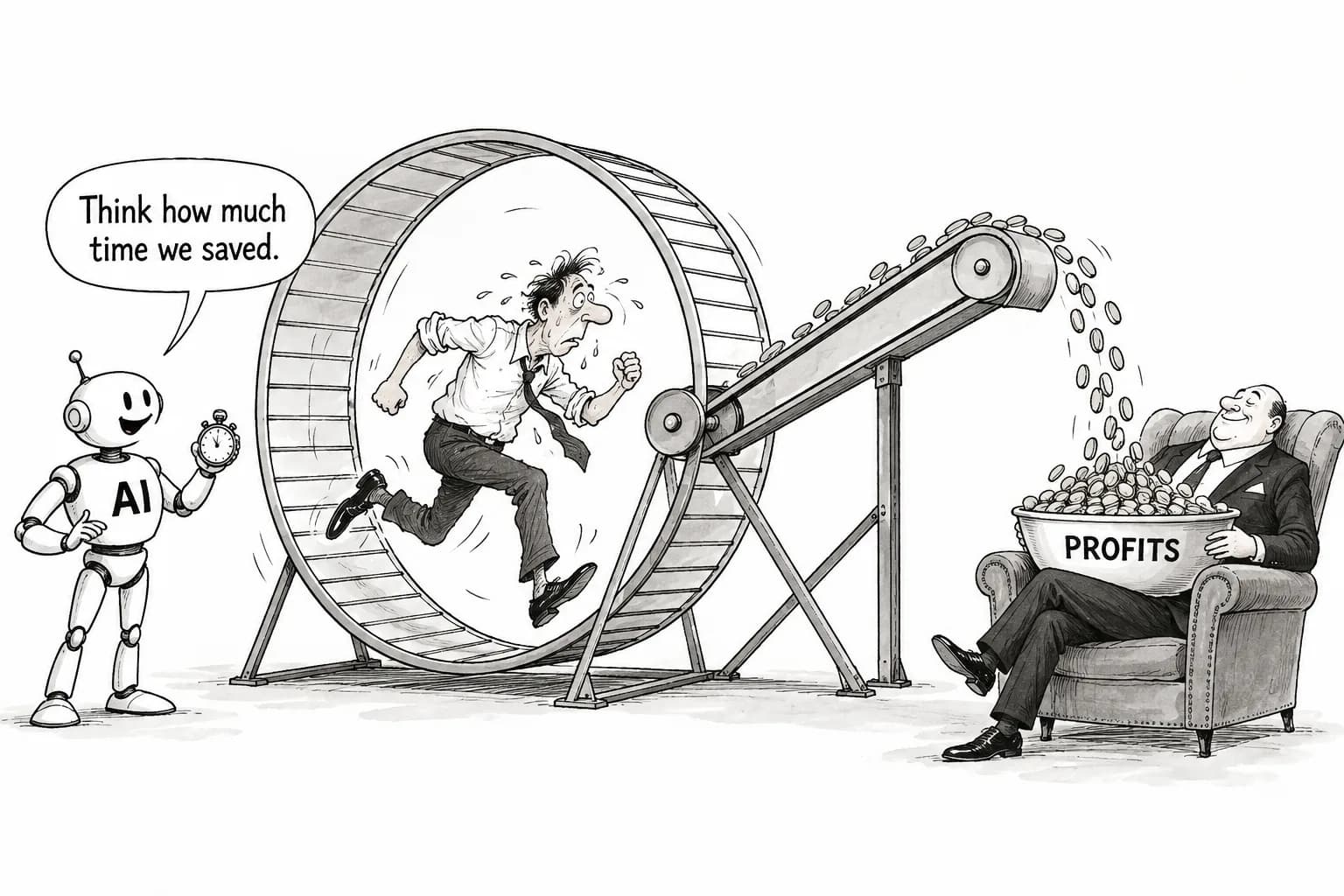
At first glance the two findings conflict. Workers say they have more work, while employers say capacity hasn't grown as much as expected. Placed in Peters' framework, though, they fit together. The time AI frees up is not being used to change how organizations work and create new value. Instead, it is filled with extra work. To workers, the job has gotten harder. To employers, efficiency hasn't improved as much as hoped. Both point to the same thing: we have not yet reached the "smarter" way of working that would lift TFP.
Note that the survey was released by Hubstaff itself, and we have not verified how the sample was built or how large it was. The company sells products that measure employees' working time, and its conclusion about "turning time into capacity" also suits its business. The 46% figure is best read as a sign of direction.
Where the gap between expectations and data lies
The gap becomes clearer next to the high expectations of the companies building AI. In an October 16 study, "The AI expectations gap," Anthropic compared forecasts for GDP growth through 2030. The forecast drawn from its own employees was 17.1%, against 5.4% from the general US public. A post published the same day, "How employment is changing at Anthropic," said commits per engineer had risen about fivefold in six months. Inside the frontier labs, AI is indeed multiplying output.
Yet what shows up in economy-wide statistics is mostly the result of working people harder. The gap between expectations and the data does not come from AI failing to work. It comes from AI working in a different way, and its gains landing in a different place, than expected. The value of Peters' argument is that it gives this difference a name.
The strongest objections: it's too early, and the statistics miss things
The objections are strong. The first is timing. With electricity and with computers, it took years of reorganizing companies and workflows before a new general-purpose technology showed up in TFP. At first, people add new tools on top of old methods, so they actually get busier. Today's "working harder" may just be a stage along the way. Hubstaff's Brown can also be read this way: the time is coming back, but organizations aren't capturing it yet. The implication is that TFP will rise once they learn how.
We don't reject this objection. But it doesn't undo Peters' conclusion. Peters isn't saying "AI doesn't work." He is saying "don't count today's gains as AI-driven efficiency." If a turning point comes, it should show up in utilization-adjusted TFP, so watch that. That proposal fits perfectly well with the timing argument.
The second objection is that the statistics miss the benefits. Much of AI is given away free or cheaply, and the benefits users get show up in neither GDP nor wages. As consumer surplus, they may be large. Peters answered this one briefly too.
Consumer surplus does not service debt.
He doesn't deny that users are benefiting. But what balances government and household budgets is taxable income and money paid out as wages. However large the invisible benefits are, they don't raise paychecks or fill gaps in tax revenue. The consumer surplus argument doesn't settle the question of distribution.
What to watch next
To sum up our position: as long as the fight over AI productivity is framed as "has it grown or not," it will never be settled, because both camps can pull the same numbers to their side. The question should be split in two. First, did the gains come from more work or from more efficiency? Utilization-adjusted TFP answers that. Second, did the gains go to wages or to profits? The labor share and profit margins answer that.
This week, a workplace survey said "work has increased," and a reading of the statistics said "the gains went to profits." Taken together, AI's economic effect today looks less like an efficiency revolution and more like people being worked harder. Is that a passing stage, or will it stick? With AI companies going public and hyperscalers piling on capital spending, now is the time to track in numbers not just the size of growth but who gets it.
Sources: Perspective on Risk (Brian Peters), Hubstaff press release
Editorial cartoon