Infrastructure & Security · Nov 10, 2026
AI power demand lifts top US nuclear operator's earnings about 30% above forecasts
Constellation, the largest nuclear power company in the US, posted adjusted earnings of $5.06 a share for July–September, well above the roughly $3.87 expected, and raised the midpoint of its full-year outlook for the second time this year
Seiichi Tanaka · Editor-in-Chief
Key points
- Adjusted EPS was $5.06, about 31% above the forecast of roughly $3.87
- The company raised the midpoint of its full-year earnings outlook for the second time this year
- AI companies say electricity is their biggest challenge, and that demand is now showing up in a nuclear operator's profits
[Update, November 10, 2026, 4:39] We had described the data center contracts as "unverified." We have corrected this: the release lists 20-year agreements with Google and Amazon.
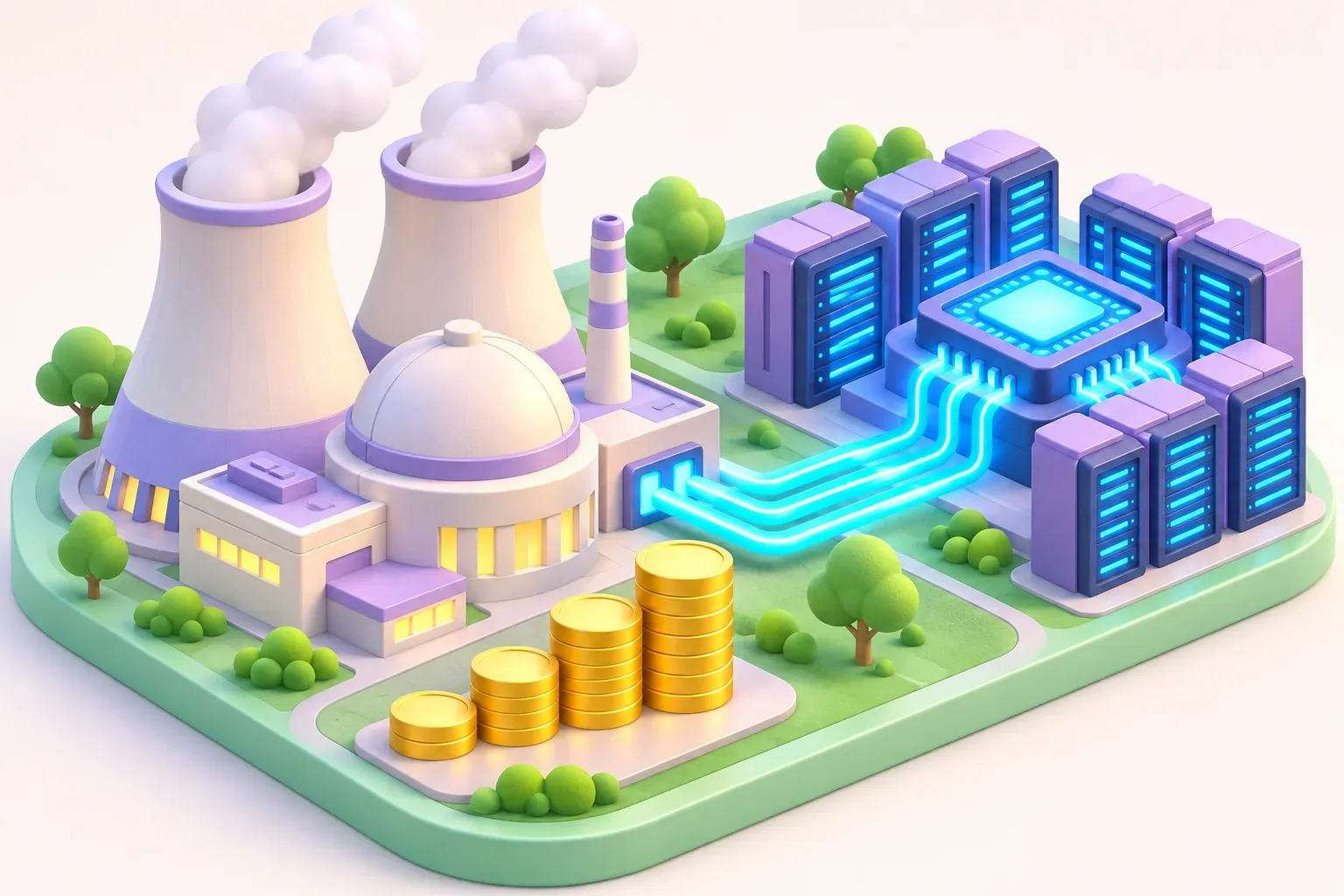
Demand for electricity to run AI is now clearly showing up in a power producer's results. Constellation Energy, which owns more nuclear plants than any other US company, reported its results for July–September 2026 on November 9. "Adjusted" earnings per share, which leave out items the company treats as one-time, came to $5.06 (about ¥800), roughly 30% above the market forecast of about $3.87. The company also raised the midpoint of its full-year earnings outlook. This was the second increase this year. AI data centers draw power day and night without stopping, and that demand is raising the value of nuclear plants, which can supply electricity steadily.
For Japanese companies: Manufacturers with plants or offices in the US should have their general affairs and accounting staff check two things with their utilities before the end of the year: the terms of next fiscal year's US power contracts (fixed-rate or market-linked) and the likely price increases. Companies that operate only in Japan are not directly affected.
Earnings about 30% above forecasts
The most striking part of the results is how far they beat expectations. Adjusted EPS of $5.06 was $1.19 above the analysts' average forecast of about $3.87, a beat of about 31%. Earnings at power companies usually move little, and results tend to land within a few percent of forecasts. A 30% beat means that power prices, sales volumes, or both were stronger than the market expected.
Adjusted earnings here leave out gains and losses the company considers one-time. They are not the same as net income under accounting standards.
What two outlook raises in one year mean
Constellation raised its full-year outlook for adjusted EPS, lifting the midpoint. It had already raised the outlook once this year, so this is the second time.
One strong quarter on its own could be put down to weather or a temporary rise in power prices. When a company raises its own outlook twice in the middle of the year, it means management expects strong demand to last for the rest of the period. The way to read these results is that power demand from AI data centers is not a passing tailwind. It is raising the company's underlying earning power.
Why AI money is flowing to a nuclear operator
AI data centers run tens of thousands of chips around the clock. They need large amounts of power that does not depend on the weather and keeps flowing at night. Solar and wind output changes with the time of day and the weather, so those sources are not enough alone. Nuclear plants produce a nearly constant flow of power all day without emitting carbon dioxide. That makes them a good fit for big tech companies that have set targets to cut greenhouse gas emissions.
Constellation has signed long-term contracts with big tech companies before. In 2024 it announced a 20-year deal with Microsoft to restart Unit 1 of the idled Three Mile Island plant, now called the Crane Clean Energy Center, and sell it the power. In 2025 it also signed a long-term deal with Meta to sell power from the Clinton nuclear plant in Illinois.
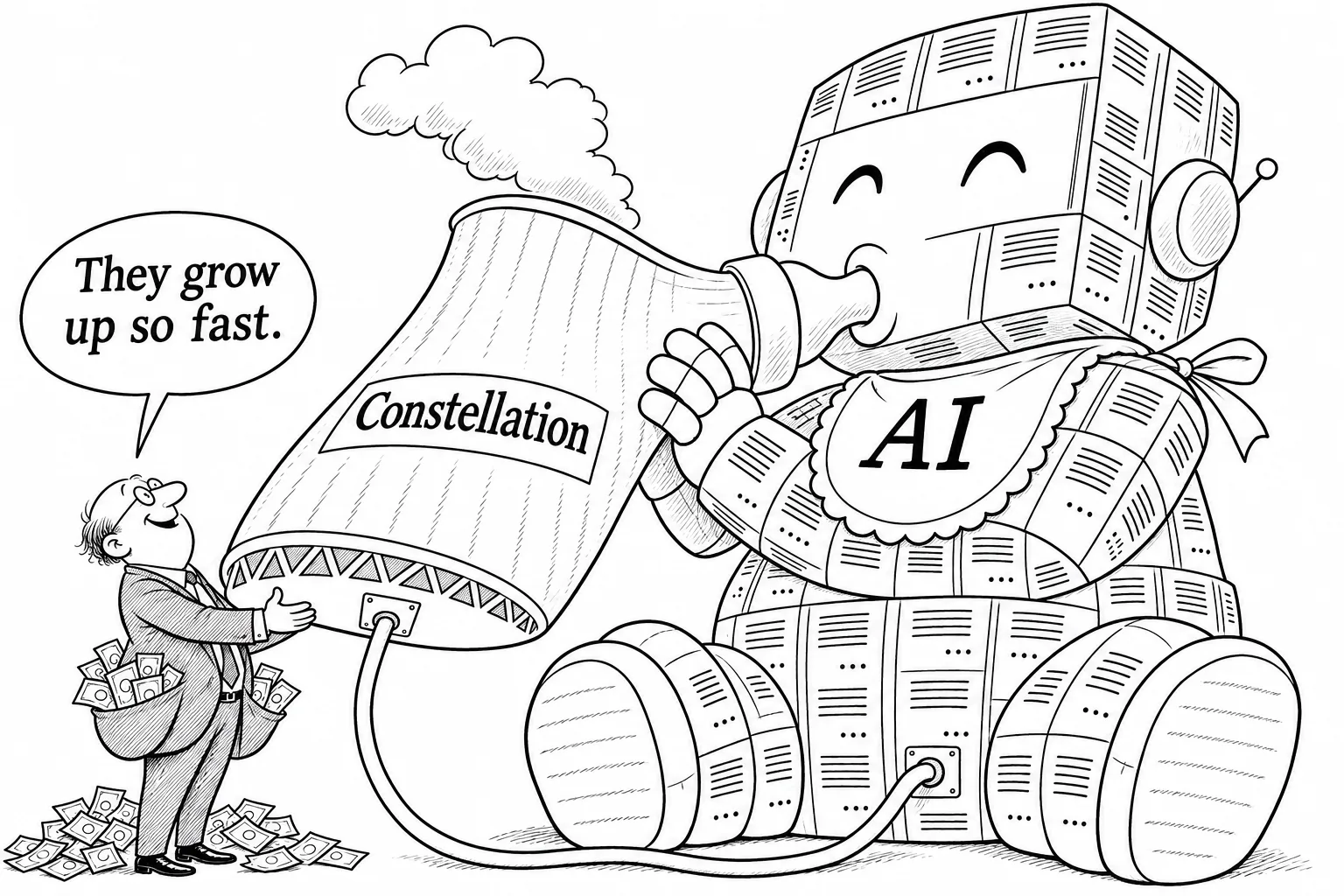
The companies building AI make no secret that they are short of power. Asked at an energy conference in Abu Dhabi on November 2 what his biggest challenge was, OpenAI CEO Sam Altman answered "energy." On November 3, the AI unit of one of Musk's companies was reported to have spent $16.4 billion on AI infrastructure in July–September, against revenue of $7.56 billion. Part of the huge sums AI companies spend on infrastructure ends up at power producers as electricity bills. That flow of money is what showed up in Constellation's earnings this quarter.
Caveats
The results were strong, but some of the strength should be discounted.
First, worries about AI capital spending itself have not gone away. In November, AI-related stocks have been sold off and yields have risen on bonds issued by companies that lease out data centers, a sign that investors doubt AI investment can keep going. If AI companies cut back on capital spending, growth in power demand will slow too.
Second, data centers face local opposition. In Texas, Georgia and Ohio in the US, and in Europe, opposition to new projects is growing over rising power bills and water use. The criticism that data centers buying up power will raise bills for ordinary households and businesses could lead to tighter regulation.
This article is limited to the company's release, market forecasts and the number of outlook raises. It does not cover net income under accounting standards, revenue or the specific outlook range. The release also lists 20-year power agreements with Google and Amazon, but we have not confirmed whether they were first disclosed this quarter.
What to watch next
Whether power demand holds up depends on whether AI companies keep spending on infrastructure. NVIDIA, the largest maker of AI chips, reports earnings on November 17. If its data center revenue keeps growing, the outlook for power demand further out will strengthen as well. If talk of cutting AI investment emerges instead, beats like this one at power companies will not last long. For Japanese companies, the results also offer a clue to how far US electricity prices may rise.
Sources: Constellation's earnings release, Filing with the US Securities and Exchange Commission (SEC), Earnings call transcript (The Motley Fool)
Editorial cartoon
Sources
- https://www.constellationenergy.com/news/2026/11/constellation-reports-third-quarter-2026-results.html
- https://www.sec.gov/Archives/edgar/data/0001868275/000186827526000116/ceg-20261109991.htm
- https://www.fool.com/earnings/call-transcripts/2026/11/09/constellation-energy-ceg-q3-2026-earnings-call-transcript/