Opinion · Nov 23, 2026
AI proof of the Riemann hypothesis largely clears verification; the debate turns to the value of a proof no one understands
Checks by the Lean community and at MIT show the proof passing most of the independent tools run on it. Whether it is correct is close to settled. The open question is how mathematics should treat a huge proof whose contents no one yet understands
Koji Yamamoto · Economics Analyst
Key points
- Lean FRO and the Mathlib Initiative said in a statement that both the statement and the proof are correct. In the MIT verification, 175,187 modules passed, and the proof relies on only the three standard axioms
- Two verification tools have yet to report results, and no human has yet understood the proof's contents. Buzzard expects understanding to take one to two weeks
- Machines guarantee correctness, and understanding comes later. Mathematics is set to split into the work of checking and the work of explaining
A proof of the Riemann hypothesis that Anthropic mathematician Levent Alpöge says was produced together with Anthropic's AI, Claude, has passed most of the independent verification tools run on it. Results from the organization behind Lean, software that machine-checks proofs line by line, and from MIT mathematician Andrew Sutherland both point to the proof being "formally correct." As a result, the weekend's debate moved from "Is it correct?" to "What does it mean for mathematics to have a proof, said to run to about 17 million lines of Lean, that no one yet understands?" This newspaper believes that shift is the real significance of the episode.
For Japanese companies: Most companies are not directly affected. A proof of the Riemann hypothesis does not break RSA or other encryption, and IT staff can safely give that answer to questions from business partners or colleagues. The companies it does concern are those using code or documents written by AI. Development and quality leads should check before the end of this month whether anything has reached production solely because it "passed the tests and automated checks," while no one can explain what is inside it.
Which checks has the AI proof of the Riemann hypothesis passed?
In a joint statement on November 21, Lean FRO, which supports Lean's development, and the Mathlib Initiative, which runs the shared mathematics library, said that Alpöge and Claude's proof is correct in "both its statement and its proof." According to the statement, two separate tools confirmed that the theorem proved is the same as the "RiemannHypothesis" already defined in Mathlib. As for the proof itself, dozens of people reproduced the same output, and it passed both Lean's core checker (the kernel) and independent checkers built differently. The statement said verification was run on output prepared so that any malicious code slipped into it would not execute.
On a verification page published by MIT's Andrew Sutherland (updated at 16:20 UTC on November 22), 175,187 modules compiled without errors on Lean and Mathlib v4.33.1. The five main theorems rely only on Lean's three standard axioms, which means no special assumptions were quietly added. The proof also passed the independent checkers nanoda (in about 27 minutes 42 seconds), con-leche (1,468,418 declarations) and lean4lean.
According to Sutherland's verification page, the proof covers not only the Riemann hypothesis but also the generalized Riemann hypothesis (GRH) for Dirichlet L-functions. GRH for Dedekind and Hecke L-functions and for general automorphic L-functions is outside its scope. The Lean FRO statement does not mention GRH.
Verification of the AI proof that is still unfinished
As of Sutherland's November 22 update, the final stage of lake comparator was still running. That stage is the Lean kernel's check of the output; the statement comparison and axiom checks are complete. Verification with Lean's default kernel and with the more skeptical "paranoid" mode kernel was also still running. That is why the headline says "largely" cleared: not every tool has returned a result.
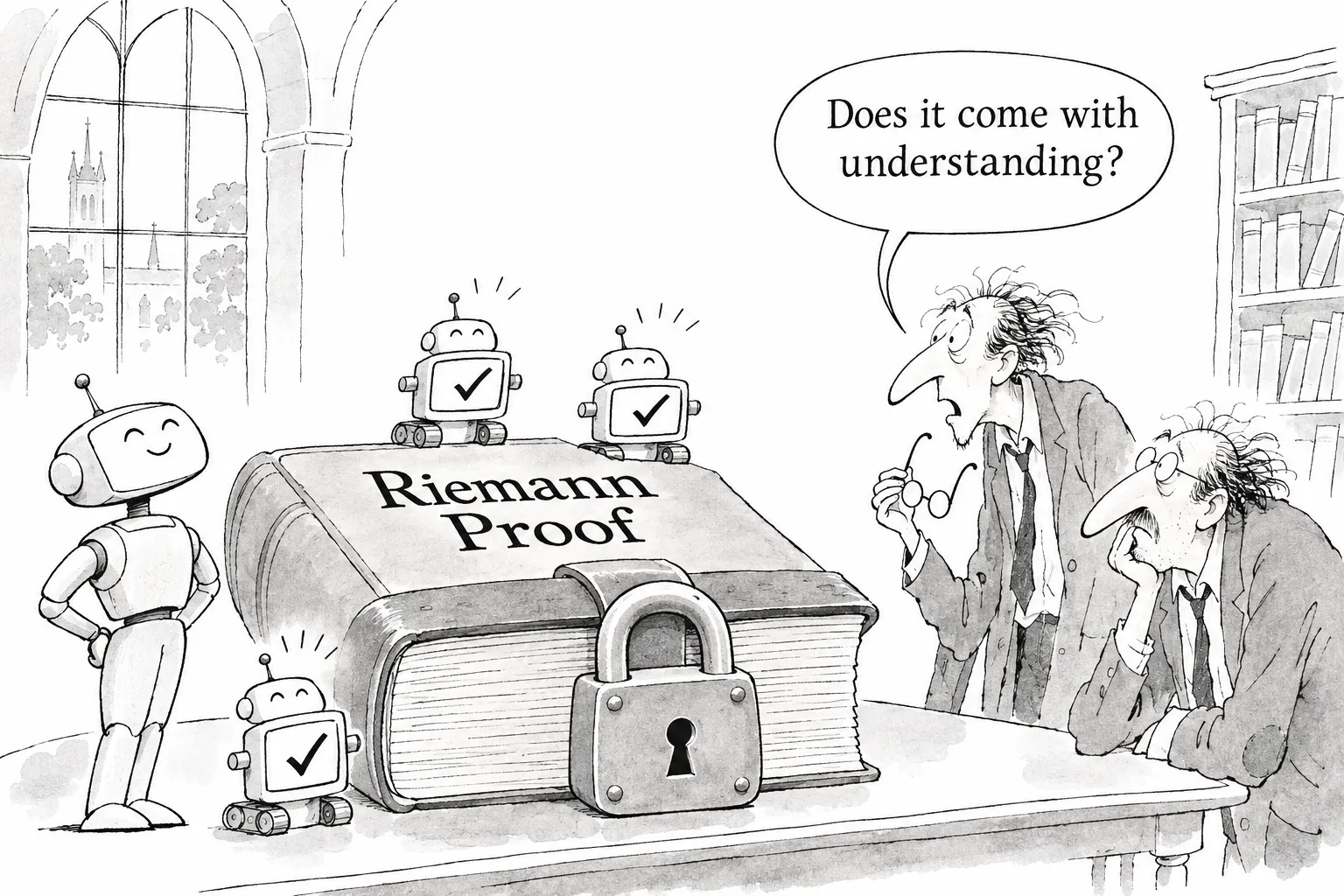
The Lean FRO and Mathlib Initiative statement also says explicitly that it vouches only for formal correctness, and that understanding the mathematics is still to come. A machine check can say "this proof has no gaps," but it cannot say why the result holds.
As for which Claude model Alpöge used, mathematician Terence Tao's blog describes it only as an "internal AI model," and the version name has not been made public. Anthropic has not made an official announcement as a company.
Once correctness is settled, the Riemann hypothesis question shifts to "understanding"
Kevin Buzzard, a mathematician at Imperial College in the UK who has long championed formalization in Lean, told Al Jazeera that "we don't even know yet why the theorem is true," and estimated that understanding it would take one to two weeks, according to Al Jazeera's report. Number theorist Abhishek Saha reportedly said that, if correct, it would "shatter my view of reality." Both remarks show bewilderment that understanding cannot keep pace, more than doubt about correctness.
A proof that machines have verified but humans cannot follow is not new to mathematics. The 1976 proof of the four color theorem had a computer check a vast number of cases, which set off debate at the time over whether it could be called a proof. The Kepler conjecture, too, left human referees unable to reach certainty, and was finally verified in 2014 with a formalization system other than Lean. In both cases, though, humans had set the strategy for what to check and how. The AI proof of the Riemann hypothesis differs in that humans cannot yet explain the strategy itself.
On the same day, AI flagged problems in a human proof of the Riemann hypothesis
On the same day the AI proof was clearing verification, the opposite happened. On November 20, Ravi Vakil of Stanford, president of the American Mathematical Society (AMS), released a draft proof of GRH of about 940 pages by postdoctoral researcher Alessandro Masullo. The draft was described as written by hand, and number theory expert Brian Conrad had spent several months reading it.
About eight hours after Masullo's draft was posted, Vakil added a note saying several people, each using different AI models, had found problems, and that Vakil was not claiming the proof's approach was correct. The note did not say what the problems were. In a November 22 blog post, mathematical physicist John Baez listed two reported issues. One was a point raised in an AI-assisted check: the theorem's prediction and a limit calculation disagree at the prime 2. The other was a 444-page step that extends a property holding for one kind of basis to another kind of basis. Baez said the problems might be fixable, or the criticisms themselves might be mistaken.
Putting the Masullo and Alpöge episodes side by side makes the picture clear. A proof that humans wrote while understanding it had holes found by AI. A proof that AI produced and humans do not yet understand passed machine checks. In the same week, "being understood" and "being correct" went in opposite directions.
Our view: a proof no one understands still has value, but the work is not done
The AI proof of the Riemann hypothesis has real value even before anyone understands it. Number theory and computer science contain many results proved on the condition that "if the Riemann hypothesis or GRH is true." For example, the guarantee that Miller's primality test runs quickly and reliably rested on GRH for Dirichlet L-functions. Because Sutherland's verification covers that GRH, once the formal proof is fully verified, the condition on such results falls away.
Even so, the AI proof does not mean the work of mathematics is finished. Mathematicians pursued the Riemann hypothesis not only for a "yes" but because they wanted to know why the primes are distributed the way they are. If the proof contains new ideas, they cannot be applied to other problems until humans extract them and put them into words. This proof is the first major example of mathematics splitting into "the work of having machines verify correctness" and "the work of humans explaining meaning." This newspaper believes the value of the latter will rise, not fall.
The workplace is moving in the same direction. Even if code written by an AI agent passes automated tests, trouble follows when it needs fixing or something breaks if no one in the company can explain why it works. Harness engineering, which gets code through the checks, and keeping code explainable by humans are separate jobs and should have separate budgets.
What we could not confirm
We have not confirmed in primary sources the figure of about 17 million lines for the proof's length (the archive previously reported is about 239MB, with 175,187 files). The name of the Claude model used is not known. Among essays and posts published over the weekend, Gary Marcus wrote that the AI did not solve the problem alone and needed Alpöge's guidance, and that it is unclear whether this will carry over to other fields. Erik Hoel wrote an essay about a day spent walking with Hoel's son, and Emily M. Bender posted that Anthropic and OpenAI chase famous math problems to make people believe they are building a "machine god."
Editorial cartoon
Sources
- https://math.mit.edu/~drew/grh/
- https://johncarlosbaez.wordpress.com/2026/11/22/masullo-on-the-riemann-hypothesis/
- https://garymarcus.substack.com/p/levent-alpoge-has-solved-the-riemann
- https://bsky.app/profile/emilymbender.bsky.social/post/3n2ucwmctac2c
- https://www.theintrinsicperspective.com/p/on-the-day-the-riemann-hypothesis