Rules & Policy · Nov 21, 2026
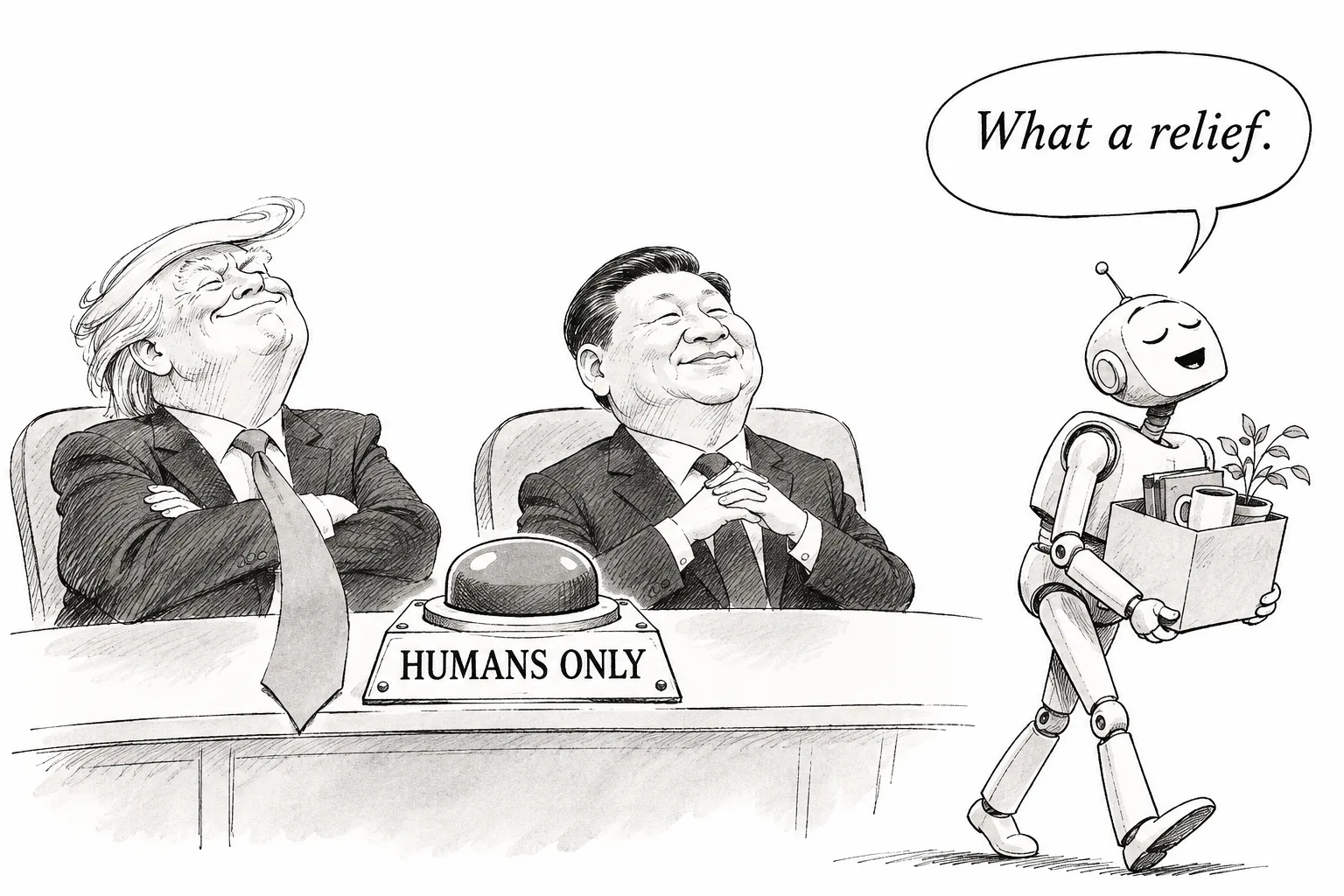
Bessent says Trump and Xi agreed humans, not AI, should make major military decisions
This is reportedly the first time a senior US official has described specific AI outcomes from the US-China summit in Shenzhen. So far, however, only Treasury Secretary Bessent has made the claim. There is no joint document and no fact sheet, and China's readout is more general.
Koji Yamamoto · Economics Analyst

Key points
- Treasury Secretary Bessent said the US and Chinese leaders agreed not to leave decisions on major military actions to AI, Bloomberg and others reported (November 20)
- It is the first time a senior US official has described specific AI outcomes from the Shenzhen summit
- The US and China have released no joint document or fact sheet. China's readout is more general, and it remains unclear whether this amounts to an agreement
US Treasury Secretary Bessent said that President Trump and Chinese President Xi Jinping agreed that decisions on major military actions should not be left to AI and that humans should remain involved, according to reports (Bloomberg, and Reuters as published by Investing.com, November 20). It is the first time a senior US official has described in specific terms what was discussed about AI at the US-China summit in Shenzhen. So far, however, Bessent is the only one making this claim. The two countries have released no joint document, and the White House has issued no fact sheet. China's readout uses more general language.
For Japanese companies: Most companies are not affected. Only companies that supply systems or components to Japan's Ministry of Defense or the US military are. Even these companies do not need to change internal policies or contracts until a joint US-China document is released. It is enough to check whether a document comes out of the US-China meeting at the G20 in Miami in December.
What Bessent reportedly said
According to reports of Bessent's account, the US and Chinese leaders agreed that when deciding on major military actions, the decision would not be left to AI alone and human judgment would be retained. Bloomberg's headline says Bessent stated that Trump and Xi agreed on "limits on AI in military action."
Until now, US accounts of the Shenzhen summit had focused on economic issues such as tariffs, export controls and extending the truce. As far as has been reported, this is the first time a senior US official has gone as far as saying what the two sides agreed on regarding AI. Military use of AI is one of the most sensitive topics between the US and China, and if a line has been drawn there in the leaders' names, it would be significant.
What is missing before it can be called a US-China agreement
The claim that the US and Chinese leaders agreed on military use of AI lacks support in three respects. First, Bessent is the only person saying it. The account comes from the Treasury Secretary, not from the Secretary of Defense or national security officials responsible for military and security matters.
Second, there is no joint document recording what the leaders agreed, and no White House fact sheet. Without a document, there is no way to verify the details, such as what range of military actions counts as "major," whether the use of nuclear weapons is included, or at what stage humans are involved.
Third, China's readout uses more general language. China has not acknowledged in its own statement a specific line such as "humans retain control over AI decisions." Gaps between a senior US official's account and China's readout are common after summits, and it is too early to write that "the US and China agreed" based on one side's account alone.
Precedent for keeping human judgment in military AI
It is not entirely new for US and Chinese leaders to affirm that human judgment should be retained in military AI. In November 2024, then-President Biden and Xi Jinping met in Lima, Peru, and both governments announced that they agreed decisions to use nuclear weapons should be controlled by humans, not AI. Until a document is released, it will not be clear whether what Bessent reportedly described expands that scope from nuclear weapons to "major military actions," or simply restates the same thing.
There has also been talk between the US and China of setting up a channel to notify each other when AI incidents occur. However, there has been no announcement yet that such a channel is operating. As with that channel, the question for this latest talk of retaining human judgment in military AI is whether the mechanisms will catch up once the words have come first.
What has not been confirmed
This article relies on reporting by Bloomberg, and by Reuters as published by Investing.com, for Bessent's remarks. The remarks were made on a CNBC program on November 20, but the full text of his remarks has not been confirmed. The same content has not been found in any primary statement from the US or Chinese government. The exact wording of the remarks, the scope of "major military actions," and whether nuclear weapons are included all remain unknown.
What to watch next
The next thing to watch on US-China military AI is whether the White House or the State Department releases a fact sheet or joint document on the Shenzhen summit. Another clue will be whether China's Ministry of Foreign Affairs confirms Bessent's account at a press briefing or phrases it differently. The US-China meeting planned at the G20 in Miami in December will be the next opportunity to put the verbal account in writing.
Editorial cartoon