Rules & Policy · Nov 20, 2026
US requires licenses for Chinese companies' cloud access to AI chips, effective immediately
A new Commerce Department rule was published in the Federal Register on November 19 and took effect the same day. Data centers that provide large amounts of compute to companies headquartered in China and other covered countries must obtain a license within 90 days. Exports of advanced chips to Indonesia, Malaysia, Singapore, Thailand and Brazil now also require a license
Koji Yamamoto · Economics Analyst

Key points
- A Commerce Department rule was published in the Federal Register on November 19 and took effect that day. Data centers providing large amounts of compute to companies headquartered in China and other covered countries must obtain a license within 90 days
- Exports of advanced AI chips to Indonesia, Malaysia, Singapore, Thailand and Brazil now also require a license
- The US closed two loopholes at once: renting chips through the cloud instead of buying them, and routing them through Southeast Asia. The grace period is expected to end in mid-February
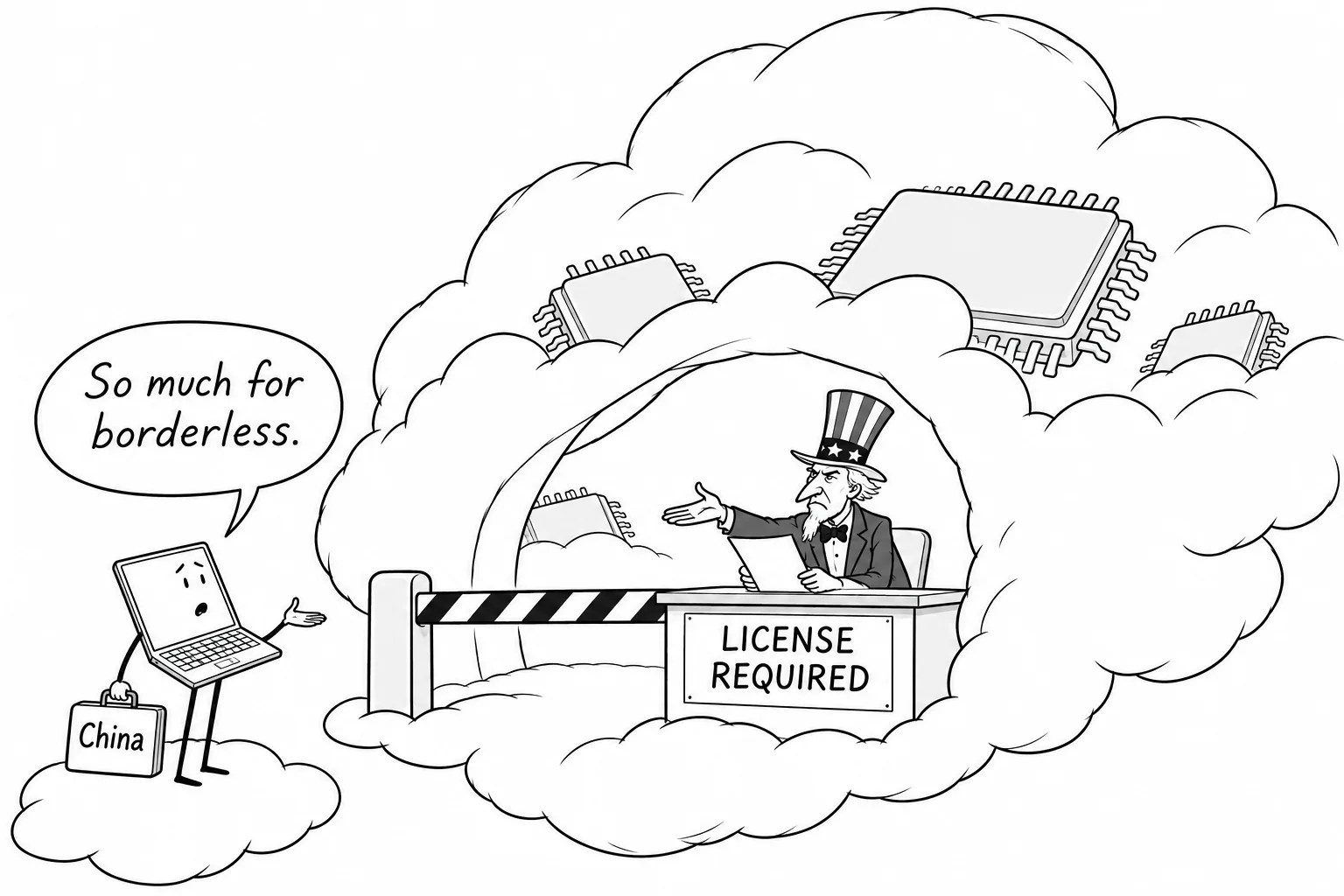
The US Commerce Department on November 19 published a new rule in the Federal Register, the federal government's official journal, that restricts companies headquartered in China and other covered countries from renting advanced AI chips in remote data centers. The rule took effect the day it was published. Data centers that provide large amounts of compute to companies headquartered in China and other covered countries must obtain a license from the US government within 90 days. The same rule also requires a license to ship advanced chips to five countries: Indonesia, Malaysia, Singapore, Thailand and Brazil. Until now, the US has focused on stopping chips from being shipped to China. The new rule closes two other routes together: renting chips in the cloud without taking possession of them, and routing them through third countries such as those in Southeast Asia.
What it means for Japanese companies: Most companies that simply use generative AI or cloud services are not affected. Two kinds of companies are. The first is trading houses, electronics makers and IT companies that sell GPU servers into Malaysia, Singapore, Thailand, Indonesia or Brazil, or send them to their own local operations there. Their overseas sales and export control staff should check with their supplier manufacturers this week whether shipments after November 19 require a US license. The second is operators that rent out GPU cloud or data center capacity and have customers headquartered in China or other covered countries, which may include those companies' Japanese subsidiaries. Their legal teams should identify where their customers are headquartered before the grace period ends, expected in mid-February.
What the Commerce Department's new rule changes: "renting" chips now requires a license too
What is new about the Commerce Department's rule is that it widens the focus of the controls from who owns the chips to who uses them. Previous export controls aimed to stop advanced AI chips from being physically shipped to China. But a company does not need to buy the chips: by signing a contract with an overseas data center, it can run the same computations over the internet. The industry calls this "remote access," and it has long been flagged as a gap in the controls.
Under the Commerce Department's rule, data centers that provide large amounts of compute to companies headquartered in China and other covered countries must obtain a license. The deadline is 90 days after the rule took effect, which, counting from November 19, falls in mid-February 2027. By then, cloud providers need to determine where their customers are headquartered and, if they want to keep providing large amounts of compute to customers that fall under the rule, apply for a license.
Exports to four Southeast Asian countries and Brazil now need a license: closing the third-country route
The rule's other pillar is a license requirement for shipping advanced chips to five countries: Indonesia, Malaysia, Singapore, Thailand and Brazil. Southeast Asia has seen a wave of large data center construction in recent years and has become a place to host compute just outside China. Under the previous controls, it was hard to stop an arrangement in which chips sat in a Southeast Asian data center and a Chinese company rented them as a cloud service.
The Commerce Department appears to have closed cloud use and third-country exports in the same rule because the two loopholes have been used in combination. Blocking only chip shipments to Southeast Asia would still leave the option of renting from data centers in countries outside the controls, such as the US or Japan. Blocking only cloud use would make it hard to track where and by whom chips are used once they flow to third countries. By tightening both at once, the routes for Chinese companies to obtain the computing power of advanced chips become much narrower.
Why the US moved quickly to close the loopholes: an analysis that Chinese models were trained on banned chips
The US moved quickly to close the cloud and third-country loopholes after a run of evidence in recent weeks suggesting the controls were not working. In a report dated November 12, former OpenAI researcher Will DePue (Unemployment Labs) examined traces left in published model weights and concluded that six Chinese models, from DeepSeek, Moonshot (Kimi), MiniMax, Ant and others, were trained on NVIDIA's Blackwell, which is banned from export to China. He estimates that about 12,000 chips in total were used across five training runs. The report is at the level of a preprint (a paper that has not been peer reviewed), and neither the Chinese companies nor NVIDIA have publicly responded.
The Unemployment Labs analysis has clear limits. The author himself writes that the report does not show where the chips were located or how they were obtained. It is not known whether the chips were brought into China or rented from overseas data centers. Still, if they were rented, it remains possible that this was not illegal under the previous controls. The new rule eliminates exactly that room. Separately, a Justice Department investigation has been reported in the Megaspeed case concerning the flow of NVIDIA chips.
Open questions about the new BIS rule: China's response and the end of the 90-day grace period
Much remains to be settled about the rule from the Commerce Department's Bureau of Industry and Security (BIS), which oversees export controls. China may take countermeasures. November 19, the day the rule was published, was also the day of the APEC (Asia-Pacific Economic Cooperation) leaders' meeting in Shenzhen, China, where President Trump and Chinese President Xi Jinping were scheduled to meet. The US and China are in a truce set to expire on January 10, and it is not yet clear how the rule will affect those negotiations.
The reaction of the five countries that now need export licenses under the BIS rule will also be closely watched. Brazil and Thailand in particular sit outside the US alliance framework and have made attracting data centers a pillar of national growth. How many licenses the new cloud providers renting out GPUs in Southeast Asia can obtain by mid-February will shape the momentum of data center investment in the region. Whether a second rule follows, addressing the loophole of using data centers inside the US, is also worth watching.
What we could not confirm
This article is based on the rule as published in the Federal Register and an analysis by the law firm Fenwick. The details are as follows. The threshold for "large amounts of compute" is a total processing performance (TPP) of more than 12 million, either at a single data center or summed across multiple networked data centers. "China and other covered countries" refers to companies whose headquarters or ultimate parent is in Macau or in US Country Group D:5 (which includes China). The rule covers data centers anywhere in the world and does not mention Japan by name. License applications are reviewed case by case; the rule does not say there is a presumption of denial. Previously ordered shipments that were in transit on November 19 will be treated under the previous rules if completed by December 21. The rule does not include an exception for existing contracts. This article could not confirm the details of how facilities located in Japan are treated. Japanese businesses should check the text of the rule or consult an export control specialist before any transaction.
Sources: Federal Register, "Addressing Remote Access to Advanced Semiconductors", govinfo (full text of the Federal Register notice), Fenwick analysis
Editorial cartoon