Work & Society · Nov 12, 2026
"Made by humans" becomes a selling point as anti-AI sentiment turns into youth culture
A Spanish fashion ad casts a human actor as a robot, and young New Yorkers proudly call themselves "Luddites." A cultural reading of the mood behind the polling numbers
Koji Yamamoto · Economics Analyst

Key points
- Desigual's ad has a human play a role modeled on Tesla's humanoid robot, with a copy of *R.U.R.*, the play that gave the world the word "robot," used as a prop. Its star, Vivian Wilson, has said herself that "systems are not fought with campaigns"
- In the U.S., Heineken, Polaroid and Cadbury have promoted their work as "human-made," and Aerie pledged not to use AI-generated people. Meanwhile, ads with AI models and AI actors drew backlash. The 2025 Word of the Year was "slop," a term for mass-produced low-quality AI content
- In Japan, a January 2026 survey found about 87% of creators saw generative AI as a threat to their livelihood, and in September a game company suspected of using AI-generated material apologized. Distrust, not an angry movement, is changing how people receive creative work
For companies in Japan: PR, marketing and recruiting staff at companies that plan to release ads, recruitment videos or product images before the end of the year should decide, before commissioning a production company, whether generative AI will be used and, if so, how that use will be disclosed. They should put the decision in writing. In September, a Japanese game company was pushed into an apology within a week of being suspected of using AI in a announcement video, and even artwork made without AI came under suspicion. Companies that do not run ads are not directly affected.
Reading the ad: a human plays the robot and holds a play
The star is Vivian Jenna Wilson, a 22-year-old model and transgender rights activist. She is the eldest daughter of Tesla CEO Elon Musk and is estranged from her father. The robot is called DESI84. European media described it as "suspiciously similar" to Tesla's humanoid robot Optimus. According to the directing team, the movement coach spent days studying footage of Tesla's robot to recreate its gait and posture.
The props carry a message too. The book Wilson is reading is *R.U.R.*, the 1920 play by Czech writer Karel Čapek that popularized the word "robot" around the world. In its plot, robots forced into labor rise up in revolt. The ad borrows that century-old vision of robots, but this time it is the humans who declare they will "disobey."
The ad was directed by PSG, a trio made up of Yukihiro "Sho" Shoda, Pau López and Gerardo del Hierro. It is their first project under the new name. Production was handled by ProdCo, and the concept came from Desigual's in-house team. In its announcement, the brand wrote that the greatest act of rebellion is not fighting the system but refusing to become part of it.
Wilson's own words go further than the brand's copy. She told the U.S. magazine People that AI takes work away from talented creators and harms the environment. She told another outlet to "stop using AI for everything." But speaking to the LGBTQ outlet Out, she drew a line around what advertising itself can do: "systems are not fought with campaigns." The fight, she said, belongs to protests, activists and political movements. She made the remarks in the context of transgender people being used as political "scapegoats" ahead of the U.S. midterm elections in November. The face of an anti-AI ad is pointing out the limits of advertising herself. That distance is an honest picture of anti-AI culture today.
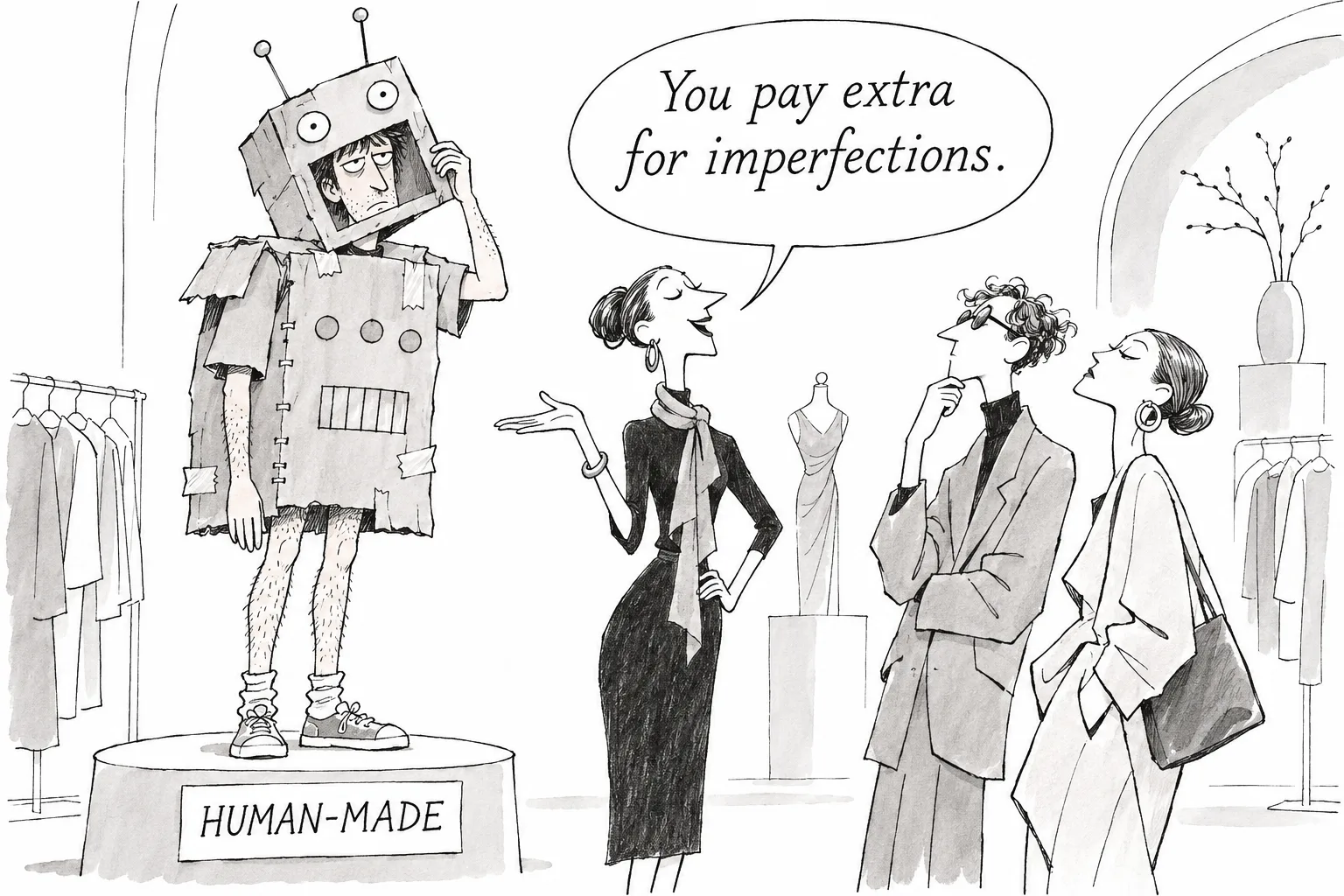
"Made by humans" becomes a selling point
Desigual is just one example. According to an article published in December 2025 by Paul Harrison, a professor of consumer behavior at Australia's Deakin University, Heineken, Polaroid and Cadbury have labeled their ads "human-made" and run them on television and on billboards in New York. In October 2025, U.S. intimates brand Aerie formally pledged not to use images with AI-generated people or bodies in its advertising, and asked the creators it works with to make the same commitment. A March 2026 ad featuring Pamela Anderson cuts from a screen of someone typing prompts to an AI to a live-action shoot, and ends with the line "You can't prompt this."
On the other side, ads that used AI drew fire. A Guess ad that ran in the U.S. edition of Vogue in August 2025 featured an AI-generated "model" and was criticized with comments such as "I want to see real people in magazines" and "lazy and cheap." At the end of September that year, the U.S. actors' union SAG-AFTRA issued a statement on Tilly Norwood, an AI-created "actress," saying it was "not an actor, it's a character generated by a computer program." U.S. dictionary publisher Merriam-Webster chose "slop," meaning low-quality content mass-produced with AI, as its 2025 Word of the Year.
A caveat is in order. "Made by humans" is also a business calculation. Research cited by Harrison found that the same artwork was rated more beautiful and more meaningful when it was labeled "made by humans." Judgments shift not with the content but with who people are told made it. Aerie, too, has acknowledged that while it bans generated people, it continues to use AI for media buying and analytics. AI running behind companies that champion anti-AI messages is normal in today's advertising industry. What buyers look at is where the line is drawn: how much is done by human hands, and how that is shown.
Young people who call themselves "Luddites"
The attitude has spread beyond clothing and advertising. From June 28 to July 5, 2026, a weeklong festival called "Summer of Ludd" was held in Manhattan, New York. The name comes from the Luddites, the craftsmen who smashed machines in England in the early 19th century. It was organized by NYC Off Tech, an anonymous collective, and promoted without the web, using only paper posters and word of mouth. Events included a workshop on quitting dating apps, a study session on how to oppose data centers, and a mock trial of OpenAI and its CEO Sam Altman. Attendance was in the hundreds and skewed heavily toward Gen Z (born roughly between the late 1990s and around 2010). The Wall Street Journal dubbed the season "Hot Luddite Summer."
"Luddite" has long been an insult for an ignorant person who resists progress, but in New York a group of young people calling itself the "Luddite Club" has embraced the label. Steven Vallas, a sociologist and professor emeritus at Northeastern University in the U.S., notes that historical research does not view the Luddites as simple technophobes. What angered them was sweeping change imposed in disregard of workers' knowledge and interests. What young people are pushing back against today is likewise less the technology itself than how decisions about it are made.
The numbers underneath the mood
These cultural shifts are backed by data. In a Gallup survey of 1,572 Americans aged 14 to 29 conducted in February and March 2026, the share who said AI made them feel "excited" fell from 36% a year earlier to 22%, while "anger" rose from 22% to 31%. Among young people with jobs, 48% said the risks of AI at work outweigh the benefits. Yet about half use it at least once a week, unchanged from a year earlier. They use it while disliking it.
The same holds for infrastructure. In a Gallup survey of 1,000 adults in March 2026, 71% opposed an AI data center being built in their area, and 48% were "strongly opposed." Opposition to a nuclear power plant stood at 53%, meaning Americans today are more accepting of nuclear plants than data centers. Research group Data Center Watch counted at least 75 projects worth about $130 billion that were halted or delayed by local opposition in January through March 2026, the most ever in a single quarter. On July 14, New York State issued an executive order pausing state environmental permits for large data centers for up to one year. In Japan, residents of Inzai, Chiba Prefecture, filed a lawsuit in March 2026 seeking to revoke a building permit.
In Japan, distrust rather than anger
In Japan, there is no festival like New York's and no ad from a major brand championing an anti-AI stance, as far as could be confirmed. But creators' pushback took shape early. In October 2024, voice actors including Koichi Yamadera, Toshihiko Seki and Ryusei Nakao launched the "NOMORE無断生成AI" (No More Unauthorized Generative AI) campaign, objecting to their voices being used for training without permission and to lines they never recorded being sold. In January 2026, the Japan Freelance League, a general incorporated association, released a survey with 24,991 responses. About 70% of respondents were illustrators. About 87% said generative AI was a serious threat to their livelihood, and about 12% said their income had actually fallen.
The backlash has also moved to the audience side. Game company Level-5 was accused, in Japan and abroad, of using generative AI in a video announcing new titles on September 10, 2026. President Akihiro Hino apologized on the 12th, and on the 17th the company acknowledged that "careless use of AI" had damaged trust in its work as a whole. Even the power lines in a hand-drawn illustration were questioned as "possibly AI," forcing the company to explain that an in-house designer had drawn them. Some called the thinly supported accusations a "witch hunt." By contrast, ads that disclosed AI use from the start, such as Tokyo City Keiba's "We tried making a horse racing commercial with generative AI," were received as entertaining. In Japan, whether something draws a backlash depends less on whether AI was used than on whether it looks like it was hidden.
A movement or a style?
For now, anti-AI sentiment is not an organized movement. It has no leaders and no common demands. Still, it is spreading as an attitude and an aesthetic, in the form of clothing slogans, ad catchphrases, a dictionary's Word of the Year and the name of a youth festival. Wilson is right that "systems are not fought with campaigns," but that does not rule out ads reflecting a mood, and that mood moving votes and purchases.
There are three markers to watch. First, whether "made by humans" labels end as a passing brand trend or become an industry standard. Second, whether the state-level data center pauses that began in the U.S. spread. Third, on the Japanese side, whether creators' distrust filters down into consumers' purchasing decisions. The Level-5 case looks like the first sign of that.
What we could not confirm
Whether Desigual used AI at any stage of producing this ad has not been disclosed, and we have not confirmed it. No figures have been released on how the ad affected sales. Wilson's remarks to People were confirmed through quotations in other outlets. Reported attendance at "Summer of Ludd" ranges by outlet from "a march of about 100 people" to "hundreds," and there is no official figure from the organizers. We found no survey that would allow young people's feelings about AI in Japan to be compared in the same format as Gallup's.
Editorial cartoon
Sources
- https://www.adsoftheworld.com/campaigns/born-to-disobey
- https://www.euronews.com/culture/2026/09/08/vivian-wilson-hits-out-at-ai-and-estranged-father-elon-musk-in-new-desigual-fashion-campai
- https://www.reasonwhy.es/actualidad/desigual-born-to-desobey-robot-vivian-wilson
- https://theimpression.com/desigual-confronts-ai-with-vivian-wilson/
- https://www.lgbtqnation.com/2026/09/vivian-jenna-wilson-says-to-disobey-as-gop-targets-trans-scapegoats-in-midterm-elections/
- https://aihub.org/2025/12/17/a-backlash-against-ai-imagery-in-ads-may-have-begun-as-brands-promote-human-made/
- https://www.glossy.co/fashion/pamela-anderson-fronts-aeries-anti-ai-push-as-it-bans-generated-bodies/
- https://abc7news.com/post/controversy-stirs-ai-generated-models-new-guess-ads-appearing-vogue/17390923/
- https://techcrunch.com/2025/10/01/hollywood-is-not-taking-kindly-to-the-ai-generated-actress-tilly-norwood
- https://www.engadget.com/ai/slop-is-merriam-websters-word-of-the-year-181903322.html
- https://404media.co/luddite-events-nyc-off-tech-summer-of-ludd
- https://news.northeastern.edu/2026/09/02/luddites-ai-protests-politics/
- https://news.gallup.com/poll/708224/gen-z-adoption-steady-skepticism-climbs.aspx
- https://news.gallup.com/poll/709772/americans-oppose-data-centers-area.aspx
- https://www.datacenterwatch.org/q1-2026
- https://axios.com/2026/07/14/ny-gov-kathy-hochul-data-center-moratorium-executive-order
- https://www.jiji.com/jc/article?k=2026072200799&g=eco
- https://www.animenewsnetwork.com/interest/2024-10-22/koichi-yamadera-toshihiko-seki-ryusei-nakao-other-voice-actors-discuss-no-more-unauthorized-/.217035
- https://www.ben54.jp/news/3117
- https://advertimes.com/20260920/article558214