Money · Nov 8, 2026
US stocks post worst week since April 2025 as AI and chip stocks sell off; chip index falls 12%
AI and energy stocks reportedly sold off after the US midterm elections, and a strong jobs report raised expectations of a rate hike. But no report has said how much each of the two factors contributed
Koji Yamamoto · Economics Analyst
Key points
- In the week ended November 6, the S&P 500 reportedly had its worst week since April 2025, and the Philadelphia Semiconductor Index (SOX) fell 12% over the week
- AI and energy stocks were reportedly sold after the US midterm elections, and a strong October jobs report raised expectations of a rate hike
- Reports have not separated how much each factor contributed to the decline. US consumer price data on November 10 and earnings from AI infrastructure companies should begin to make the distinction clearer
[Update, November 8, 2026, 7:15] An earlier version of this article said the sell-off continued on Friday, November 6. It has been corrected: that day the S&P 500 rose 0.31% and the Nasdaq Composite rose 1.09%, and only the Dow fell. An earlier version also said daily price moves could not be confirmed. Because the S&P 500's 0.31% gain on November 6 is known, it has been corrected to say that the moves through November 5 could not be confirmed.
AI and semiconductor stocks are being sold together in the US stock market. In the week ended Friday, November 6, the S&P 500, the main US stock index, reportedly had its worst week since April 2025, when the Trump administration's tariffs set off a sharp drop in stocks. The Philadelphia Semiconductor Index (SOX), which tracks major US chip stocks, reportedly fell 12% over the week. Two reasons for the sell-off have been reported. AI and energy stocks were sold after the US midterm elections, and a strong October jobs report raised expectations that the Federal Reserve would raise interest rates. However, reports have not said how much each factor contributed to the decline.
What it means for Japanese companies: Sales and corporate planning staff at manufacturers that sell semiconductor equipment, materials or power equipment for US AI uses should check, before NVIDIA's earnings on November 17, whether their main customers have changed their capital spending plans. A fall in share prices alone does not change the contracts or prices for enterprise versions of ChatGPT, Copilot or Gemini. Most companies that hold no US stocks or bonds and have no AI-related business will see no direct impact.
What has been reported
US investment news site 247 Wall St. (November 7) reported that the S&P 500 had its worst week since the April 2025 tariff shock in the week ended November 6. Breaking news from CNBC (November 5) and Yahoo Finance (November 6) described the same pattern: AI stocks were sold from midweek, and on Friday the Dow fell after the jobs report while the Nasdaq Composite rebounded 1.09%.
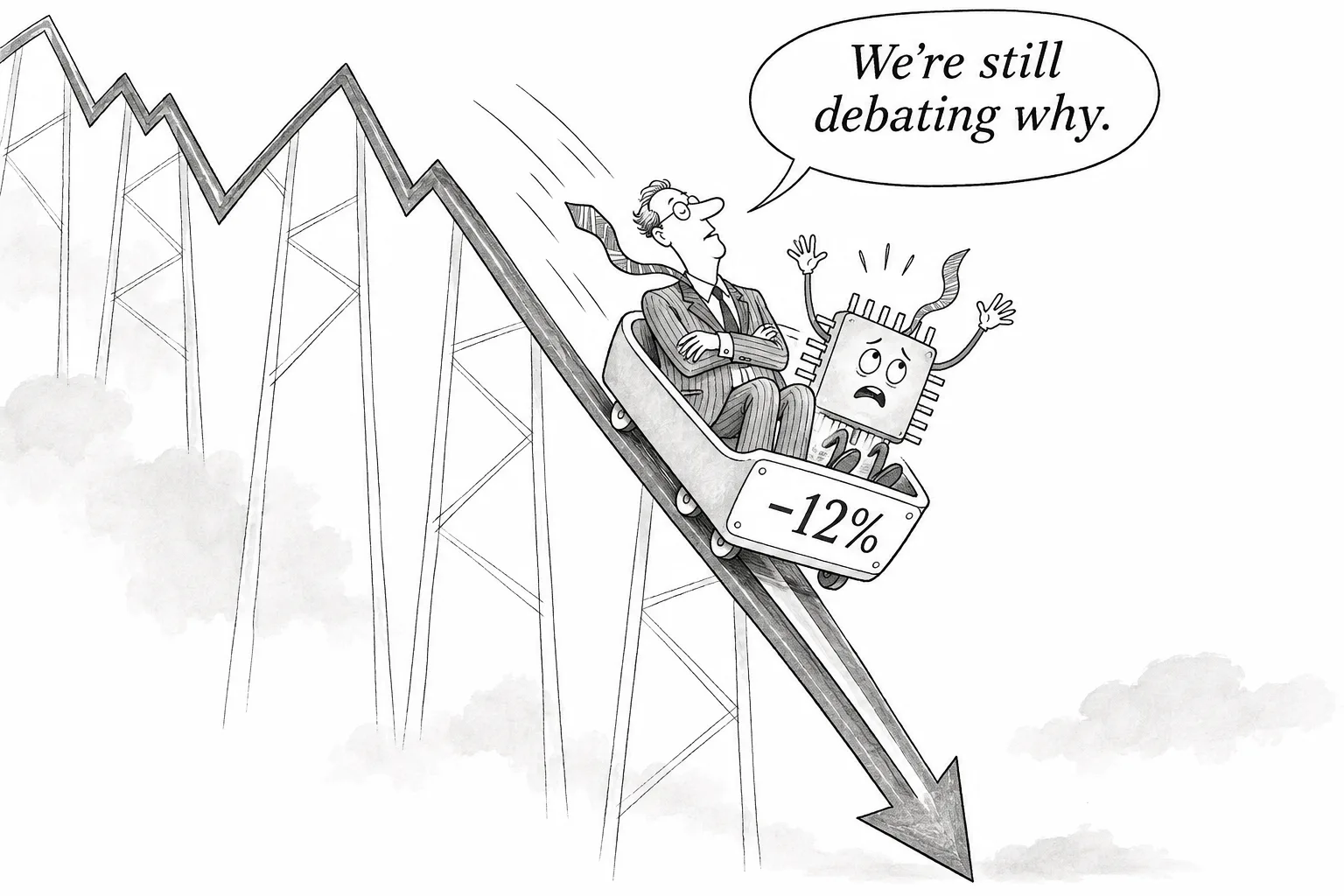
Semiconductors fell especially hard, with the SOX reportedly down 12% for the week, a much steeper drop than the S&P 500 as a whole. AI and chip stocks, which have led the market's gains in recent years, were at the center of this decline.
Two reported reasons for the sell-off
First: AI and energy stocks sold after the midterm elections
According to reports, AI and energy stocks were sold after the results of the US midterm elections came in. Energy stocks likely fell alongside AI stocks because many of them had been bought on expectations of rising electricity demand from data centers. Stocks bought on the outlook that AI computing would use more power tend to be sold together when doubts arise about AI's momentum.
Second: a strong jobs report and expectations of a rate hike
The October jobs report released on November 6 was reportedly strong. When employment grows and the economy looks strong, expectations rise that the Fed will raise rates to contain inflation. Markets now reportedly see a 78% chance of a rate hike in December.
AI and semiconductor stocks are especially vulnerable to rising rates, for two reasons. First, these companies' share prices are high because investors expect large profits many years in the future. Higher rates reduce the present value of those future profits. Second, many companies building AI data centers rely on debt. Bonds issued by CoreWeave, which rents out AI computing capacity, have been reported to trade at yields above 16%. Higher rates make debt more of a burden for companies like these.
How much each factor contributed is unknown
This is the most important point of this article. The two factors came in the same week. Both the post-election sell-off and the reassessment of rates after the jobs report hit AI and chip stocks hard. As a result, reports so far have not separated how much of the 12% drop came from the election and how much came from rate-hike expectations.
The difference matters for decisions by companies and investors. If most of the decline came from rate-hike expectations, demand for AI itself remains intact, and stocks could recover once the rate outlook settles. If instead the main cause is a shift after the election in the policy or demand outlook for AI and data centers, there is a risk that AI-related capital spending itself will slow. For Japanese manufacturers selling semiconductor equipment and materials, the second case would hit harder.
The following could not be confirmed: weekly declines for indexes other than the S&P 500 and the SOX, the specific figures in the October jobs report, which parts of the midterm results led to the sell-off in AI and energy stocks, and daily price moves through November 5. On November 6, when the jobs report came out, the S&P 500 is known to have rebounded slightly, by 0.31%.
Next week's releases should start to tell them apart
Clues for telling the two factors apart will arrive next week.
Monday, November 10: US consumer price index (CPI). If prices come in strong, December rate-hike expectations rise further and AI stocks are sold again, that would suggest rates were the bigger factor. If prices are calm but chip stocks do not recover, that would point to factors other than rates weighing more heavily.
Also on November 10: CoreWeave earnings, and October sales from SoftBank Group and TSMC. CoreWeave has expanded its data centers with borrowed money, making it the company most likely to show weakness when rates rise. TSMC's monthly sales show directly whether demand for AI chips is actually falling. If sales stay strong, that would suggest demand has not collapsed and that stock valuations are being reassessed instead.
NVIDIA earnings on November 17, after Nebius reports on November 12. NVIDIA's results will be the most important gauge of demand for AI chips. In Japan, the Nikkei average has reportedly entered a bear market, down more than 20% from its recent high, and the cost of insuring SoftBank Group's bonds against default (credit default swaps, or CDS) is also being watched. These earnings will also show how far Japanese stocks follow US AI stocks.
Editorial cartoon
Sources
- https://247wallst.com/investing/2026/11/07/the-sp-500-just-had-its-worst-week-since-the-april-2025-tariff-crash/
- https://www.cnbc.com/2026/11/05/stock-market-today-live-updates.html
- https://finance.yahoo.com/markets/live/stock-market-today-friday-november-6-dow-sp-500-nasdaq-jobs-report-earnings-135953863.html