Money · Nov 12, 2026
AI data center operator CoreWeave's revenue jumps 2.7-fold and shares rise more than 20%, but interest costs are still twice its profit
CoreWeave's July–September results beat its own guidance, and the company now raises money mainly through customer prepayments and loans tied to individual facilities. That has eased worries about how AI infrastructure spending gets funded for now. The interest burden is just as heavy, though, and the company expects it to grow next quarter
Koji Yamamoto · Economics Analyst
Key points
- Revenue was 2.7 times the year-earlier figure, and profit beat the company's own guidance. Shares rose more than 20%, leading a rebound in AI stocks
- Funding has moved to customer prepayments and loans secured on individual facilities. Part of the debt burden now rests on customers and on the assets themselves
- Interest payments were still about 2.2 times adjusted operating profit and will rise next quarter. The worries have been pushed back, not removed
CoreWeave, a U.S. company that owns large numbers of GPUs (graphics processing chips) used for AI computing and rents them by the hour to customers including OpenAI, reported results for the July–September quarter after the close of trading on November 10, according to its 8-K filing with the SEC, the primary source for this report. Revenue was 2.7 times the figure for the same quarter a year earlier, and profit beat the guidance the company had given. The company has also changed how it raises money, relying on customer prepayments and on loans secured against individual facilities. That has eased, for now, fears that AI data centers are being overbuilt on borrowed money. The shares rose more than 20% and reportedly led a rebound in AI stocks on Wall Street. However, interest payments were about 2.2 times adjusted operating profit, and the company says they will rise further next quarter.
For Japanese companies: Most companies will see no immediate effect. The results matter to companies negotiating multi-year bulk GPU rental contracts, and to fund managers at financial institutions holding AI infrastructure bonds or funds. Companies in the first group should check the contract terms before signing: whether the deal requires prepayment, and what happens to prepaid money and reserved computing capacity if the provider runs into trouble.
Revenue up 2.7-fold, ahead of guidance
CoreWeave does not build AI models itself. It brings together power, buildings and GPUs and rents them to model developers and major cloud providers, something like a landlord and power plant for the AI era. Revenue grew 2.7-fold in a year because AI companies are still competing hard for computing capacity.
What the market cared about was less the revenue growth than whether financing could keep up with it. Building data centers and buying GPUs comes first, and rental income arrives later. Debt fills the gap. Since the start of November, growing expectations that U.S. interest rates will rise had made investors quick to sell shares of companies that build facilities with borrowed money. Against that backdrop, profit came in ahead of guidance, and buyers piled back into the stock.
A funding model that spreads the burden to customers and facilities
The bigger story in these results is not the numbers but the change in how the company raises money. It now relies mainly on two sources.
The first is customer prepayments. Customers that reserve computing capacity for long periods pay before they use it. For CoreWeave, that is cash to buy equipment without borrowing. In return, customers take on part of the loss if the provider runs into trouble.
The second is loans tied to individual facilities. Instead of borrowing on the strength of the company's overall credit, CoreWeave borrows against specific data centers or GPUs, together with the contracts of the customers renting them. For lenders, the source of repayment is clear: even if the company as a whole runs into trouble, they can be repaid from that facility's earnings.
Both arrangements spread the weight of the debt across customers and facilities instead of concentrating it on one company's credit. Concerns about AI data center financing eased because this model now appears to be working.
Interest still more than twice profit
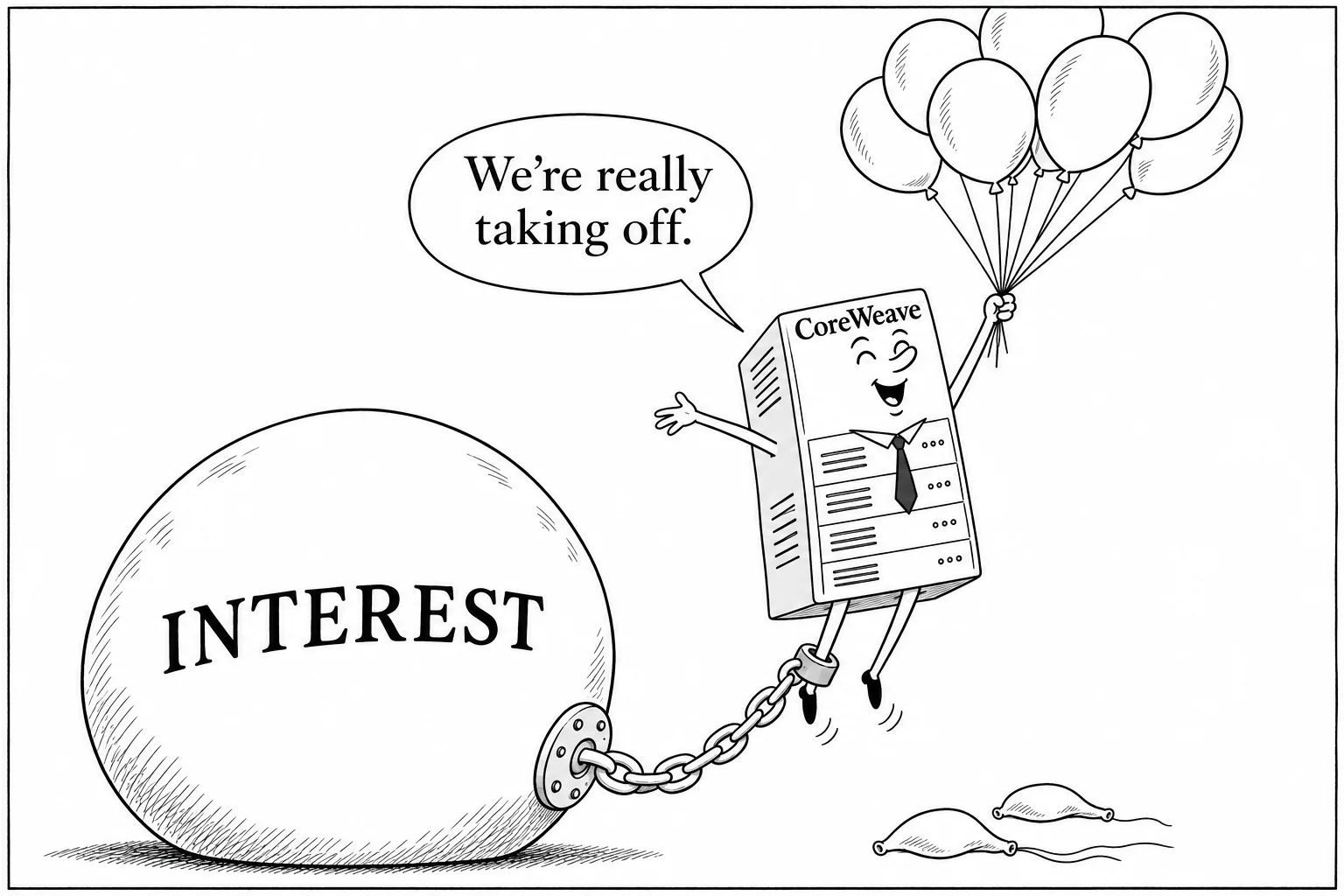
What has eased is the worry, not the debt. Interest payments in the July–September quarter were about 2.2 times adjusted operating profit (core earnings excluding one-time costs and similar items). In other words, for every dollar the business earns, the company pays more than two dollars in interest. The company also says interest will rise further in the October–December quarter. Interest on money borrowed to build new data centers starts going out right away, while rent from those facilities comes in later.
The approach pays off only if new facilities fill up on schedule and customers keep paying as their contracts require. Many of those customers are AI companies that are not yet profitable. Prepayments and facility-level loans actually make the company more dependent on its customers' ability to pay. These results did not solve the AI data center debt problem. It is more accurate to say they pushed back the day of reckoning.
What we could not verify
For this article, we were unable to read the earnings documents, the earnings call transcript or the full text of market reports directly. This article therefore does not include the actual dollar amounts of revenue, profit and interest; the figures in the October–December guidance; the size of the prepayments and loans; or the exact size of the share price gain and the moves in major stock indexes. The ratios of 2.7 times, about 2.2 times and more than 20% come from reporting notes based on primary sources.
Editorial cartoon