Rules & Policy · Nov 18, 2026
US to curb remote access to AI chips through overseas data centers from Nov. 19; China warns of countermeasures
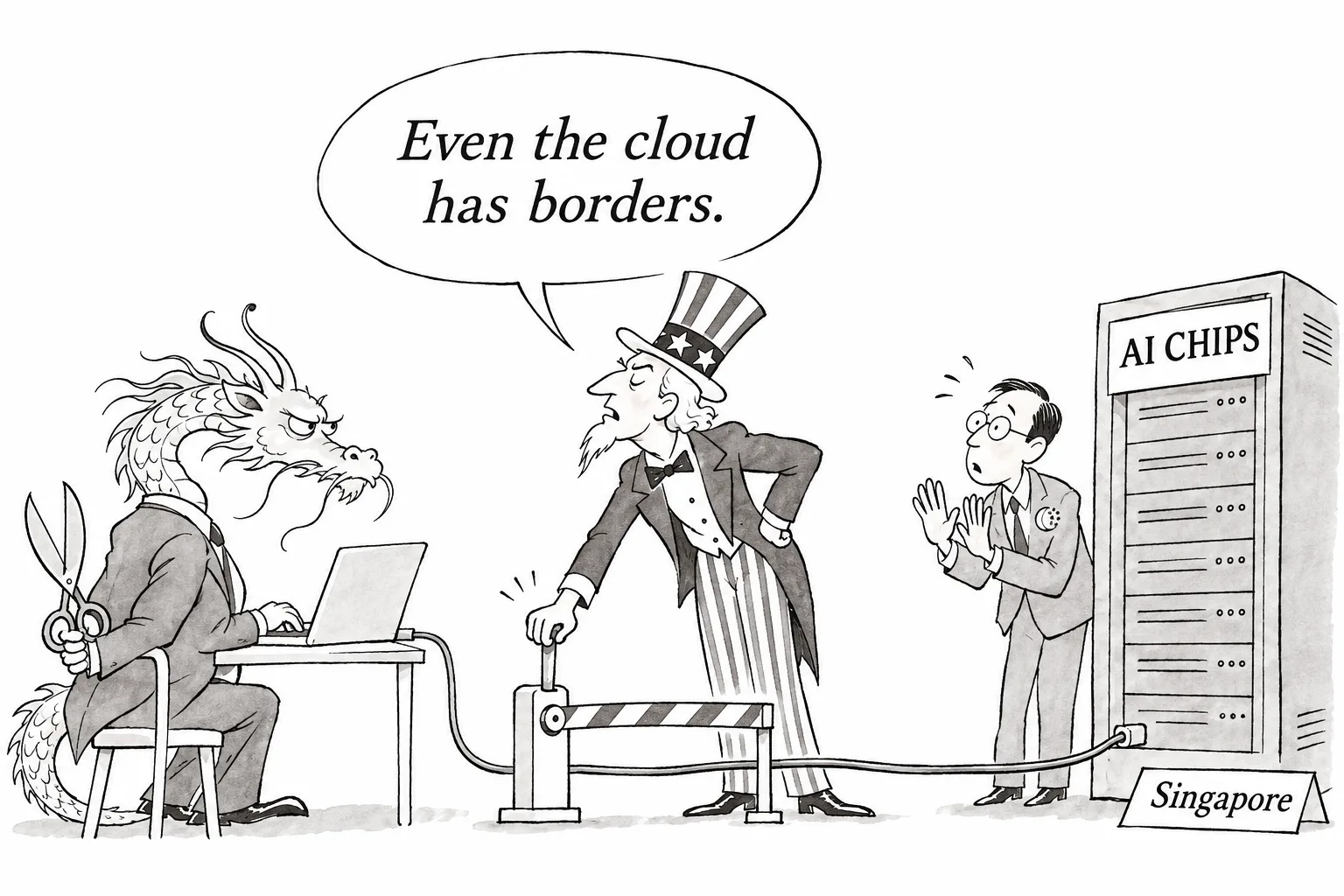
The US Commerce Department is closing a route that lets Chinese companies rent advanced chips in overseas data centers. The rule is expected to be published in the Federal Register on November 19 and will take effect that day. Existing arrangements have 90 days to obtain licenses. Singapore has begun talks with the United States.
Koji Yamamoto · Economics Analyst

Key points
- Chinese companies did not need chips shipped to China: they could rent them in overseas data centers. The US is closing this loophole with a new rule
- The rule is expected to be published in the Federal Register on November 19 and will take effect that day. Existing arrangements must obtain licenses within 90 days
- China warned of countermeasures, and Singapore entered talks with the US. US and Chinese leaders meet the same day at APEC in Shenzhen
The Bureau of Industry and Security (BIS), the US Commerce Department agency that oversees export controls, has issued a rule that closes the route for remotely using advanced AI chips through overseas data centers. The rule is expected to be published in the Federal Register, the US government's official journal for notices, on November 19, and will take effect that day. Until now, controls were designed to stop physical chips from being shipped to China. They did not fully cover the practice of renting, over the internet, the computing power of chips housed in overseas data centers. China warned it would take countermeasures, and Singapore, a hub for data centers, has entered talks with the United States.
For Japanese companies: Manufacturers and software companies that have subsidiaries or development sites in China and rent GPUs (the semiconductors used for AI computing) from cloud providers in Southeast Asia, such as in Singapore or Malaysia, should check with their legal teams and their cloud providers this week whether their usage falls under the rule. So far there has been no indication that companies whose employees only use enterprise versions of ChatGPT, Copilot or Gemini at work will face new procedures. Companies with no business dealings or sites in China are unlikely to be directly affected.
US AI chip controls shift from exports of goods to remote use
US controls on advanced AI chips have mainly worked by stopping the chips themselves from being sent to China. Even when Chinese companies could not obtain the chips, they could rent chips housed in data centers in third countries as a cloud service. Because no goods crossed a border, this was hard to catch with export controls. The new BIS rule brings this "rent and use remotely" route itself under control. According to an analysis by Nixon Peabody, a license will be required to send advanced chips or servers to data centers that provide computing power exceeding 12 million in total processing performance (TPP) to companies headquartered in places such as China and Macau. Shipments of advanced chips to Singapore, Malaysia, Thailand, Indonesia and Brazil will also require a license.
In AI development, how much computing power a company can access matters more than whether it owns the chips. Training a large model requires thousands to tens of thousands of GPUs linked together and running for long periods. No matter who owns the chips, if the user is a Chinese company, US controls miss their target. The BIS rule widens the net from "who owns" the chips to "who uses" them.
The BIS rule takes effect the day it is published in the Federal Register
The key point of the BIS remote-access rule is when it takes effect. The rule is expected to be published as an interim final rule in the Federal Register on November 19 and will take effect that day. Comments will be accepted for 60 days from publication. Some rules allow several months of preparation before they take effect, but this one offers no grace period on its effective date. However, data centers that already provide computing power to companies headquartered in China and other covered places can continue if they obtain a license within 90 days of the effective date.
Ahead of publication in the Federal Register, the rule was placed on public inspection, and BIS also posted the rule on its own website. On November 16, the US law firm Nixon Peabody issued a client alert describing the rule as BIS targeting remote access to advanced chips through overseas data centers.
China warns of countermeasures on the same day as the APEC summit
The Chinese government warned it would take countermeasures against the new US remote-access controls. The US and China are in a trade truce that is said to expire on January 10. China has suspended its export controls on critical minerals such as gallium, but that suspension also expires on November 27. If China moves ahead with countermeasures, trade in materials for semiconductors and electronic components could be affected.
November 19, the day the US rule takes effect, is also the day of the APEC (Asia-Pacific Economic Cooperation) leaders' meeting in Shenzhen, China, where President Trump and President Xi Jinping are set to meet. Malaysia's Free Malaysia Today reported that the US tightened AI chip curbs on data centers ahead of Trump's visit. With the rule taking effect on the day the leaders meet face to face, it casts a shadow over whether the truce can be extended at the summit.
Singapore enters talks with the US as Southeast Asian data centers feel the impact
Singapore has entered talks with the United States over the remote-access rule. Singapore is one of the most concentrated data center hubs in Southeast Asia, and large data centers have also spread to nearby areas such as Johor in Malaysia. If Chinese companies have been renting computing power in these locations, operators in this region will be the first to feel the rule's impact.
In Singapore, a company called Megaspeed has reportedly become an issue in the United States in connection with NVIDIA chips. Al Jazeera, the Middle Eastern satellite broadcaster, reported that the US moved to block China's remote access to AI chips amid an NVIDIA scandal. On November 13, an analysis was also published claiming that six Chinese open models were trained on NVIDIA's Blackwell chips, which are banned from export to China. The author of the analysis wrote that it does not show where the chips were located or how they were obtained. The problem that chips can be used no matter where they are located lies behind the rule.
What has not yet been confirmed about the BIS rule
Several details of the BIS remote-access rule have not been confirmed: the legal basis for the rule; whether there are exceptions for major cloud providers from allied countries (recipients headquartered in the US are exempt from the license requirement for the five countries if they file monthly reports); the reactions of the governments of Malaysia, Thailand and Indonesia (according to Free Malaysia Today, the three countries did not immediately respond, and Brazil said it was monitoring the situation); and what countermeasures China will take, and when. The text of the rule and media reports are listed in the sources, but the points above could not be fully verified in our reporting.
What's next for US remote-access controls
The next focus for US remote-access controls is whether a second rule will be issued to close loopholes that remain within the United States. Upcoming figures will also show how much the rule affects the revenue of new cloud companies renting out GPUs in Southeast Asia, and of NVIDIA, which sells chips to them. How far China goes with countermeasures at the November 19 US–China summit in Shenzhen, and whether the truce can be extended beyond January 10, will also affect Japanese companies' procurement of parts and materials.
Sources: Federal Register public inspection document, BIS rule document, Nixon Peabody, The Next Web, Al Jazeera, Free Malaysia Today
Editorial cartoon
Sources
- https://public-inspection.federalregister.gov/2026-23529.pdf
- https://www.bis.gov/media/documents/rin-0694-ak50.pdf
- https://www.nixonpeabody.com/insights/alerts/2026/11/16/bis-targets-remote-access-to-advanced-chips-through-overseas-data-centers
- https://thenextweb.com/news/china-warns-us-of-countermeasures-over-new-ai-chip-remote-access-curbs
- https://www.aljazeera.com/economy/2026/11/17/us-moves-to-block-chinas-remote-access-to-ai-chips-amid-nvidia-scandal
- https://www.freemalaysiatoday.com/category/business/2026/11/17/us-tightens-ai-chip-curbs-on-data-centres-ahead-of-trump-s-visit