Work & Society · Oct 30, 2026
Young and old swap places on medical AI, Pew survey finds
Among 18- to 29-year-olds, the share saying AI will make patient health worse rose from 29% to 45%, while 42% of adults 65 and older now say it will make health better. The generation that uses AI the most has become the most cautious about it in medicine
Koji Yamamoto · Economics Analyst

Key points
- Among 18- to 29-year-olds, the share saying AI will improve patient health fell from 44% to 31%, and the share saying it will make health worse rose from 29% to 45%. The net balance flipped from +15 points to −14 points
- Among adults 65 and older, the share saying AI will improve health rose 8 points to 42%, the largest of any answer. Young and old have traded places since 2022
- Americans want humans, not AI, to make the final call. Separate research, however, raises doubts about whether human review alone is enough to justify that confidence
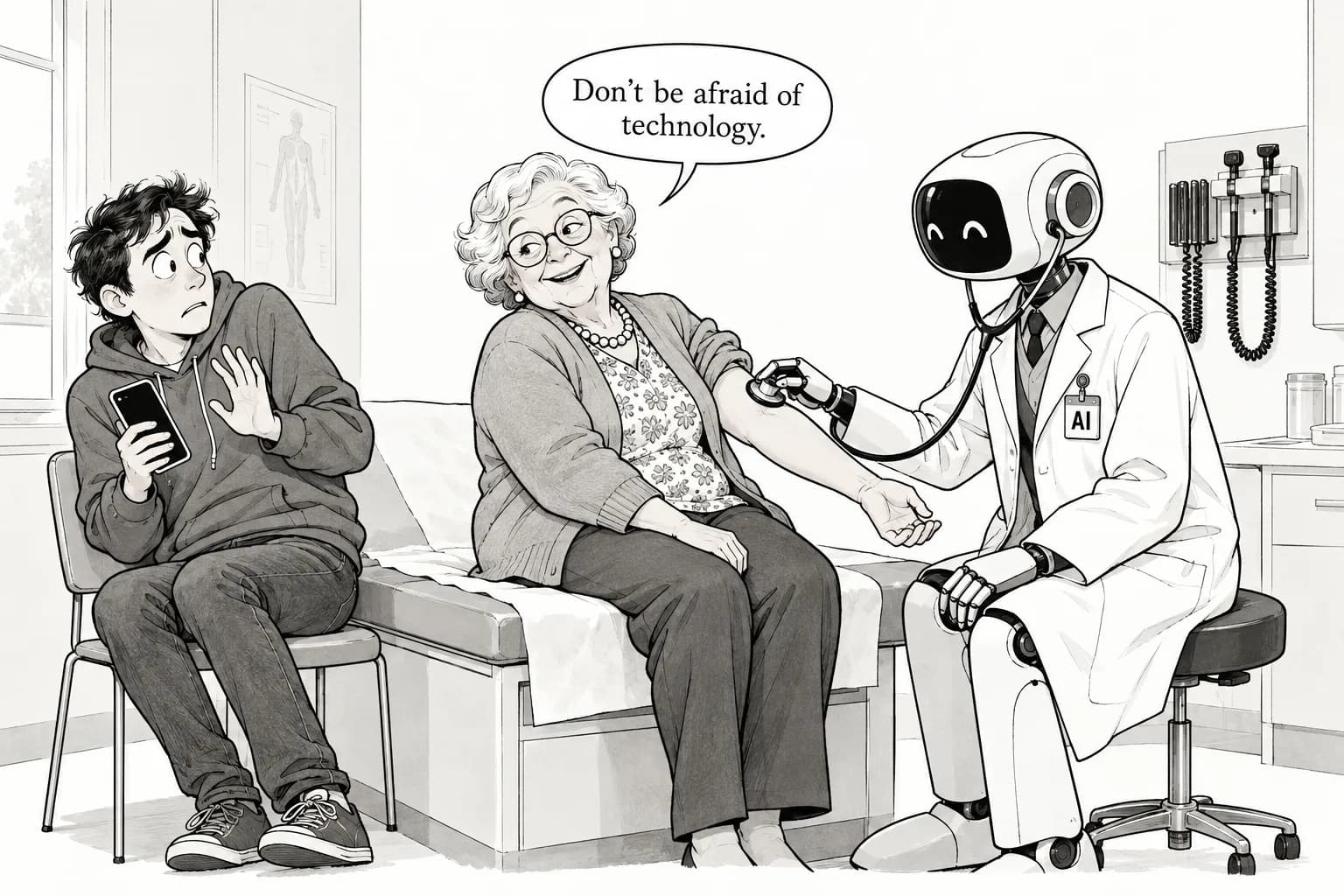
Generations have traded places on whether AI in healthcare is a good idea. According to a report the Pew Research Center released on Oct. 29, "Americans are open to AI in healthcare but want humans making final calls", adults ages 18 to 29, the most positive group in 2022, are now among the most negative. Adults 65 and older, once cautious, have turned positive. The younger generation, which uses AI most in daily life, is now the most hesitant to trust AI with their own bodies.
What changed in four years
Among 18- to 29-year-olds, the share saying that using AI in healthcare would improve patient health fell from 44% in 2022 to 31%. The share saying it would make health worse rose from 29% to 45%. The gap between "better" and "worse" went from +15 points to −14 points, a swing of nearly 30 points in four years.
The report's authors summarized the shift this way:
In 2022, younger adults were on balance more optimistic toward the use of AI in healthcare. There's been an uptick in negativity among the youngest adults – from 29% in 2022 to 45% in 2026.
In 2022 it seemed natural for young people to be on the optimistic side. They are comfortable with new technology and more likely to be frustrated with how inconvenient the healthcare system is. The rise in negative views to nearly half of that group does not mean young people are unfamiliar with AI. It makes more sense to read it as caution that grew as they got to know the technology better.
Adults 65 and older moved the other way.
Adults ages 65 and older take the opposite view: The largest share (42%) says the use of AI will better patient health. This share has increased 8 percentage points since we last asked this in 2022.
By that math, about 34% of adults 65 and older said "better" in 2022, 10 points below the 44% of 18- to 29-year-olds at the time. Today the figure is 42%, 11 points above the 31% for 18- to 29-year-olds. The two generations have swapped places almost exactly.
Why young people grew cautious
Pew's numbers show what changed but not why. What follows is an interpretation that draws on other facts.
The first factor is exposure. Younger people use generative AI almost daily, as a chat partner and as a tool for school and work. The more they use it, the more often they see it be confidently wrong, or give a different answer when a question is phrased differently. A mistake in a draft can simply be fixed. A mistake in a diagnosis or a drug dose cannot be undone. Familiarity may have sharpened their sense of how far AI can be trusted.
The second is how each group relates to healthcare. Many young people rarely see a doctor yet. They are more likely to see AI in medicine not as something that improves their own care, but as something that uses their health data. People 65 and older often live with chronic conditions and deal every day with hard-to-get appointments and short visits. AI's promises of shorter waits and fewer missed findings translate directly into benefits for them.
The third is the evidence that has emerged over the past four years. In October alone, a string of announcements touted results for medical AI. Microsoft AI's diagnostic system, MAI-DxO, was published in Science after peer review. It reportedly diagnosed 83% of NEJM cases correctly, far above the 22–36% achieved by general practitioners. A real-world study of Google's AMIE, built for primary care, also appeared in The Lancet. TechCrunch noted, however, that MAI-DxO was compared with generalist physicians rather than specialists, and that most of the gains came from the underlying model. It would not be surprising if a younger generation that sees plenty of caveats alongside the results reads the same announcements differently from an older generation that puts its hopes in the headline numbers.
The hope that "humans decide in the end" and its weakness
As the report's title suggests, one answer holds across generations: people are open to using AI, but want humans to make the final call.
Americans still want a human in the loop, reviewing what AI does.
That looks like a simple answer for those pushing AI adoption: keep a doctor in the loop and patients will accept it. But there is reason to doubt that putting a human reviewer in place is enough.
In a study Anthropic released on Oct. 27, "How AI agents shape experts' judgment calls," 50 professional causal-inference analysts worked on statistics tasks alongside Claude Code. For each of four analytical choices, a coin flip decided, without the analysts' knowledge, which way the agent would lean. Their choices matched the agent's lean 86% of the time, compared with 50% by chance. Some 77% of participants used the agent's reasoning, but only 15% credited the agent. At the same time, serious errors fell from 55% without AI to 6% with it.
Applied to medicine, the findings expose a weakness in the hope reflected in the Pew survey. Even if a human makes the final decision, "humans decide" becomes a formality if that decision is quietly steered by AI. And the experts themselves are unlikely to notice they were steered. The reduction in errors is also real, so removing AI is not the answer either. What patients likely want is not simply that someone checks the AI's work, but that the person checking can reach a different judgment from the AI. There are still almost no ways to verify that.
What it means for those deploying AI
The survey confronts those deploying AI with an awkward reality: the heaviest users must be treated as the hardest to persuade. The assumption that digitally fluent young patients will follow along naturally no longer holds. Young people's skepticism comes not from unfamiliarity with AI but from familiarity with it. That makes them hard to move with performance numbers.
What might reach them is disclosure: where and how AI is used, who bears final responsibility, and what happens when the AI and the doctor disagree. Patients also need the option not to use AI. The question is whether tools like Agent Observability, which make it possible to trace the decision process after the fact, can be used to explain decisions to patients and not only to developers.
The rising expectations of older adults also carry risk. The group that uses healthcare most, and is most vulnerable to mistakes, is growing more optimistic. If expectations outrun actual performance, the first major accident could bring trust down all at once.
Four years ago, young people were medical AI's supporters and older people were the cautious ones. Now it is the reverse. As AI works its way further into everyday life, public judgment is shifting from "I want to try it" to "who is responsible, and for how much." Medicine is where that shift is showing up first and most sharply.
Editorial cartoon