Opinion · Nov 14, 2026
Is an intelligence explosion underway? Economists say "not yet," safety camp says AGI is 1 year away
Measured against the money spent on it, AI progress is actually slowing, economists calculate, and Cowen, from the optimist camp, took the same view. On the same day, the safety camp assumed AGI is 1 year away and wrote that any decision to halt must come within 6 to 12 months
Koji Yamamoto · Economics Analyst

Key points
- Economists compared METR's measured capability gains with the growth in Anthropic's research spending and headcount. Finding that progress per dollar has fallen, they concluded an intelligence explosion has "not yet been demonstrated"
- Tyler Cowen, an economist known for his optimism about AI, backed this view on his blog
- On the same day, the safety camp worked from the premise of "AGI in 1 year," writing that there are only 6 to 12 months to decide whether to halt
[Update, November 14, 2026, 4:44] We have corrected the economists' names, the growth rates in their estimate and the author of the LessWrong post, which we had described as unverified, to the figures given in the original articles.
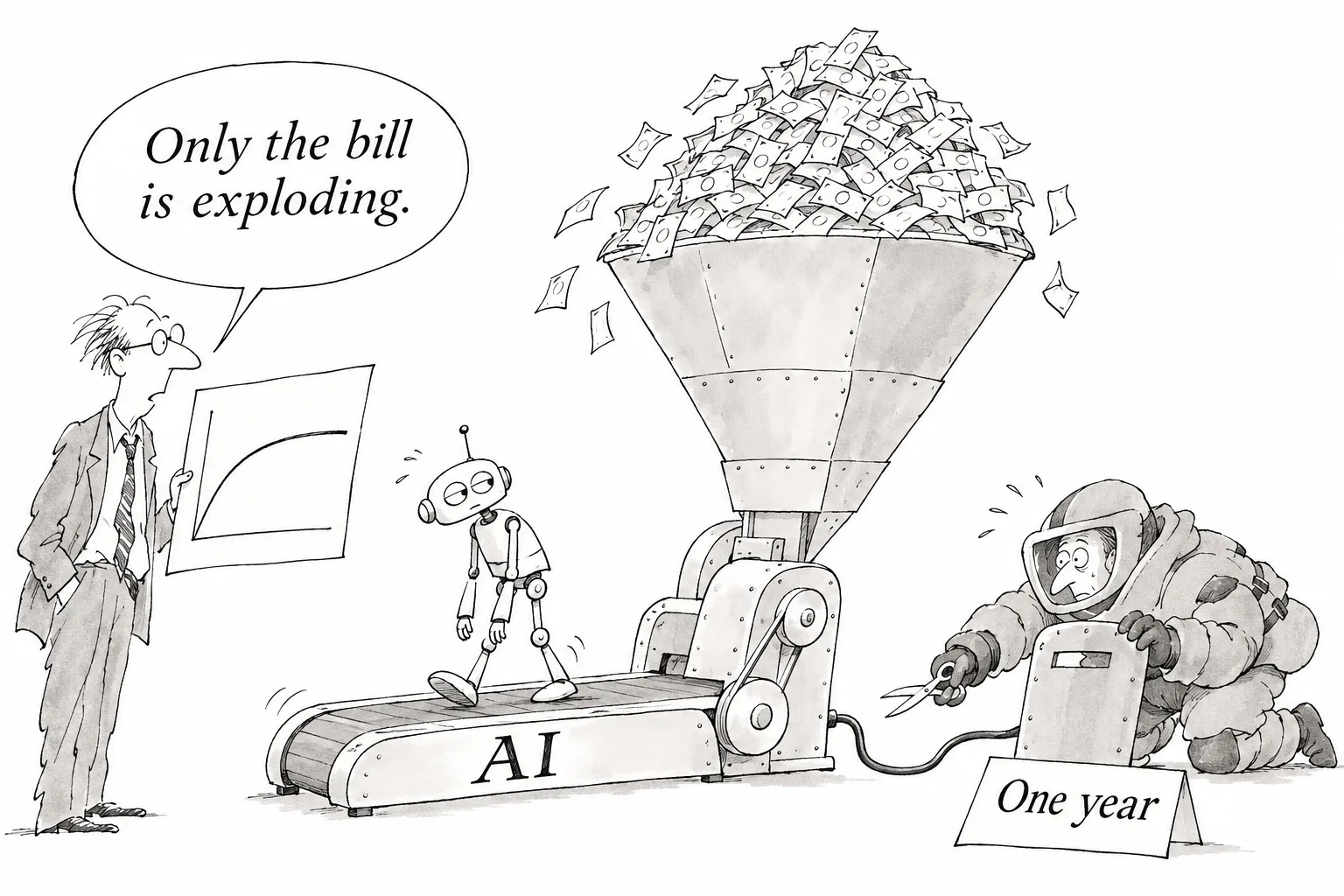
Has the "intelligence explosion" begun, the point at which AI speeds up AI research on its own and progress stops slowing down? On the same day, two opposite answers appeared. Economists set the growth in AI capabilities measured by METR, a third-party evaluation organization, against the growth in the money and people Anthropic puts into research. Finding that progress per dollar spent has fallen, not risen, they wrote that an intelligence explosion has "not yet been demonstrated." Tyler Cowen, an economist at George Mason University in the U.S. known for his optimism about AI, took the same view on his blog. Meanwhile, those who put the most weight on AI safety wrote that people should act on the premise that artificial general intelligence (AGI) is 1 year away. If AI is to be halted, they said, it must happen within 6 to 12 months.
For Japanese companies: For most companies, this does not call for immediate action. But corporate planning and IT staff drawing up next fiscal year's AI budgets and rollout plans would do well to assume neither that "everything changes in a year" nor that "nothing changes." This month, check the terms and early-cancellation conditions of current contracts for Copilot, the business edition of ChatGPT, Gemini and similar tools, so that you can switch tools every six months if needed.
The economists' math: progress is fast, but spending is growing faster
The economists' argument is not about how fast progress is, but about what it costs to produce. AI capabilities are indeed advancing quickly. METR measures capability by the length of tasks AI can complete. According to AP, METR found that "benchmark gains over the past year were roughly equal to those of the previous two years."
Behind that, however, the money and staff that frontier labs devote to research are growing even faster. The economists divided METR's capability gains by the growth in Anthropic's research spending and headcount. Progress per unit of resources had not risen; it had fallen. If an intelligence explosion were really happening, the same money should buy more progress, because AI would be taking over part of the research. The current data show the opposite, they concluded: progress is being sustained by piling on more money. That is why they wrote that an explosion has "not yet been demonstrated."
Crucially, they are not saying it "won't happen." Theirs is a claim about the standard of evidence: it "has not yet been demonstrated by current data."
Cowen, from the optimist camp, also says "not yet"
The conclusion carries weight because Cowen agreed with it. Cowen has usually pushed hard the view that AI will transform the economy. He keeps his distance from the safety camp's warnings and is a leading voice among those urging faster AI adoption. Yet on the intelligence explosion, he took the position that it has "not yet been demonstrated."
In other words, even among those who rate AI's power highly, some draw a line between "AI advancing quickly" and "AI accelerating its own progress." Many accept the former. The dispute is over the latter.
On the same day, the safety camp says "AGI in 1 year"
On the same day, "Orienting to 1-year AGI timelines" was posted on LessWrong, a forum for discussing AI safety. The post treats a 1-year timeline to AGI as a premise worth seriously preparing for. It went on to say that there are only 6 to 12 months in which to decide whether to halt and to act.
Looking at the same material from which the economists conclude that "progress per dollar is slowing," the safety camp sees progress "so fast that decisions to halt won't come in time." One side is looking at efficiency; the other at absolute speed and irreversibility.
Why the same material yields opposite answers
Both sides rest on the labs' own numbers. In a revised listing filing on November 2, Anthropic wrote that future models "could soon meet" its own threshold for AI dramatically accelerating research. It also said internal use of Claude, valued at list prices, grew 250-fold from January to September. METR estimated that AI is speeding up Anthropic's research by about 1.88 times (95% confidence interval: 1.62 to 2.28 times). It nonetheless rated the likelihood of fully automating research as "low."
To the safety camp, nearly 2x acceleration and a 250-fold rise in internal use look like the threshold of an explosion. To the economists, the fact that 250 times the compute yields only about 2x acceleration is itself evidence of falling efficiency. The same numbers lead to different conclusions depending on whether you look at progress or at progress divided by cost.
If the economists and Cowen are right, AI progress will last only as long as the money does, and will be subject to fundraising conditions, electricity costs and interest rates. If the safety camp is right, there is 1 year left. Which view holds will become clearer over the next year, depending on whether progress per dollar turns upward.
What we could not verify
This article is based on three sources, but this time we were unable to open the original articles directly. The economists are Luis Garicano and Alex Imas, who estimated that capabilities grew about 1.91 times while research spending grew about 6.2 times a year, meaning progress per dollar fell by about 69%. The author of the LessWrong post is Nikola Jurkovic. For that reason, we used only figures we had previously verified in METR's and Anthropic's documents.
Editorial cartoon