AI in the Field · Nov 6, 2026
A $795 home robot that hangs from the ceiling, after 1,000 hours of testing at home
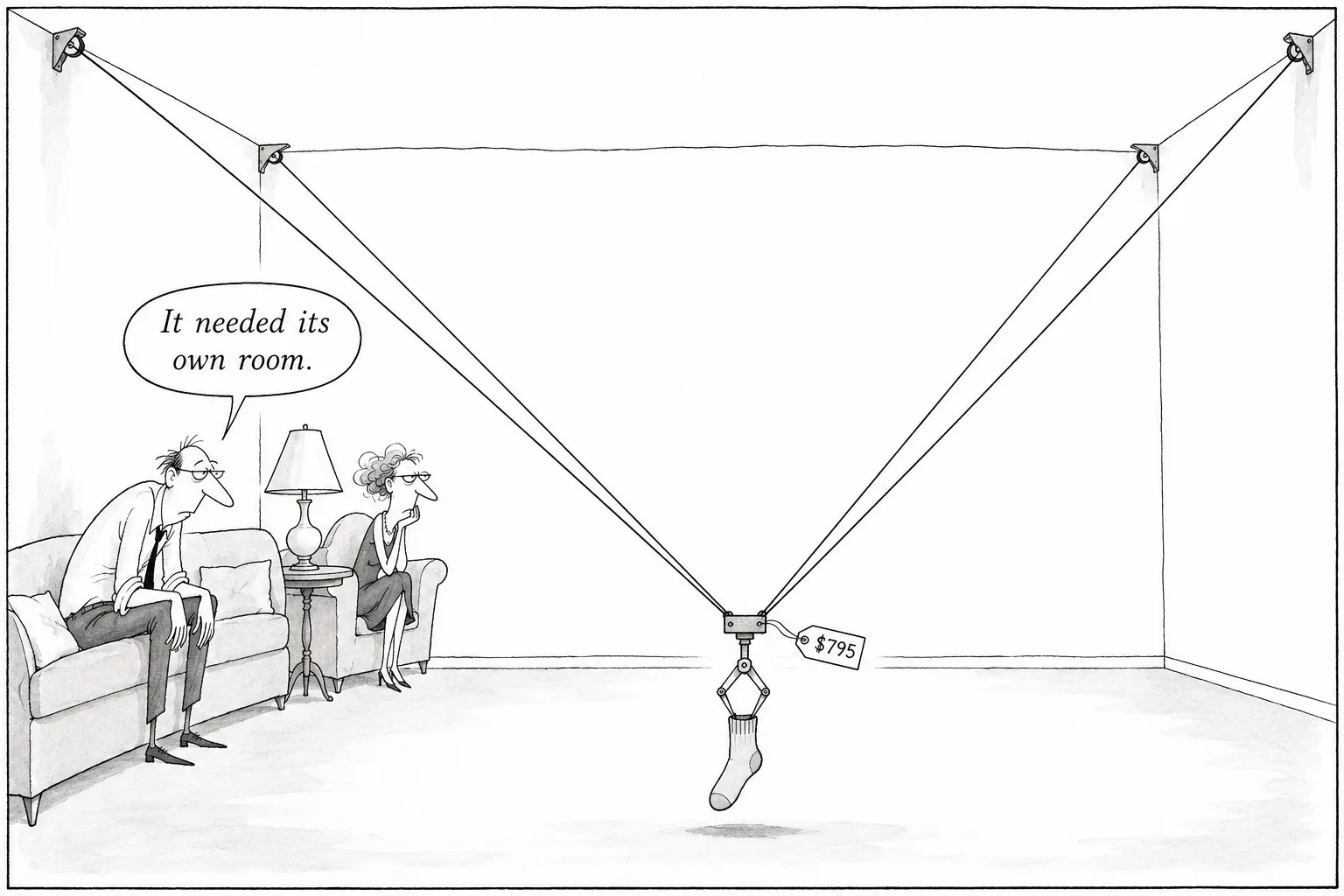
Stringman, which picks up objects around a room with four strings, is drawing attention overseas. It can lift about 2kg, but out of the box it can only pick up laundry. Concerns about the cables wrapping around a person's neck were debated too
Haru Misaki · Field Correspondent
Key points
- Stringman is an open-source robot that suspends a two-fingered gripper from four cables strung to the four upper corners of a room. The assembled version costs $795, and the company ships to Japan
- It can lift up to 2.2kg near the floor and has been tested for about 1,000 hours in the creator's home. Out of the box, though, the only task it can do is picking up laundry, and no success rate has been published
- A mechanism slowly releases tension when 28N of force is applied to any one cable. Even so, many commenters warned that the cables could be dangerous if they wrapped around someone's neck, and said the robot can't reach things in rooms with a lot of furniture
String cables to the four upper corners of a room, hang a two-fingered gripper from them, and use it to pick up objects anywhere in the room. That's the idea behind Stringman, a home robot that got a lot of attention among engineers overseas this week. It isn't humanoid, and it doesn't roll around on wheels. The assembled version costs $795. Its creator says he has tested it for about 1,000 hours in his own home, but the project also drew plenty of worried questions along the lines of "what happens if that wraps around someone's neck?" For this story, Haru went through the official website, the publicly available control software, the forum discussion and coverage in overseas media.
For Japanese companies: Frankly, there's no direct impact yet. But Japan is on the official list of shipping destinations, so the robot may be worth a look as a test platform for just under $800. That goes for companies whose staff spend a lot of time picking things up off the floor, such as nursing care facilities, housekeeping services, and stores or warehouses that need tidying, and for manufacturers' development teams that want to prototype with a cheap robot.
What's the point of a hand hanging from the ceiling?
The robot is made by Neufangled Robotics, a small company. According to its official website, anchor points go near the ceiling in the room's four corners. Two of them have motors and the other two are pulleys. Four cables run from the anchors to the gripper, and the system moves the gripper around the room by changing the cables' lengths. It's the same idea as the cable-suspended cameras that fly over stadiums and stages. Runtime Wire reported that Nathaniel Nifong founded the company in North Carolina in 2025.
The appeal is that it's cheap and covers a lot of space. According to the company, it can lift up to 2.2kg near the floor and 1.9kg on average across the whole room. That's about six times the 0.32kg a typical robot arm with seven motors can handle. It moves at about 0.4m per second. The company also compares how much space $1,000 can buy you: 185 cubic meters for Stringman versus 0.35 cubic meters for a research arm, or roughly 500 times as much. An arm can only reach as far as it extends from where it sits, but hang the robot from the ceiling and the whole room becomes its workspace.
For vision, the robot uses two Full HD cameras running at 30 frames per second on the anchors and one 684x384 camera running at 60 frames per second on the gripper, according to a summary by StartupHub.ai. It reportedly uses four motors that cost $66 each. The design avoids expensive parts wherever possible and relies on cameras and AI to make up the difference.
The project was posted to Hacker News, a forum popular with engineers, on Nov. 4. It got 835 points and 246 comments and climbed to No. 3 on that day's front page. Nifong joined the thread himself and answered questions one by one. Humanoid robots are often said to cost tens of thousands of dollars, so the attention paid to an under-$800 "hang it on strings" design suggests a lot of people are waiting for a cheap home robot.
What can it do out of the box for $795?
First, the pricing. The assembled model (the hardware revision is called Arpeggio) costs $795, and orders placed now ship in four weeks. A kit of parts that buyers 3D-print and assemble themselves costs $655 but is sold out. A Hackster.io article from about five months ago put the kit at $1,000, so the price has dropped a lot in less than half a year. The company also says that shipments to Canada are subject to a 25% retaliatory tariff.
Then there's the key question of what it can actually do. The company is quite candid here. It says the only task the robot can do on its own out of the box is "picking up laundry from the floor and putting it in a basket." It hasn't published a success rate, and it goes as far as saying the product is meant for people who can accept that it won't always work. To teach it anything else, owners have to demonstrate the task themselves, at least 50 times. Hackster.io wrote that this training process is far from intuitive and that the robot isn't something you can just set up and use. For now, it's better thought of as a DIY kit than a home appliance.
Haru was a little excited to see that the robot comes with a Python interface and an MCP server. That means you can set up an AI agent such as ChatGPT or Claude so that you can ask it to "pick up the towel on the floor" and have the AI drive the robot. In effect, it lends a cheap pair of hands to an AI that has no body.
The installation requirements are fairly specific, according to StartupHub.ai's summary. The room's diagonal must be 3 to 10m, and the ceiling must be 2.3 to 4m high. The cables cross the open space of the room, and small white brackets stay on the ceiling even after the system is taken down. It won't work in rooms with low-hanging light fixtures. Running it also requires a Mac or PC with an AI processor (an NPU or GPU), and calibration takes about five minutes. Ceilings of around 2.4m, common in Japanese apartments, fall within the range, but rooms with pendant lights are out.
What about necks? Safety was the biggest debate
As expected, safety was the longest-running topic in the Hacker News thread. Asked whether the cables could wrap around someone's neck or endanger children, Nifong replied that the motors slowly release tension when 28N of force is applied to any one cable. That's roughly the force of holding a 2.9kg object, about the weight of a backpack. He said the power cable is built to withstand being pulled at 50N. He also acknowledged that the gripper visibly swayed in an earlier demo video.
Many people weren't convinced. Several used strong language: "If it wraps around your neck, releasing tension won't save you," "a 2kg object moving fast is dangerous," and "if that's the official approach, this robot will kill someone someday." One commenter cited a case in their neighborhood where a 2-year-old died after getting caught in a window blind cord, warning about the dangers of cords in the home. Blind cord accidents are also the subject of safety warnings in Japan, so this is likely to be the first concern for households with small children.
There were also clear doubts about how practical it is. Some dismissed the idea outright, saying "cables are basically unusable in a home." Others pointed out that "it can't reach things next to the sofa because the cables hit the sofa, so it only works in sparse, empty rooms." Another said "its payload is small, so it can only carry things lighter than most Roombas." One commenter asked how the robot would deal with slack if the cables stretched over time, but we couldn't find a direct answer from the creator.
In Haru's view, it was honest of the creator to give a concrete figure like 28N, acknowledge the swaying and answer the questions head-on. Still, critics have a fair point that the tension-release mechanism alone doesn't solve the danger once a cable has already wrapped around someone. Households with children or pets will need to consider whether the cables can be taken down when the robot isn't in use.
Software that's updated daily, and numbers that don't match
One encouraging sign is how fast the control software's public repository is being updated. It has 1,641 commits in total, 167 stars and 11 forks. Changes have gone in almost every day since Oct. 19. An MCP server for AI agents was added on Oct. 22, and settings for a quick-grab motion were added on Nov. 4. Claude is listed as a co-author on the MCP-related changes, offering an interesting glimpse of AI being used to write robot software. That said, the control PC needs at least eight cores and 8GB of memory, the PyTorch and CUDA dependencies alone are about a 5.5GB download, and the data for the robot's onboard Raspberry Pi takes up another 1.6GB. It isn't something you can casually try out.
Comparing sources also turned up several numbers that don't match. A July article by ui44 put the home testing time at about 800 hours, while the company now says about 1,000 hours. That may just mean four more months of testing, but we found no explanation. On payload, ui44 said "3kg while moving, 1kg recommended," while the company says 1.9kg on average. Even the official website describes the room size three different ways: a 3 to 10m diagonal, 10x10m and about 8x8x3m. Runtime Wire wrote that there are "four motorized anchors," but the company says there are two motorized anchors and two pulleys. Some of this is understandable for a new product, but readers are safest relying on the company's latest figures.
As of July, ui44 wrote that the robot couldn't be properly judged until there was data on how often a person has to step in to help, and on how it performs in early buyers' actual rooms. Haru agrees completely. For now, Stringman is a fascinating prototype whose idea of hanging from the ceiling sharply lowers the barriers of cost and reach. But no one can yet say whether it can handle chores beyond laundry, or whether it's safe to put in a home with a family. It was a week that showed clearly how far a cheap, non-humanoid home robot has come, and where it has stalled.
Editorial cartoon