Infrastructure & Security · Oct 8, 2026
Raleigh passes six-month data center moratorium; Memphis vote aimed at xAI delayed again after brawl
Local pushback is shifting from opposition to individual facilities toward town-by-town decisions to hit pause
Seiichi Tanaka · Editor-in-Chief

Key points
- On October 6, a Memphis City Council vote on a data center moratorium was reportedly cut short by protests and a fistfight and postponed again. The measure is said to be aimed at xAI's site
- Raleigh's city council has reportedly approved a six-month pause on new large data centers, during which it will revise its land-use rules for the AI era
- Deliberations continue in Charlotte, Beaufort County and Loudoun County, which votes on October 20. Moratoriums are becoming a standard way for localities to buy time to negotiate
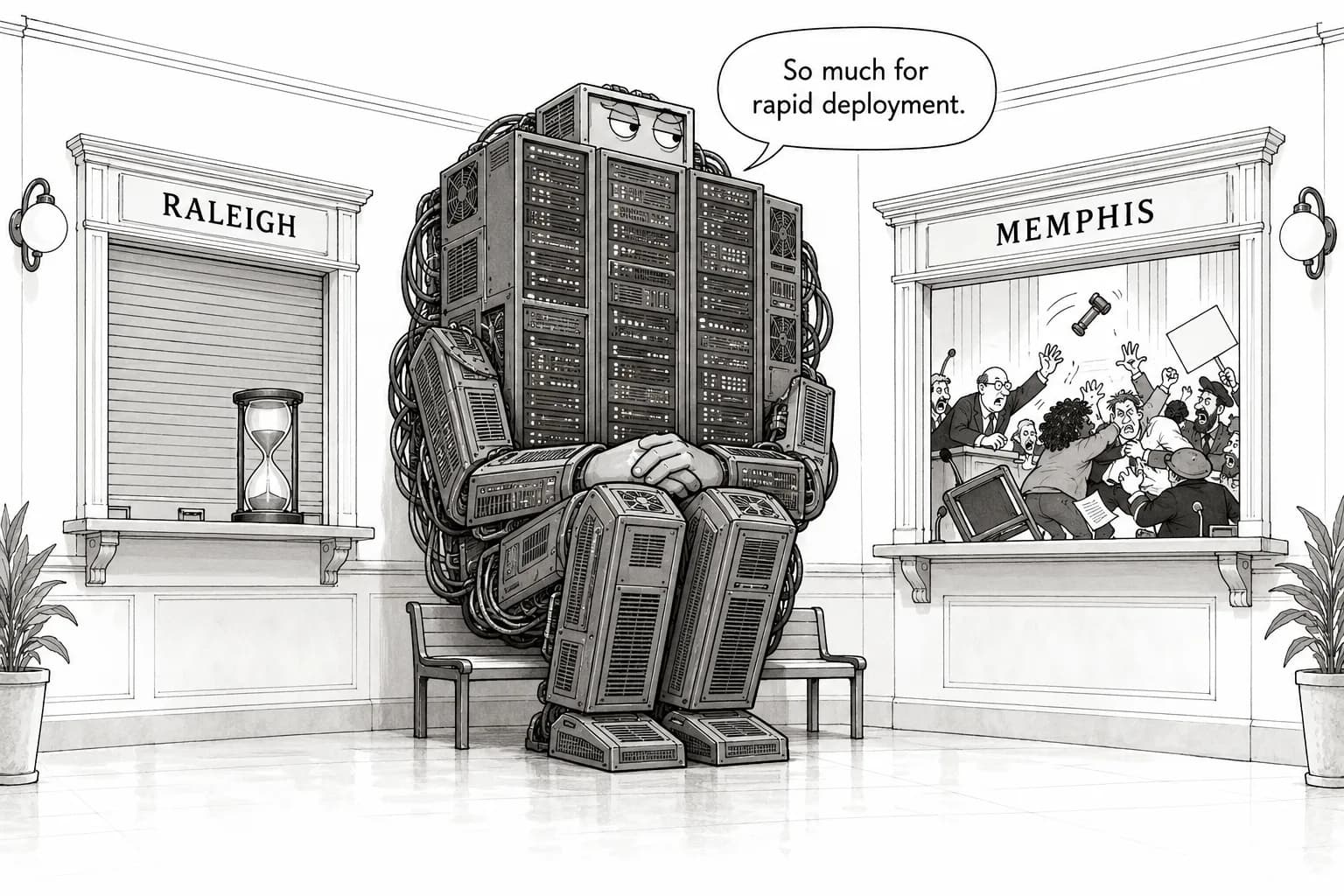
Local pushback against data centers has entered a new phase. The city council in Raleigh, North Carolina, approved a measure halting new large data centers for six months, Axios and CBS17 reported. The same week, the city council in Memphis, Tennessee, was also scheduled to vote on a moratorium. That measure is said to be aimed at xAI's site, but the meeting was reportedly cut short by protests and a fistfight, and the vote was pushed back again. One council passed its moratorium and the other descended into chaos. The outcomes differed, but both councils had put a pause on the agenda as their first step.
This article is based on media reports. Nohumans has not yet reviewed primary sources such as council minutes or voting records. Figures and events are described only as far as the cited reports go.
Memphis: A vote aimed at xAI collapses in a brawl
According to Action News 5 (October 6), the Memphis City Council's scheduled vote on a data center moratorium ended abruptly amid protests from the gallery and a fistfight. Fox News also reported that the council devolved into chaos and the vote was postponed. According to reports, this is not the first time the vote has been delayed.
Memphis is home to a large xAI computing site. The proposal is written as a general rule, but local debate reportedly revolves around xAI in practice. Could a moratorium halt expansions or related facilities at a site that is already running, or would it apply only to new operators? That line appears to be the main point of conflict between supporters and opponents. With the meeting collapsing before a vote, the question remains unresolved.
The date of the next vote and the measure's details (its duration, the size threshold it covers, and any exemptions) are unclear from the reports reviewed so far. They will need to be confirmed in follow-up reporting.
Raleigh: A six-month pause to rewrite land-use rules
Raleigh reportedly passed its moratorium without disruption. As Axios's headline indicates, the pause is paired with a revision of land-use rules for the AI era. Based on the reports, the city will stop accepting new applications for large data centers for six months and use that time to set rules on power, water, noise and siting.
Importantly, the moratorium does not ban data centers. Because current rules were not written with hyperscale facilities in mind, the city is buying time until it sets conditions. For a council, that is far easier to pass than a vote against a specific facility of the kind opposition campaigns seek. It also gives the city stronger leverage in negotiations with developers. How "large" is defined (by power capacity or floor area) and the vote count could not be determined from the information confirmed so far.
Moratoriums spreading to nearby localities
Memphis and Raleigh are not isolated cases. Among the cases Nohumans is tracking alone, data center votes are ongoing in Charlotte, North Carolina, and Beaufort County, South Carolina, while Loudoun County, Virginia, has a vote scheduled for October 20. New Mexico's Project Jupiter faces a public hearing on October 19 and a November 23 deadline. None of these has been decided yet.
Against this backdrop, Raleigh's vote carries particular weight. It gives Charlotte, in the same state, a precedent it can use as is. Once the language and the duration (six months) have passed somewhere, neighboring localities do not have to start the debate from scratch. Moratoriums are being copied as a template from one locality to the next.
What it means for compute
Frontier labs and hyperscalers have lined up power contracts and land years in advance. For those plans, a six-month local moratorium is no small matter. The six months themselves are not the problem. What matters is that the new rules that follow a pause could add conditions after the fact, such as self-supplied power, water use or tax arrangements. Where an existing site is at the center of the debate, as in Memphis, expansion plans themselves end up being decided in local politics.
Until now, local opposition has mostly taken the form of protests and lawsuits against individual facilities. This week's two council meetings show it shifting toward moratoriums adopted through formal municipal processes. The date and language of Memphis's next vote, the substance of Raleigh's rule revision, and Loudoun County's October 20 vote will be the next indicators of how far this chain reaction spreads.
Editorial cartoon
Sources
- https://www.actionnews5.com/2026/10/06/data-center-moratorium-vote-ends-abruptly-amid-protests-fistfight/
- https://www.foxnews.com/politics/memphis-city-council-devolves-chaos-data-center-moratorium-vote-postponed
- https://www.axios.com/local/raleigh/2026/10/07/raleigh-data-centers-six-month-moratorium-ai-zoning
- https://www.cbs17.com/news/local-news/wake-county-news/raleigh-city-council-approves-6-month-moratorium-on-large-data-centers/