Rules & Policy · Nov 19, 2026
US to require licenses for AI data centers in Singapore and four other countries, with rule expected to take effect on the 19th
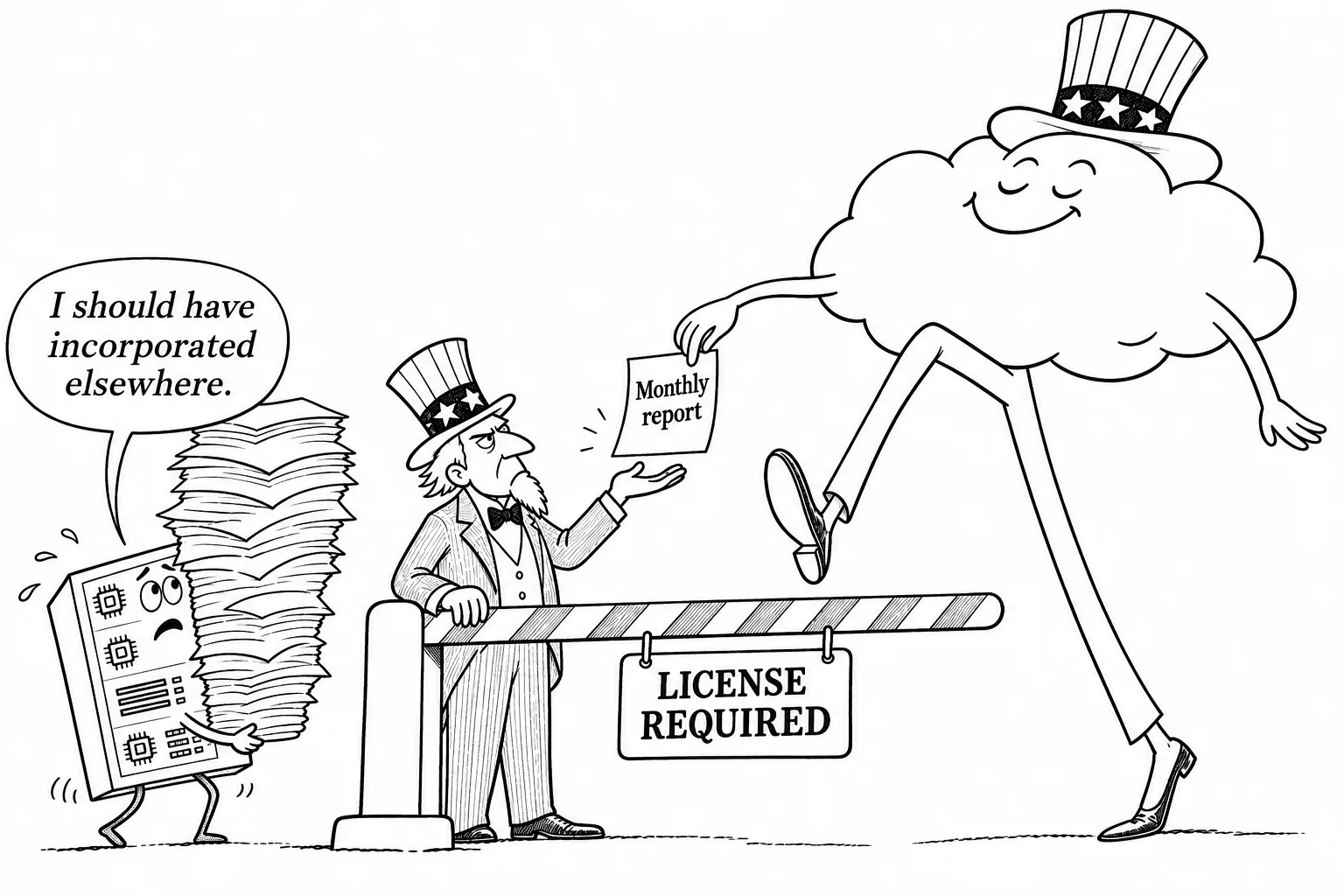
The rule covers data centers that use advanced chips. Large US cloud providers are exempt if they report monthly, so the licensing burden falls on local neocloud companies. Malaysia said, in effect, that operators must comply
Koji Yamamoto · Economics Analyst

Key points
- The US Commerce Department's remote-access rule is expected to be published in the Federal Register and take effect on November 19
- In five countries (Singapore, Malaysia, Indonesia, Thailand and Brazil), data centers using advanced chips will need a US license
- Large US-headquartered cloud providers are exempt if they report monthly, so the rule mainly hits local neocloud companies. Malaysia said, in effect, that operators must comply
The Bureau of Industry and Security (BIS), the US Commerce Department agency in charge of export controls, is issuing a rule that restricts "remote" use of advanced AI chips through overseas data centers. The rule is expected to be published in the Federal Register and take effect on November 19. It covers five countries (Singapore, Malaysia, Indonesia, Thailand and Brazil), where data centers using advanced chips will need a US license. Large cloud providers headquartered in the United States are exempt if they file monthly reports. As a result, the rule will in practice fall on local upstart cloud companies that rent out GPUs by the hour, known as neoclouds.
For Japanese companies: Most companies are not affected. If you only use large US cloud providers such as AWS, Microsoft Azure or Google Cloud at sites in Singapore or the other countries, the direct impact is likely to be small, because US-headquartered companies are exempt through monthly reporting. The companies affected are those that rent GPUs from local cloud companies in the five countries for AI training or inference, and those that invest in or operate data centers there. Those companies should check with their providers this month on whether they plan to obtain a US license, and what happens to their contracts if they cannot.
The US rule: licenses for advanced-chip data centers in five countries
The BIS remote-access rule targets a loophole: using advanced chips housed in overseas data centers over the internet, without moving the chips themselves. Until now, export controls have mainly restricted shipping chips from one country to another. If chips sat in a data center in a country without restrictions, even companies in restricted countries could rent the computing power alone. The new rule aims to close that gap by requiring a license to export advanced chips to data centers anywhere in the world that rent large amounts of computing power to companies in China and other countries of concern, and by also requiring a license to export advanced chips to the five countries of Singapore, Malaysia, Indonesia, Thailand and Brazil.
The BIS remote-access rule was posted for public inspection in the Federal Register (a procedure that makes documents public before formal publication) as document number 2026-23529. Publication is expected on November 19, and the rule is to take effect that day. Law firm Nixon Peabody, in an analysis dated November 16, described the rule as one "targeting remote access to advanced chips through overseas data centers."
Large US cloud providers exempt through monthly reporting, leaving local neoclouds in scope
The BIS remote-access rule has a major exception. Shipments to companies headquartered in the United States, or whose ultimate parent is in the United States, do not need a license as long as the exporter reports to BIS every month. Sites run by AWS, Microsoft, Google and others in the five countries can keep operating as before, as long as the reporting continues.
Because US-headquartered cloud giants are exempt, those needing licenses in the five countries are mainly local upstart cloud companies. These companies have won customers by renting out GPUs more cheaply and quickly than the big US providers. From the perspective of US authorities, they are also harder to monitor in terms of who is renting their capacity. The rule has a two-tier design: reporting is enough for the big US companies, while local companies that are harder to monitor must obtain licenses.
A design that favors US-headquartered cloud providers weighs heavily on local industry in the five countries. Singapore and Malaysia have sought growth by attracting AI data centers. While the big US companies need only report, local companies must wait for licenses. For customers, choosing a big US provider becomes the safer bet.
Malaysia calls for compliance, China pushes back
Malaysia's trade minister said, in effect, that data center operators must comply with the US remote-access rule, Tech Times reported, citing Reuters. Among the five countries, Malaysia has seen a rapid build-out of data centers, centered on the state of Johor. The country has made clear that it will not resist the US rule and will have local operators abide by it.
China's government criticized the US remote-access rule as "economic coercion," Tech Times reported (November 18). China's Commerce Ministry said it would take countermeasures if the United States does not change course, but what those would involve is not yet known.
ChinaTalk, a newsletter covering US policy on Chinese technology, covered the rule under the headline "BIS tackles compute leakage." Its assessment was that BIS had squarely addressed remote access, a loophole it had previously left untouched.
What is still unclear about the BIS remote-access rule
Several points about the BIS remote-access rule have yet to be confirmed. The rule covers advanced chips and servers falling under export control classifications such as 3A090 and 4A090, and the remote-access restrictions apply to data centers providing companies in China and other countries of concern with computing power exceeding a combined TPP (total processing performance) of 12 million. The monthly reports must include the recipient and its parent company, the item's classification and product name, TPP, quantity and shipment date. Details on how long licenses will take to be granted have not been confirmed. Data centers already renting large amounts of computing power to companies in China and other countries of concern before the rule was published must obtain a license within 90 days of the effective date (the date of Federal Register publication) to continue. Thailand's government said before the rule was announced that it would tighten screening of importers, and Indonesia's government is reviewing the rule, according to Tech Times. There has been no reported reaction yet from Brazil's government. Some are calling for a second rule to close loopholes that remain within the United States, and whether a next step follows will be closely watched.
The BIS remote-access rule does not include Japan among the covered countries. However, Japanese companies using local cloud companies in the five countries may need to switch computing providers, depending on whether their providers obtain licenses. A good first step is to check whether contracts with providers specify what happens if service is halted due to regulation.
Editorial cartoon
Sources
- https://www.federalregister.gov/api/v1/public-inspection-documents/2026-23529.json
- https://www.nixonpeabody.com/insights/alerts/2026/11/16/bis-targets-remote-access-to-advanced-chips-through-overseas-data-centers
- https://www.techtimes.com/articles/330982/20261118/beijing-calls-us-chip-export-rule-economic-coercion-malaysia-tells-data-centers-comply.htm
- https://www.chinatalk.media/p/bis-finally-takes-a-stand