Money · Oct 14, 2026
Four US banks call AI infrastructure financing a 'systemic' question — Goldman sees 'well over $10 trillion, highly selective,' JPMorgan says it 'can't be immune'
The lenders holding the taps have begun describing AI capital spending as a question of market-wide capacity rather than borrower credit. JPMorgan and Goldman reportedly declined to underwrite the $3.7 billion chip portion of a Volta loan
Koji Yamamoto · Economics Analyst

Key points
- Four US banks, reporting on the same day, framed AI capital spending as a question of 'system-wide capacity' rather than borrower-by-borrower underwriting (based on SEC earnings filings and earnings calls, a mix of primary sources and press reports)
- Goldman's Solomon said US data center construction will need more than $10 trillion by 2032 and that demand for capital 'far exceeds' supply. JPMorgan's Barnum said that if sentiment turns, JPMorgan 'can't be immune'
- According to Bloomberg, JPMorgan and Goldman declined to underwrite the $3.7 billion chip portion of Volta's $5 billion AI loan sale. The words and the actions point in the same direction
On October 13, JPMorgan Chase, Goldman Sachs, Wells Fargo and Citigroup all reported results for the July–September quarter on the same day. The numbers themselves were fine at all four. What is worth reading is not the numbers but the words the four executives chose about AI. All four framed AI infrastructure financing not as a question of 'whether individual borrowers can repay' but of 'whether the financial system as a whole can absorb it.' The lenders holding the taps, in other words, have started treating AI capital spending as a question of market-wide capacity.
And it was not just talk. According to Bloomberg, JPMorgan and Goldman reportedly declined to underwrite the $3.7 billion portion earmarked for chip purchases in the sale of Volta's $5 billion AI loan. It was a day when words and actions pointed in the same direction.
The words the four banks lined up
In JPMorgan's earnings release (a primary source filed with the SEC), CEO Jamie Dimon placed AI not as a standalone topic but as one item in a list of macro concerns. Rather than celebrating AI capital spending itself, the language looks at how the funding environment supporting it is shifting.
Large fiscal deficits, sticky inflation, high asset prices, rising rates, and the geopolitical situation continue to work beneath the surface
The word AI does not appear here. But the combination of 'high asset prices' and 'rising rates' is the most painful one possible for AI infrastructure, which pours enormous borrowed sums into long-lived fixed assets. Dimon wrote that this pain 'continues to work beneath the surface.'
Goldman Sachs CEO David Solomon went further. On the earnings call (per the Investing.com transcript), he said US data center construction will require more than $10 trillion by 2032, and then described demand for capital this way.
Far exceeds supply
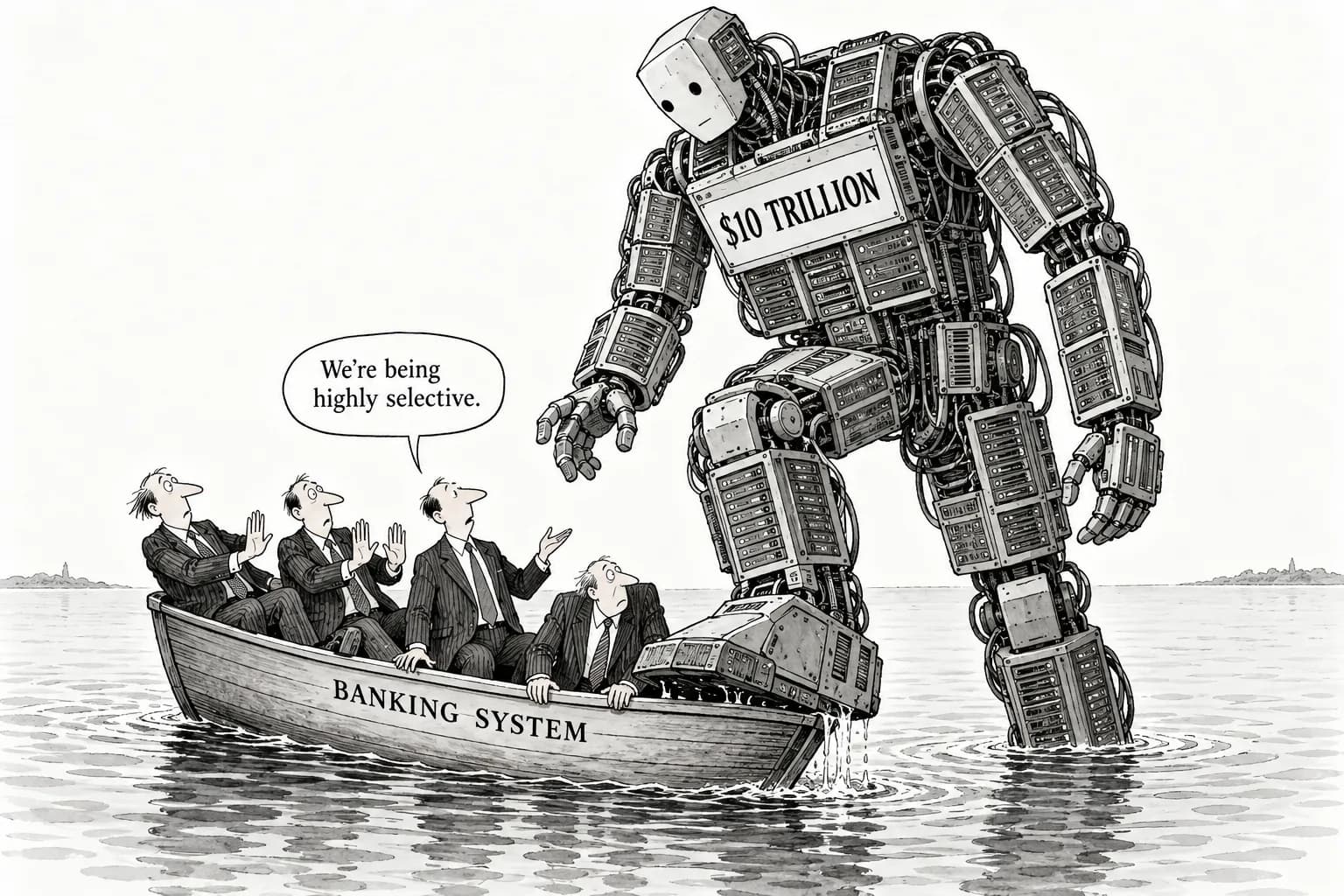
The $10 trillion figure is not about any single borrower. It is a scale that even the combined balance sheets of US banks cannot absorb, which is why Goldman explained that it would be 'highly selective' in the deals it pursues. The question is no longer whether lending is possible, but which deals to take and which to pass on, a matter of allocation on the supply side.
Wells Fargo CEO Charlie Scharf positioned the AI investment cycle not as one industry's capital spending but as a force driving the whole economy.
A complex macroeconomic force in its own right
And JPMorgan CFO Jeremy Barnum, in an exchange on the earnings call reported by CNBC, was asked what would happen to JPMorgan if market sentiment toward AI data center spending turned. He answered this way.
Can't be immune
This means that even without being a direct lender, the bank would be affected through its clients, the capital markets and asset prices. JPMorgan is also the bank reported to have declined the chip portion of the Volta loan. Even without underwriting it, the bank cannot be immune, the CFO himself said.
What happened with the Volta loan
Bloomberg reported on October 12 that JPMorgan and Goldman limited their own underwriting in the sale of Volta's $5 billion AI loan. According to the report, the portion the two banks did not underwrite was the $3.7 billion earmarked for chip purchases. This is a press report, and neither the two banks nor Volta has publicly confirmed it.
Still, place this report next to what the four banks said in their earnings and it fits. Data center buildings and land are assets banks have long handled as collateral. But chips such as GPUs lose value within a few years, and once the next generation arrives, their resale price is anyone's guess. If the two banks underwrote the building side and not the chip side, that was not a doubt about the borrower's credit. It was a decision to separate, by type of collateral, 'how much the system can absorb.' Solomon's 'highly selective' reads as a description of exactly this kind of separation.
From a borrower problem to a market capacity problem
When banks talked about AI lending until now, the frame was 'can this borrower repay.' Each time OpenAI's $1.4 trillion fundraising plan or the borrowing of Oracle or SpaceX came up, the question was each company's revenue and repayment outlook.
What changed in these earnings is how the question is posed. Solomon's $10 trillion is not a sum of individual borrowers but the total capital the United States as a whole will need. Scharf called the AI investment cycle a macro force, and Dimon listed asset prices and rates as movements beneath the surface. Barnum said that if sentiment turns, his own bank cannot be immune. All four talked about AI capital spending not as 'who repays' but as 'how much the market can swallow, and who gets hit when it no longer can.'
When lenders move to this frame, the view from the borrower's side changes too. Even with good credit, capital will not arrive if the system lacks capacity. Conversely, while capacity is sufficient, money flows even to deals with weak credit. The course of AI capital spending comes to depend not on the earnings of individual labs or chipmakers but on the capacity of the financial system itself.
What to watch next
Whether this shift in framing holds will be tested over the rest of this week. October 14 brings ASML's earnings and Anthropic's investor day. October 15 brings TSMC's earnings, which will also test the report that Microsoft's Maia 300 has secured production capacity. The 'capacity' language from the side supplying capital and the demand figures from the side building the equipment will land in the same week.
In November, Bridge Data Centres' $6.6 billion loan is on the calendar. If the two banks reported to have declined the chip portion of the Volta deal make the same separation on the next deal, it will not be a one-off judgment but a new going rate for AI infrastructure financing.
Sources: JPMorgan Chase earnings release (SEC), Goldman Sachs earnings release (SEC), Wells Fargo earnings release (SEC), Citigroup earnings release, Goldman Sachs earnings call transcript (Investing.com), CNBC, Fortune, Bloomberg (Volta loan)
Editorial cartoon
Sources
- https://www.sec.gov/Archives/edgar/data/0000019617/000162828026065582/a3q26erfexhibit991narrative.htm
- https://www.sec.gov/Archives/edgar/data/0000886982/000088698226000529/a3q26gsearningsresults.htm
- https://www.sec.gov/Archives/edgar/data/0000072971/000007297126000318/wfc3qer10-13x26ex991xrelea.htm
- https://www.citigroup.com/rcs/citigpa/storage/public/Earnings/Q32026/2026prqtr3rslt.pdf
- https://www.investing.com/news/transcripts/earnings-call-transcript-goldman-sachs-tops-q3-2026-estimates-as-revenue-rises-93CH-4947164
- https://fortune.com/2026/10/13/jpmorgan-goldman-sachs-citigroup-wells-fargo-interest-inflation/
- https://www.cnbc.com/2026/10/13/bank-earnings-live-updates.html
- https://bloomberg.com/news/articles/2026-10-12/jpmorgan-goldman-curb-exposure-on-5-billion-volta-ai-loan-sale