Work & Society · Oct 13, 2026
At least 36 localities to vote on data centers in November, as a poll finds 11% support and 65% opposition to local construction
Construction continues as AI labs look for compute, but local opposition has reportedly moved past complaints and petitions to the ballot box
Koji Yamamoto · Economics Analyst

Key points
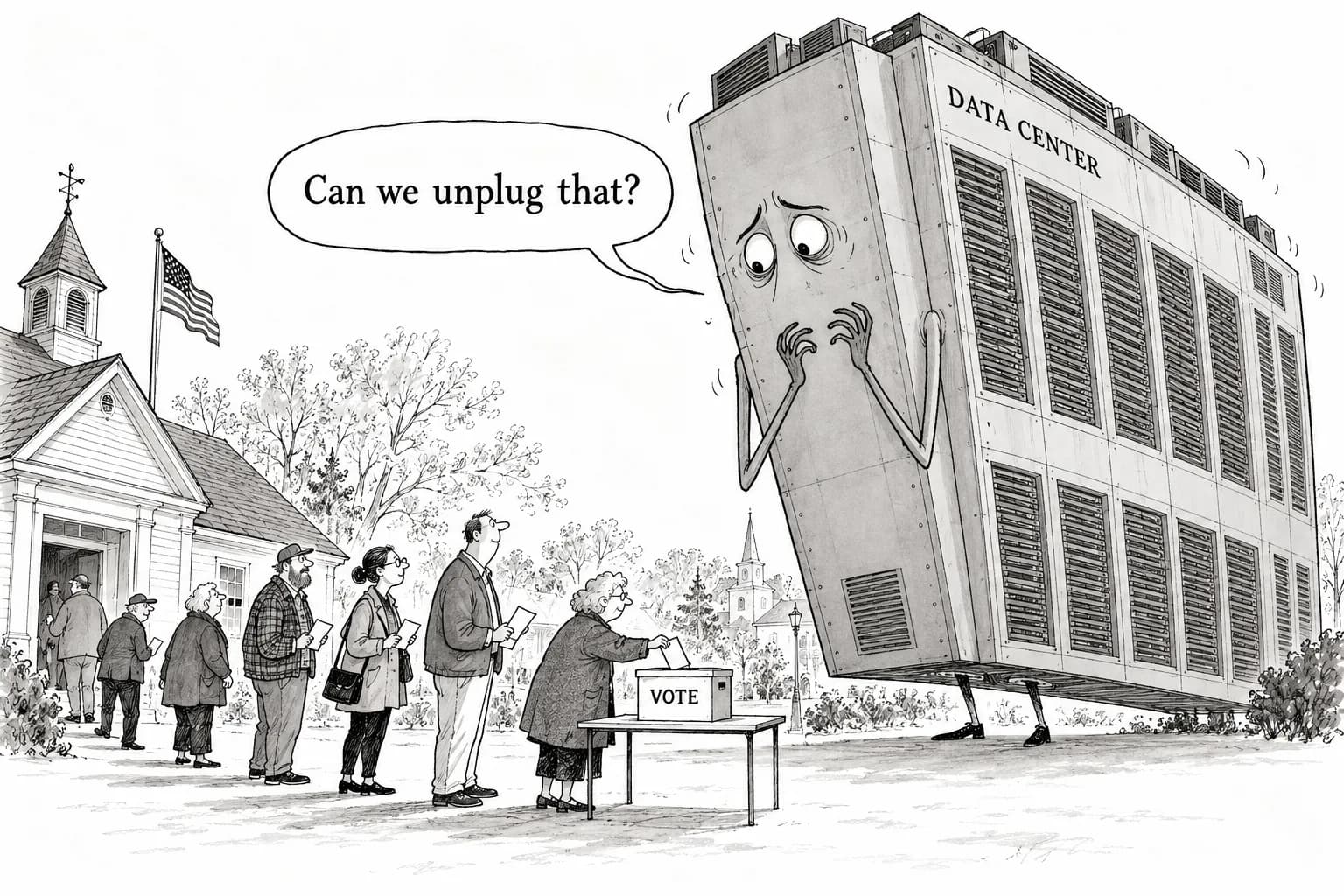
- Stateline reported that at least 36 localities will hold votes in November on measures that could ban data center construction
- The report also cites a poll in which 11% supported building a data center locally and 65% opposed it
- As AI labs rush to sign huge leases, the limits on compute are being set not only by power and chips but also at the ballot box
Opposition to AI data centers has reportedly moved beyond residents' complaints. Stateline, which covers U.S. state governments, reported on Oct. 12 that at least 36 localities will put measures that could ban data center construction to voters in the November midterm elections (Stateline). The same article cites a poll in which 11% supported and 65% opposed building a data center in their area.
Note: This story is based on news reports. We were unable to access the full text of the article, so we have not confirmed which 36 localities are involved, whether the measures are outright bans, temporary moratoriums or zoning changes, or who conducted the poll, when, and how many people were surveyed. All figures below should be read as reported by Stateline.
What was reported
The Stateline report makes two main points. The first is that the fight over data centers has shifted from public hearings and petitions before county and city councils to ballot measures, where voters decide directly. In at least 36 localities, measures that could halt construction will reportedly appear on the ballot in the Nov. 3 midterm elections.
The second is how lopsided public opinion is. Support for local construction stood at 11%, while opposition, at 65%, was about six times higher. The remaining roughly one-quarter of respondents appear to have been neutral or unsure. Because the poll's design is unknown, the gap cannot be taken as a measure of national opinion. Even so, in a ballot measure, a large majority against a project can translate directly into the result.
From complaints to votes: what changes
Until now, opposition to data centers has mostly come in the form of complaints about noise, water use, rising electricity bills and the effect on the landscape. When opposition took that form, developers could negotiate with local councils and officials and move ahead with construction in exchange for tax breaks or contributions to the community.
A ballot measure narrows that channel for negotiation. Voters decide the question all at once, and a measure that passes is harder to overturn than a council decision. If the 11% support and 65% opposition figures hold roughly in actual voting, construction could reportedly be stopped in many of the 36 localities. For developers, this means that when choosing sites, they will need to gauge the likely outcome of local votes, in addition to power contracts and transmission capacity.
It also matters that the votes coincide with the midterms. If candidates make their position on data centers a campaign issue, the ballot measures could spill over into state and federal races. The headline of Stateline's article reflects the same view, that the backlash against data centers could sway the midterm elections.
The builders' side
Opposition has moved to the ballot just as demand for construction has grown to an unprecedented scale. As we previously reported, The Information reported on Oct. 11 that Anthropic is pressing its partners to speed up data center leases worth about $530 billion (the article is paywalled and we have not read its full text, and Anthropic has not confirmed the report). Analysts reportedly estimate that a single 245MW site would bring in about $1.3 billion a month. The same report said Anthropic had signed a cloud contract with IREN.
Securing this compute ultimately means putting buildings and substations on land in some locality. The more capacity labs need to train and run their models, the greater the impact when more sites are rejected by local communities. Chip and power supply are no longer the only factors that limit compute.
What comes next
Data center proceedings will continue in many places before the Nov. 3 vote. Among the cases we are following, New Mexico's Project Jupiter has a public hearing on Oct. 19, with a deadline of Nov. 23. Cases in Memphis and Loudoun County, Virginia, are scheduled to move forward on Oct. 20, and zoning in Lexington, Kentucky, on Oct. 22. Another open question is whether developers' moves to stop using non-disclosure agreements (NDAs) with local governments will ease opposition.
Much remains to be confirmed: the list of the 36 localities and what each measure does; who conducted the poll, when, and whom it surveyed; and how many of the measures that could ban construction pass when the votes are counted on Nov. 3. We will check Stateline's primary sources and each locality's official election notices and report back in a follow-up.
Editorial cartoon