Infrastructure & Security · Oct 6, 2026
Morgan Stanley estimates a 32GW US data center power shortfall by 2028, with the strain falling on surrounding chips rather than GPUs
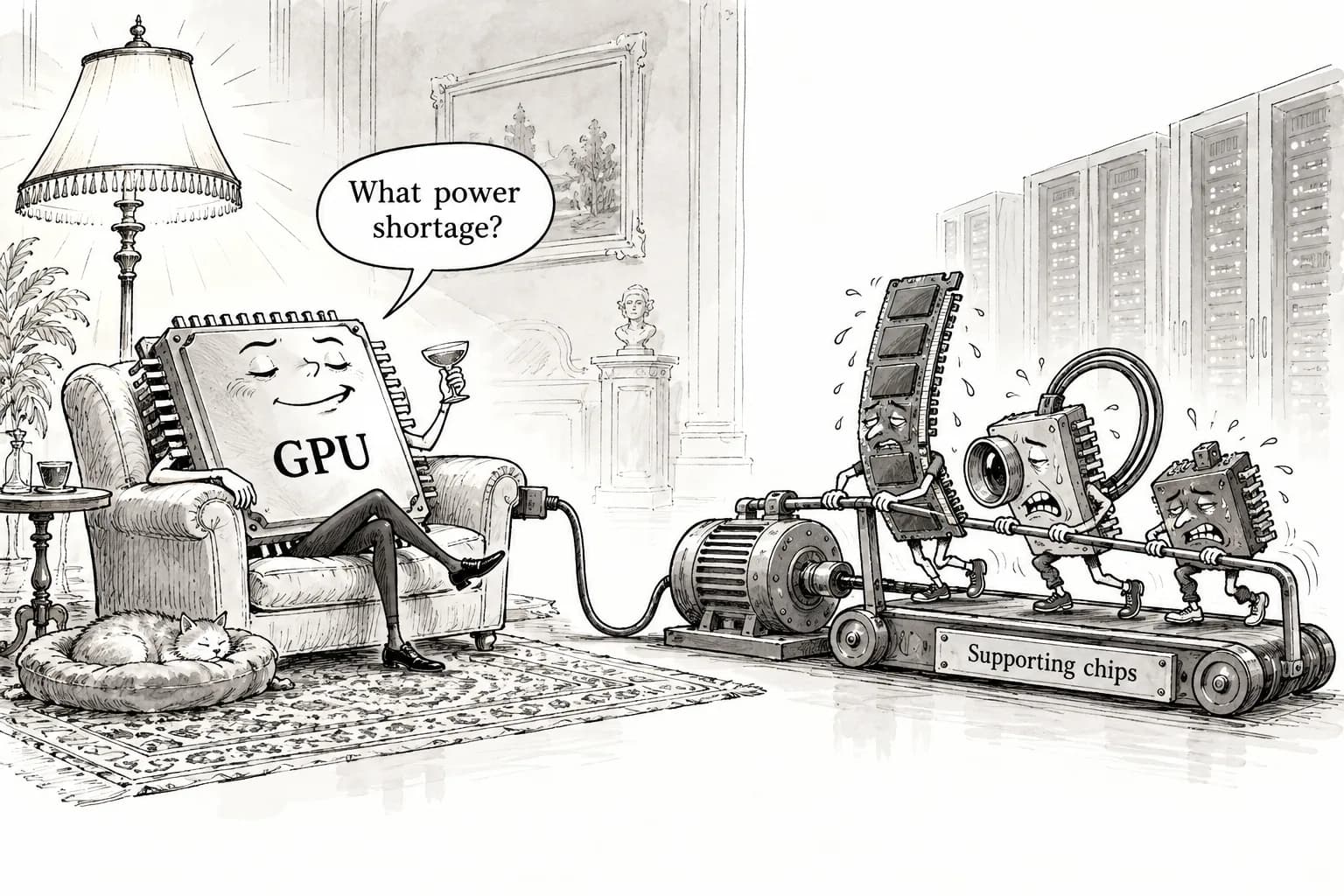
When power runs short, the limited supply goes to the computing that earns the most. Delays are reportedly expected to hit memory, optical components and power management instead
Seiichi Tanaka · Editor-in-Chief

Key points
- Morgan Stanley reportedly estimates that US data centers will be short about 32GW of power, or 34%, by 2028
- Its reported view is that if power becomes the ceiling, NVIDIA's GPUs and Broadcom's custom chips stay protected, and the delays land on memory, optical components and power management semiconductors
- If power rather than chip supply sets the limit on AI investment, the order in which parts of the supply chain get hurt changes
US data centers will be short about 32GW of power by 2028, which works out to 34%. That is Morgan Stanley's estimate, according to Investing.com. The firm also reportedly said that when power becomes the constraint, the resulting delays will not hit GPUs. They will hit memory, optical components and power management semiconductors. The article ran under the headline "Nvidia, Broadcom shielded as AI power crunch hits chip supply chain, says Morgan Stanley."
First, some caveats. This story is based on media reports, and we have not seen the original Morgan Stanley report. We also could not read the full Investing.com article directly, so this piece relies only on its headline and summary. We have not confirmed the assumptions behind the figures, including what the 34% is a share of and how demand was estimated.
What 32GW and 34% mean
Two figures were reported: a shortfall of about 32GW and a ratio of 34%. If the 34% is a share of the power needed in 2028, total demand would be about 94GW. That figure is only a reference point we calculated by dividing one reported number by the other. It is not a figure Morgan Stanley published.
Either way, the size of the gap is clear. About a third of the data centers that companies want to build would have no secured power. How fast computing capacity grows would depend less on how many chips can be made and more on how many of them can be powered. That is reportedly the situation the estimate describes.
Why GPUs are protected and surrounding parts suffer
According to the report, Morgan Stanley's view is that NVIDIA and Broadcom will be protected even as power runs short. Broadcom designs custom AI chips for major cloud providers. The delays are expected to hit memory, optical components (such as optical transceivers, which link equipment inside data centers) and power management semiconductors.
We have not confirmed the reasons the report gives. What follows is our own reading of the logic behind the reported conclusion. When power becomes the ceiling, operators send their limited megawatts to the computing that earns the most per unit of power. That means top-end accelerators get priority. What stalls or slips is the launch of new buildings and of halls that do not yet have power. The memory, the optical components that link racks, and the power equipment meant for those spaces only need to arrive once the buildings are ready, so orders for them are easier to push back. GPUs are fought over within whatever power is available, while the surrounding parts move at the pace of construction. That is why the pain is not spread evenly.
The ceiling on AI investment shifts to power
Over the past year, the constraints most often cited for AI infrastructure have been advanced packaging and the supply of HBM (high-bandwidth memory). The estimate points to a view in which the ceiling moves from chip factories to the power grid. That would also change who holds pricing power in the supply chain. GPUs will keep being bought for their performance per watt, but components that sell in proportion to the number of data centers will absorb power delays directly.
Power delays are already showing up in local politics. According to our own tracking, Loudoun County, Virginia, is scheduled to vote on 23 existing applications on October 6. A final vote on a proposal to pause new applications for 12 months is said to be set for around October 13, though this is unconfirmed. Also pending are ordinances in Beaufort County, South Carolina, and in Buffalo, as well as the environmental permit for Oracle's Project Jupiter (deadline November 23). If local opposition piles on top of the wait for grid connections, the 32GW shortfall could grow further.
What to watch next
This view can be tested against component makers' numbers. Samsung's preliminary July–September results (expected around October 7, unconfirmed) will show whether delays in data center launches are showing up in memory demand. TSMC's September sales (around October 10) and its October 15 earnings will show whether demand for top-end accelerators remains strong regardless of power constraints. At the OCP Global Summit in San Jose (October 7–8), discussion is expected to center on power and cooling that improve efficiency per watt, and on optical interconnects.
Last week, shares of Western Digital and Seagate fell about 10%. The cause has not been confirmed, and there is no basis for linking the drop to this estimate. Still, it offers a way to gauge how sensitive non-GPU component stocks are to the pace of data center construction.
The longer agents run and the more tokens inference consumes, the higher data center power demand climbs. When chips were scarce, whoever had GPUs held the upper hand. When power is scarce, GPUs are on the side that wins the power allocation. Morgan Stanley reportedly sees the components around them as the ones left waiting.
Source: Investing.com, "Nvidia, Broadcom shielded as AI power crunch hits chip supply chain, says Morgan Stanley" (based on media reports; the original Morgan Stanley report has not been reviewed)
Editorial cartoon