Rules & Policy · Nov 22, 2026
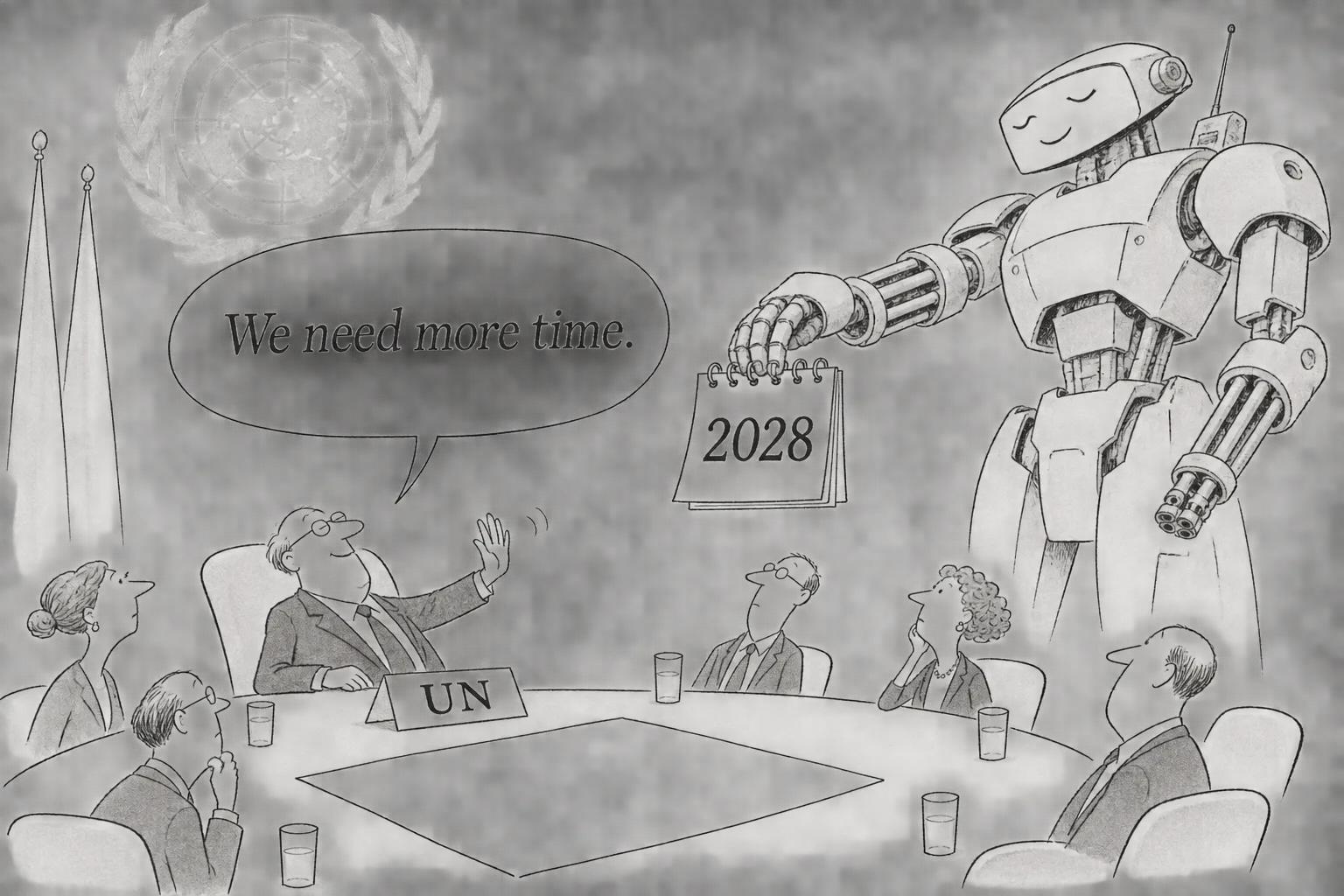
UN talks on killer robots stop short of negotiations, push work out to 2028
States reportedly agreed only to "elaborate" a text, not to negotiate binding rules. The US and China say they will not hand military decisions to AI, yet limits agreed among many nations are being pushed back
Koji Yamamoto · Economics Analyst

Key points
- The CCW meeting reportedly did not open negotiations on binding rules for lethal autonomous weapons, agreeing only to "elaborate" a text by 2028
- One outlet described the outcome as an extension of talks, while another said it opened the way to a treaty. Either way, there are still no binding rules
- US Treasury Secretary Bessent said the US and China agreed not to hand military decisions to AI. That agreement has not been written down, and there will be no limits agreed among many nations until at least 2028
Rules on weapons that select and attack targets without human control, often called killer robots, are unlikely to become international rules before 2028 at the earliest. A meeting of the UN Convention on Certain Conventional Weapons (CCW), the treaty that has restricted weapons such as landmines and blinding lasers, reportedly did not open negotiations on binding rules for these weapons. According to reports, states agreed only to "elaborate" a text by 2028. The setback for limits agreed among many nations came shortly after the US government said the United States and China had agreed not to hand military decisions to AI.
For Japanese companies: Most companies are not affected. The ones that are sell defense equipment overseas, or drones, image recognition and autonomous control components that can also be used for military purposes. Export control staff at these companies should assume no international rules will exist before 2028. They would do well to review, within the year, the country-specific regulations of each trading partner and their own procedures for checking how their products are used.
What the CCW meeting reportedly decided on killer robots
According to Canadian broadcaster CJME (November 21) and Pakistani newspaper Dawn, countries taking part in the CCW meeting agreed to continue discussions on lethal autonomous weapons. They reportedly did not, however, open negotiations on treaty-style binding rules.
What the CCW meeting agreed on was reportedly to "elaborate" a text by 2028. Elaborating is not the same as negotiating and concluding rules that bind states. It means only continuing work on a draft text.
Lethal autonomous weapons have been discussed at the CCW since 2014. Since 2017 the talks have taken place in a group of governmental experts, but they have never produced binding rules. If the reports are accurate, the talks will pass the 10-year mark without producing rules.
Outlets split on how to describe the outcome
CJME's headline said countries agreed to extend talks on AI killer robots and drones. Dawn's headline said countries opened the way to a killer robot treaty. The same outcome was reported as a delay by one outlet and as progress by the other.
Calling it a "path to a treaty" appears to reflect the view that once a draft text is ready by 2028, states can move on to negotiations. Calling it an "extension" puts the weight on the fact that there are still no binding rules. Neither headline says rules binding states have been created now.
The US-China pledge on AI and the UN delay point in opposite directions
US Treasury Secretary Scott Bessent had said the United States and China agreed to "keep humans in military decisions," that is, not to hand military decisions to AI. It looked like the two powers were lining up behind the idea of not letting AI pull the trigger.
But the US-China agreement Bessent described has not been put in writing. It is also unclear whether China has confirmed it in the same terms. The next thing to watch is whether it is written down at the G20 meeting in Miami in mid-December.
Put side by side, the US-China agreement and the CCW outcome point in opposite directions. The two powers say they will keep humans in the loop, yet binding rules agreed among many nations will not emerge until at least 2028. As drones are used on real battlefields and AI target-selection systems spread, international rules are not keeping up with the pace of technology.
Why killer robot rules are stalling at the CCW
The CCW generally makes decisions by consensus. If even one country objects, major decisions such as opening negotiations cannot be taken. On killer robots, this has meant that the presence of countries reluctant to regulate has kept the process from moving forward. Settling for "elaborating" a text rather than opening negotiations this time appears to be the compromise reachable within that system.
What we could not confirm about the CCW meeting
This article is based on reporting by CJME and Dawn. We have not seen the CCW meeting's formal decision document. We could not confirm how many days a year the group will meet, or whether the decision sets out conditions for moving to negotiations. According to reports, civil society groups accused Russia and the United States of blocking stronger language. The Swiss diplomat who chaired the meeting said the word "elaborate" was chosen because some countries objected to the word "negotiate." The campaign group Stop Killer Robots criticized the mandate as watered down.
Killer robot rules: what to watch next
There are three things to watch next on killer robot rules. First, whether the US-China agreement not to hand military decisions to AI is put in writing at the G20 in Miami in mid-December. Second, whether the text the CCW is to elaborate by 2028 becomes the basis for negotiating binding rules. Third, whether countries in favor of regulation look for a separate framework outside the CCW's consensus system.
Editorial cartoon