Infrastructure & Security · Oct 14, 2026
Korean memory stocks fall for a second day: KOSPI −5.46%, SK hynix −10%, Kioxia −13% as CXMT's DRAM and Broadcom CEO's 'casino' remark become a pretext for capital outflows
Doubts about the ceiling of the memory boom acquired concrete names and quotable words, turning into foreign selling. ASML's earnings on October 14 and TSMC's on October 15 are the next test
Seiichi Tanaka · Editor-in-Chief
Key points
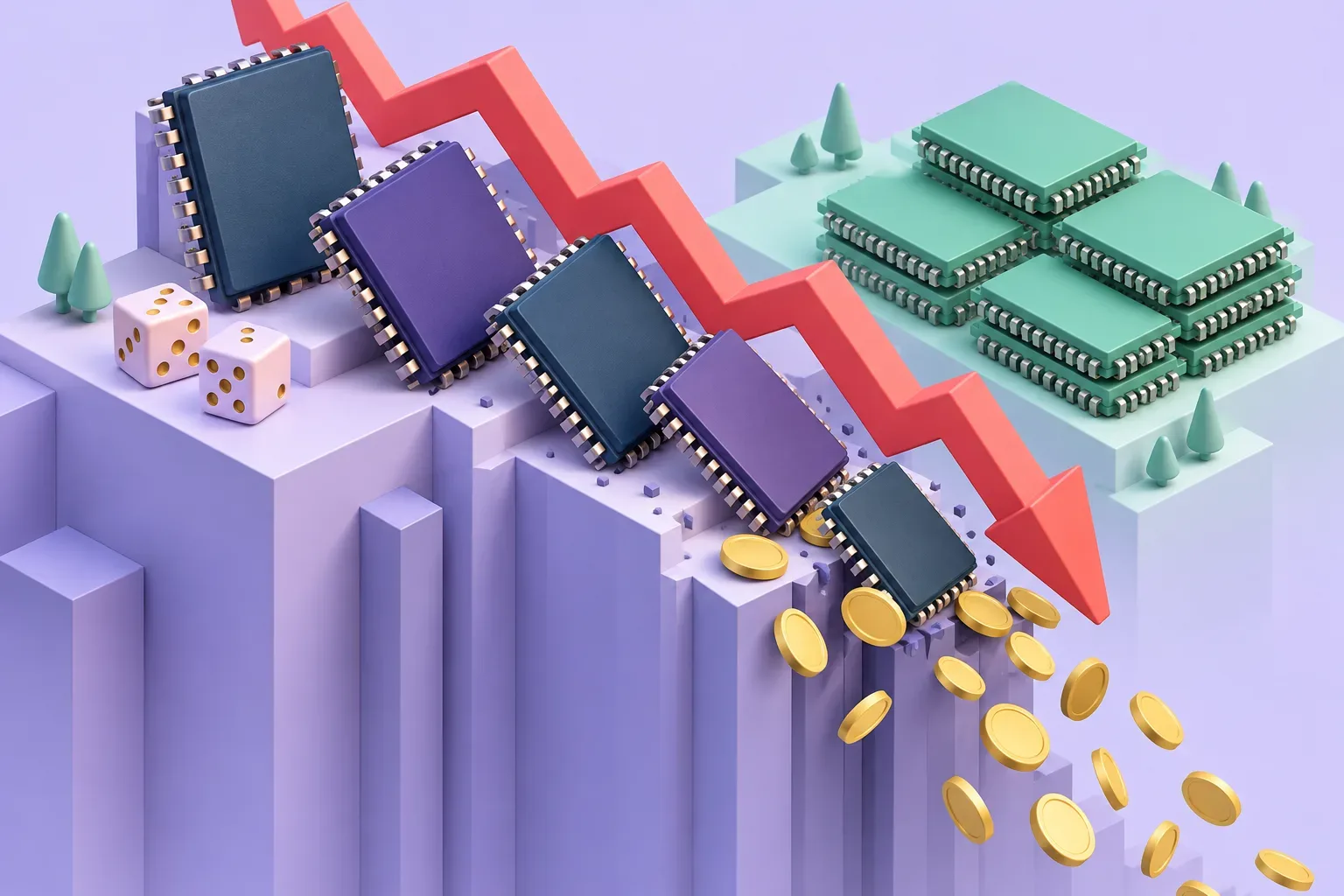
- Korean memory stocks doubled their decline on the second day, with the KOSPI reportedly closing at −5.46% and SK hynix at −10%. Japan's Kioxia followed at −13%
- There were two pretexts for the selling: a concrete name, China's CXMT and its 4F² DRAM, and Broadcom CEO Hock Tan's remark that 'investors are almost like being in a casino'
- Doubts on the supply side (CXMT) and the capital side (Hock Tan, Lip-Bu Tan) converged in the same week and turned into foreign selling. ASML's earnings on October 14 and TSMC's on October 15 will test the numbers on the demand side
The decline in Korean memory stocks did not stop after a single day. The Korean market on October 13 closed with roughly double the previous day's losses, with the KOSPI at −5.46% and SK hynix at −10%, according to SBS and Asia Economy. Japan's Kioxia followed at −13%. This article is based on press reports; primary information from the exchanges or the companies themselves has not been obtained.
The previous day's decline had been attributed to Microsoft's announcement of Azure Maia 300, its in-house chip for inference, and to speculation surrounding DRAM from China's CXMT (ChangXin Memory Technologies), as previously reported. The acceleration on the second day was reportedly not so much the result of new facts emerging, but rather that doubts about the ceiling of the memory boom acquired a concrete name, 'CXMT's 4F² DRAM', and a quotable phrase, the 'casino' remark by Broadcom CEO Hock Tan, making them usable as reasons for foreigners to sell.
The second day's decline was double the first
According to SBS and Asia Economy, foreign investors were the main sellers on the 13th. Foreigners sold further the stocks that had fallen the day before, and within the Korean market the selling was concentrated in the two memory companies, SK hynix and Samsung Electronics. Seoul Economic Daily (Sedaily) reported that the decline pushed the Korean market's total capitalization below a key threshold, under the headline 'China chip fears return'.
The fact that Japan's Kioxia followed at −13% shows that the selling is directed at the memory sector itself, not at circumstances specific to Korea. Kioxia's main business is NAND, and its product mix differs from that of SK hynix. That the two nonetheless moved in the same direction on the same day means that what the sellers are looking at is not the performance of individual companies but a single question: how far can memory prices keep rising?
CXMT's 4F² DRAM gave the doubt a name
Doubts about whether the memory boom would continue had existed for some time. The question was how long the rise in HBM for AI, and in commodity DRAM dragged along with it, could last. Until now, however, that doubt had no concrete basis. This week, the name CXMT's 4F² DRAM filled that gap.
4F² is a structure that shrinks the area of a DRAM cell from the conventional 6F², allowing more chips to be taken from the same wafer. According to Seoul Economic Daily, speculation that CXMT is advancing DRAM with this structure reportedly ignited the view that the technological lead of Korea's two memory companies may not last long. When and at what scale CXMT's production will begin cannot be confirmed from the reports. Still, what mattered to the market was not the certainty of the facts but that a concrete name had been put forward on the side of increasing supply.
Whereas Microsoft's Maia 300 (previously reported) was a demand-side doubt, that demand for GPUs might decline, CXMT is a supply-side doubt, that the supply of DRAM might increase. With the two converging in the same week, the material for questioning the ceiling of memory prices was in place from both sides.
Hock Tan's 'casino' added pressure from the capital side
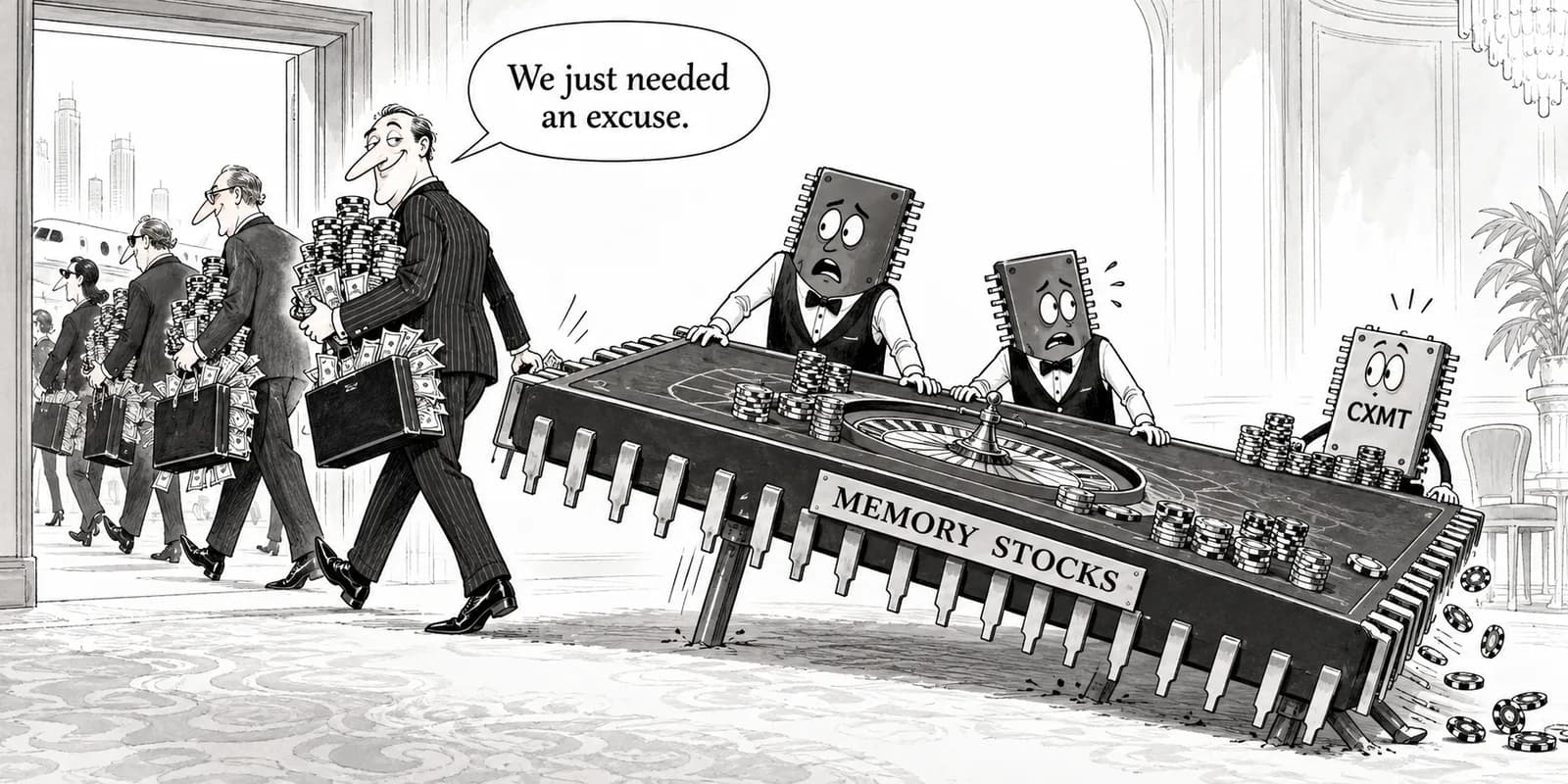
The other pretext was a remark from the head of a company on the demand side of semiconductors. Broadcom CEO Hock Tan spoke on October 12 at the DBS Asia Future Forward in Singapore about the flow of money into AI investment, as reported by The Next Web and CNBC.
Many investors have no idea what they are investing in... it's almost like being in a casino
Broadcom makes custom AI chips for hyperscalers and is one of the companies that stands to gain most from continued AI capital spending. For its CEO to liken investors' understanding to a 'casino' amounts to an admission that the money flowing into AI investment is not coming in with a grasp of the substance. The foreign money buying memory stocks is part of that same flow. The remark was not aimed at the Korean market, but Korean market participants reportedly read it as 'a reason for money to leave'.
At the same event, Intel CEO Lip-Bu Tan placed the next constraint on AI not on compute or power, but on capital itself.
If there is a challenge ahead, it is capital and the cost of capital
CNBC summarized the two executives' remarks as a warning that 'a capital crunch could become the AI bottleneck'. The constraints on AI discussed until now have been GPUs, power, and land for data centers. That the heads of two semiconductor companies named none of these but rather 'capital and the cost of capital' means a return to the premise that the investment side is not infinite. Since the rise in memory prices rests on the assumption that AI capital spending will continue, doubt on the capital side translates directly into doubt about memory demand.
Three doubts, on supply, demand, and capital, converged in the same week
This decline cannot be explained by a single factor. Maia 300 (the demand side) came the day before, followed on the 13th by CXMT (the supply side) and Hock Tan and Lip-Bu Tan (the capital side). Any one of them alone might have left memory stocks with a one-day correction. With all three lined up in the same week, the question of where the memory boom ends took a form sufficient to serve as a reason to sell.
The point worth noting is that none of these factors shows that real demand for memory has fallen. CXMT's DRAM is still at the stage of speculation, Hock Tan's remark concerned investors' understanding, and Lip-Bu Tan's concerned the cost of capital. Even so, the stocks fell sharply over two days. This shows that memory stock prices were shaped less by the numbers of real demand than by expectations about how long the boom would last.
The next test is the numbers on the demand side. ASML reports earnings on October 14 and TSMC on October 15. Whether AI capital spending is continuing shows up earliest in these two companies' orders and guidance. If both post strong numbers, this week's selling reverts to 'a temporary outflow that found a pretext'. If they are weak, doubts about the memory ceiling become not a pretext but a basis. Which numbers the money Hock Tan called a 'casino' is waiting for will become clear over those two days.
Editorial cartoon
Sources
- https://news.sbs.co.kr/english/article.do?news_id=N1008795608
- https://www.asiae.co.kr/en/article/2026101315545803228
- https://en.sedaily.com/finance/2026/10/13/china-chip-fears-return-as-korea-market-value-falls-below
- https://www.cnbc.com/2026/10/12/intel-broadcom-ceos-warn-capital-crunch-could-become-ai-bottleneck.html
- https://thenextweb.com/news/broadcom-hock-tan-ai-investors-casino-capital