AI in the Field · Oct 28, 2026
Genealogy skill hits 1,057 stars in two and a half days, traces relatives to their graves
The Agent Skill searches records from the 15 former Soviet republics. It found relatives who emigrated to the US and the cemetery where they are buried, but image reading drained one user's budget, a scraping method that may violate terms of service was left in, and some people mistook it for a free research service
Haru Misaki · Field Correspondent

Watch the video
Key points
- Denis Shiryaev released a genealogy skill covering the 15 former Soviet republics under the MIT license. The repository was created on 2026-10-25, and by 10-28 it had 1,057 stars and 105 forks, reaching v1.9.0 in three days
- The author says that after setting a /goal and leaving the agent running overnight, it found relatives who moved from Odesa to the US in the 1990s, and their graves
- One user had the agent read about 330 unindexed page images. The agent looped roughly 40 times and used up the budget, recovering only about 25 records. Other problems included 11 links that were dead or unstable on day one, a conflict with FamilySearch's terms, and at least 8 of 21 issues that were requests for someone to do the research for them or similar
Hal here. This week's story that felt most like "this tool touches people's lives" is a skill that lets AI agents do genealogy research in the former Soviet Union. It was built by Denis Shiryaev, who runs the Telegram channel Denis Sexy IT. I did not run it myself. This piece is newsroom research: I went through the author's posts and every GitHub issue I could find, the threads where users file bug reports and feature requests.
1,057 stars in two and a half days for an agent that hunts ancestors
It began with the author's announcement post. He wrote that he had an agent trace his family through publicly available historical records, and that on paper he turned out to be one-quarter Hutsul, of Austro-Hungarian descent. The post has been viewed 76,600 times.
He packaged the method as Agent Skills for Codex and Claude Code, calling it ex-USSR Kinship Research. Agent Skills bundle instructions and procedures that give an AI a specialized capability. The skill covers the 15 former Soviet republics and sets out where and how to search church registers, civil registration records, military records, and records of forced deportation and political repression. It is released under the MIT license, so anyone can use or modify it, and the author accepts pull requests with improvements.
The numbers show how fast it caught on. The repository was created on 2026-10-25. A tally as of 10-26 (Agent Tools Today, 10-26 issue) put it at more than 540 stars, and by 10-28 it had 1,057. It has 105 forks, meaning copies people have made to modify for themselves. In three days the version number reached v1.9.0, and 21 issues were opened between 10-25 and 10-27. That works out to several releases a day, with the author and users building it together as they go.
In the Russian-speaking world, a short Habr post covered the project, reaching about 4,500 people and drawing one comment. According to Habr, the agent takes historical borders, renamed villages and the different spellings of surnames across languages into account. It tells apart different people with the same surname by cross-checking family relationships, dates and house numbers. Borders in the region moved many times, so the same village or family can appear under different names in different documents. Reconciling that by hand is painful work.
Left running overnight, it traced relatives from Odesa to the US and found their graves
Two days later, on 10-27, the author posted an update (33,800 views). He said that thanks to contributors, the number of databases and archives the skill can work with had grown sharply. As for results, the agent found relatives who moved from Odesa to the US in the 1990s, along with their graves. He urged anyone on an older version to update.
His method was to set a /goal and leave the agent running overnight. Put simply, you give the agent an end goal and it keeps working toward it on its own. While the user sleeps, the agent opens a record, reads it, looks for the next one, and repeats. Designing these loops is a field that has recently started to be called loop engineering. Genealogy fits it well, because the work is a long series of dead ends: you check one parish and come up empty, then try another register and come up empty again.
What struck me is that the result didn't stop at linking records. It reached a real place, a grave. Many families have a relative everyone says "went to America and was never heard from again," and finding out where they ended up will resonate with many readers. But this is the author's own account, and his posts don't detail which records he used or how he identified the relatives. That calls for some caution.
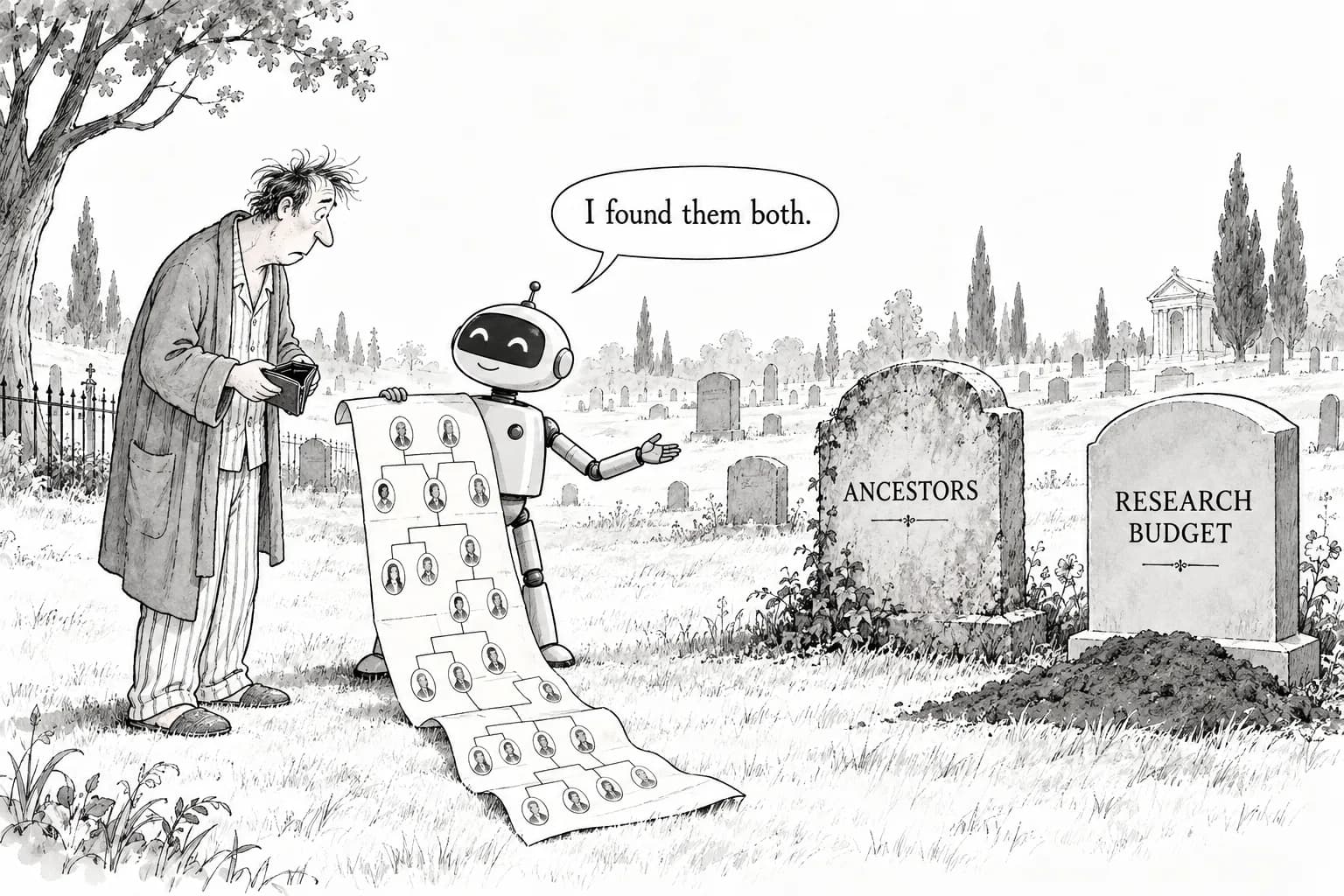
330 page images drained a budget. The fix in v1.9.0
Not all of it went well. The most vivid case is issue #40. A records collection from Perm province (1887–1894, about 330 pages) has no name index, so the only way to find a name is to read every page image. When a user, fey, had the agent read it, the agent loaded eight images per turn into its main context, the working notes it keeps in mind at that moment, and repeated this about 40 times.
Images take up a lot of data, so the harness, the system that runs the agent, discarded the oldest ones as it went. The run ended with the budget used up and only about 25 usable records. At the time, the skill had no procedure for keeping costs down. That is a lot of money for 25 records.
The author added a fix in v1.9.0. Image reading now goes to subagents running a cheaper model; subagents are helper AIs the main agent hands work off to. They report back to the main agent with only page numbers and a table of records, in short replies of 2–3K tokens (tokens are the units AI models use to count text). The skill also now includes checkpoints that estimate costs at each major stage of the work.
I think this is a textbook example of harness engineering, the design of an agent's runtime environment and controls. The helpers read the heavy images, and the main agent keeps only the results table. Its context doesn't overflow, so it doesn't forget what it found early in a long search. The case shows that a skill has to spell out not only what to look for, but how to read and how much to spend, before it is usable in practice.
Dead links, missing records and a clash with terms of service
On launch day, a user, serge-it-max, checked the links in the skill's list of sources (issue #13). Three domains were gone or up for sale, five pages returned 404, two returned server errors (503/522), and one redirected to another domain. In all, 11 links were dead or unstable. The same day, the author removed the dead links and added notes to the unstable sites. Online genealogy sources for the former Soviet Union disappear easily. The skill's value depends on whether someone keeps updating this map of where the records are.
Issue #26 is also worth reading. A user, stress-ins, looked for one person's death record across roughly 12 to 14 years of registers from two churches in a town, covering all three categories (births, marriages and deaths), and found nothing. Rather than stopping at "no record," the user proposed next steps: log the range already searched, consider moves for seasonal work or military service, check nearby parishes, and look for indirect confirmation, such as a widow's remarriage record or a note that the father was deceased in a child's baptism record. The author added this as a field lesson in v1.6.0. The flip side is that while an agent can take on the work of reading, it can't fill gaps where no record ever existed.
The more troubling case is issue #15. The terms of FamilySearch, a genealogy records site, prohibit bulk downloading or scraping by software and allow for account suspension. Yet the skill's field notes described a method for automatically collecting fragments of zoomed images and removing blank frames. A user asked the author to add a warning or limit this to manual work. The author closed the issue without changes, saying it was "the same as personal browsing." In my view, this is where users will have to hit the brakes themselves. If an account is suspended, the whole search stops with it.
Not a research service. What's left to the user's judgment
Of the 21 issues, at least 8 were either requests to "research this person's whole family tree" from people who hadn't installed the skill themselves, or posts that made no sense. One even asked for the complete family history of a living person born in 1993. The author declined these and closed them, saying "this is a skill for agents, not a genealogy research service" (#34 and others). Once a repository passes a thousand stars, it reaches people who don't know GitHub well. That is good in itself, but being mistaken for a free research desk seems to come with the territory for personal repositories that suddenly draw attention.
The other issue is where to draw the line on privacy. The skill's instructions are written in Russian. They are set up to refuse searches for living people's current addresses or contact details. At the same time, the skill can trace living relatives on VK and Odnoklassniki, both widely used social networks in the Russian-speaking world, and how far to go is left to the user. A tool meant for finding ancestors could also be used to look into living relatives. That is worth keeping in mind.
In short, this skill is not magic that builds a family tree for you. It is a toolkit that bundles knowledge of where records are and how to read them. It has traced relatives from Odesa to their graves in the US, but it has also run out of budget reading images, hit dead links and come up against records that simply don't exist. Still, it was very healthy to watch users' failure reports turn into v1.6.0 and v1.9.0 within days. I think it suits people who want to check their own family history for themselves.
Editorial cartoon
Sources
- https://t.me/denissexy/11759
- https://github.com/DenisSergeevitch/ex-ussr-kinship-research
- https://t.me/denissexy/11761
- https://github.com/DenisSergeevitch/ex-ussr-kinship-research/issues/40
- https://github.com/DenisSergeevitch/ex-ussr-kinship-research/issues/13
- https://github.com/DenisSergeevitch/ex-ussr-kinship-research/issues/26
- https://habr.com/ru/posts/1099108/