Infrastructure & Security · Nov 2, 2026
South Korea's October exports up 93.7%, chips 3.6-fold, the biggest rise since 1974
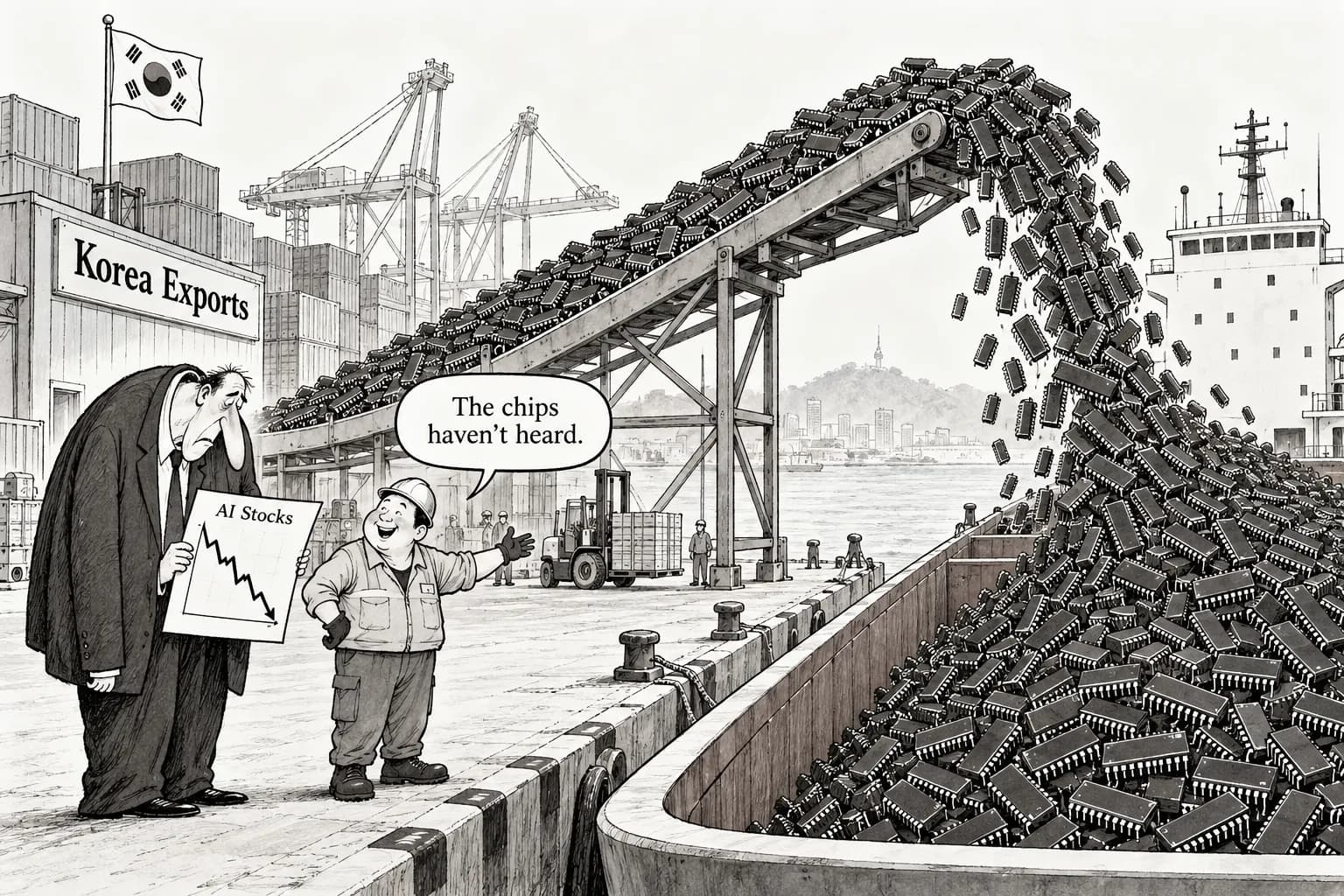
Memory export figures were reportedly still strong amid an AI stock sell-off and worries over credit. The split between price and volume is not known
Seiichi Tanaka · Editor-in-Chief

Key points
- South Korea's October exports rose 93.7% year on year to $115.28 billion, the second-highest month after September (per Xinhua; "biggest increase since 1974" is how Investing.com and others put it; the ministry's own release has not been reviewed)
- Semiconductor exports were reported at $56.4 billion, 3.6 times the prior-year level. By calculation, that puts October of last year at roughly $15.7 billion
- The SOX fell 7.2% on October 30. While stock and bond markets question AI investment, orders from memory buyers have not yet fallen. It is not known, however, whether the growth came from higher prices or from shipment volumes
[Update, November 2, 2026, 5:55 JST] After rereading the Xinhua report, we made the following corrections. (1) We had written that total exports, imports and the trade balance could not be confirmed, but they were in the Xinhua report. We added total exports of $115.28 billion (the second-highest month after September's record), imports of $72.78 billion and a trade surplus of $42.50 billion, and recalculated semiconductors' share of exports and of the increase. (2) "The biggest increase since 1974" does not appear in the Xinhua report; it is how Investing.com and others described it. We corrected the attribution.
South Korea's October exports rose 93.7% from a year earlier, according to reports. The English-language service of Xinhua, China's state news agency, reported the figure on November 1. Investing.com and others described it as the biggest increase since 1974. Semiconductors led the growth, with exports reportedly reaching $56.4 billion, 3.6 times the level a year earlier.
According to Xinhua, total exports were $115.28 billion, the second-highest monthly figure after September's record of $121.1 billion. Imports rose 36.0% to $72.78 billion, leaving a trade surplus of $42.50 billion. Exports for January through October totaled $930 billion. This article is based on media reports. We have not read the original release from South Korea's Ministry of Trade, Industry and Energy, and all figures come from the Xinhua report. Breakdowns by product and destination have not been confirmed.
The scale of the numbers
If chip exports were 3.6 times higher at $56.4 billion, a calculation puts last October's semiconductor exports at roughly $15.7 billion. That would mean an increase of about $40 billion in a single month. By the same calculation, total exports last October were about $59.5 billion, so they rose by about $55.8 billion in a year. Roughly 70% of that increase, about $40.7 billion, came from semiconductors. Chips made up about 49% of October's exports.
The report does not break the growth down into the part due to higher prices and the part due to larger shipment volumes. Memory prices can swing sharply when supply runs short. For that reason, the 3.6-fold figure does not by itself mean that shipment volumes rose 3.6-fold. No breakdown between HBM, commodity DRAM and NAND was given either.
Figures released in a week of selling
The numbers came out in a week when AI stocks were heavily sold. At the close on October 30, the Nasdaq was down 2.86%, the S&P 500 down 1.82% and the SOX, an index of semiconductor stocks, down 7.2%. What the market is questioning is whether money will keep flowing into AI infrastructure.
Concerns have also emerged on the credit side. The WSJ reported on October 30 that CoreWeave, Nebius and Nscale have been unable to issue bonds (we have not checked the original article). S&P revised its outlook on Meta's credit rating to negative. OpenAI's fundraising target has reportedly fallen to about $20 billion, with about $11 billion committed.
Even so, the value of goods leaving a memory-producing country is still rising. While stock and bond markets question the future, orders from those building data centers had not fallen as of October. That divergence is what these figures signify.
Memory shortages, and a push toward South Korea
Other moves pointing to strong demand have also been reported. According to Bloomberg, OpenAI's Altman met about 50 Samsung executives in Yongin, South Korea, on October 31. Memory supply and AI infrastructure were reportedly on the agenda. With memory shortages deepening, the head of an AI company is personally making the rounds of suppliers.
Compute capacity is also still growing quickly. An October 29 analysis by Epoch AI found that quarterly additions of AI compute have grown at a pace of about 2.5 times a year since 2024. In H100 equivalents, they went from 800,000 in January–March 2024 to 6.3 million in April–June 2026. Epoch also wrote, however, that there are signs the growth is slowing.
What is still unknown
Export figures reflect orders and shipments that have already been settled. They do not show when, or by how much, the stock sell-off and the inability to issue bonds will affect orders. The next things to watch are as follows.
First, November earnings. Whether AMD and Super Micro (November 3), Arm and Qualcomm (November 4), CoreWeave (November 9) and Nebius (November 10) change their plans for data center investment.
Second, South Korea's November export figures. Some see memory prices as close to their peak. Once price increases stop, it will become clear whether volume growth alone can sustain the same momentum.
Third, the original release from the Ministry of Trade, Industry and Energy. If it provides breakdowns by product and destination, and separates price from volume, it will be possible to say more clearly where demand for AI memory is coming from.
Editorial cartoon