Opinion · Oct 22, 2026
A publisher that chose "the word of the human" over a machine dropped its author a week later: in the Orélien case, the line on authorship was drawn not at whether AI was used, but at whether the author denied it
Éditions du Boréal never said how much AI was used. It cut ties because the author's denial fell apart
Koji Yamamoto · Economics Analyst

Key points
- On October 14, Boréal co-director Roussel reportedly said he would choose the author's word over a machine of doubtful reliability, and that it was not the publisher's role to investigate how an author writes
- On October 21, the company reportedly said it had confirmed that AI was used in writing "C'était ça ou mourir," and that because the author's claim not to have used it had been disproved, the professional relationship could not continue
- The company has not said how much AI was used. The line was drawn not at the amount used or at a machine's verdict, but at the author's own account. This writer argues it is the most defensible line available today
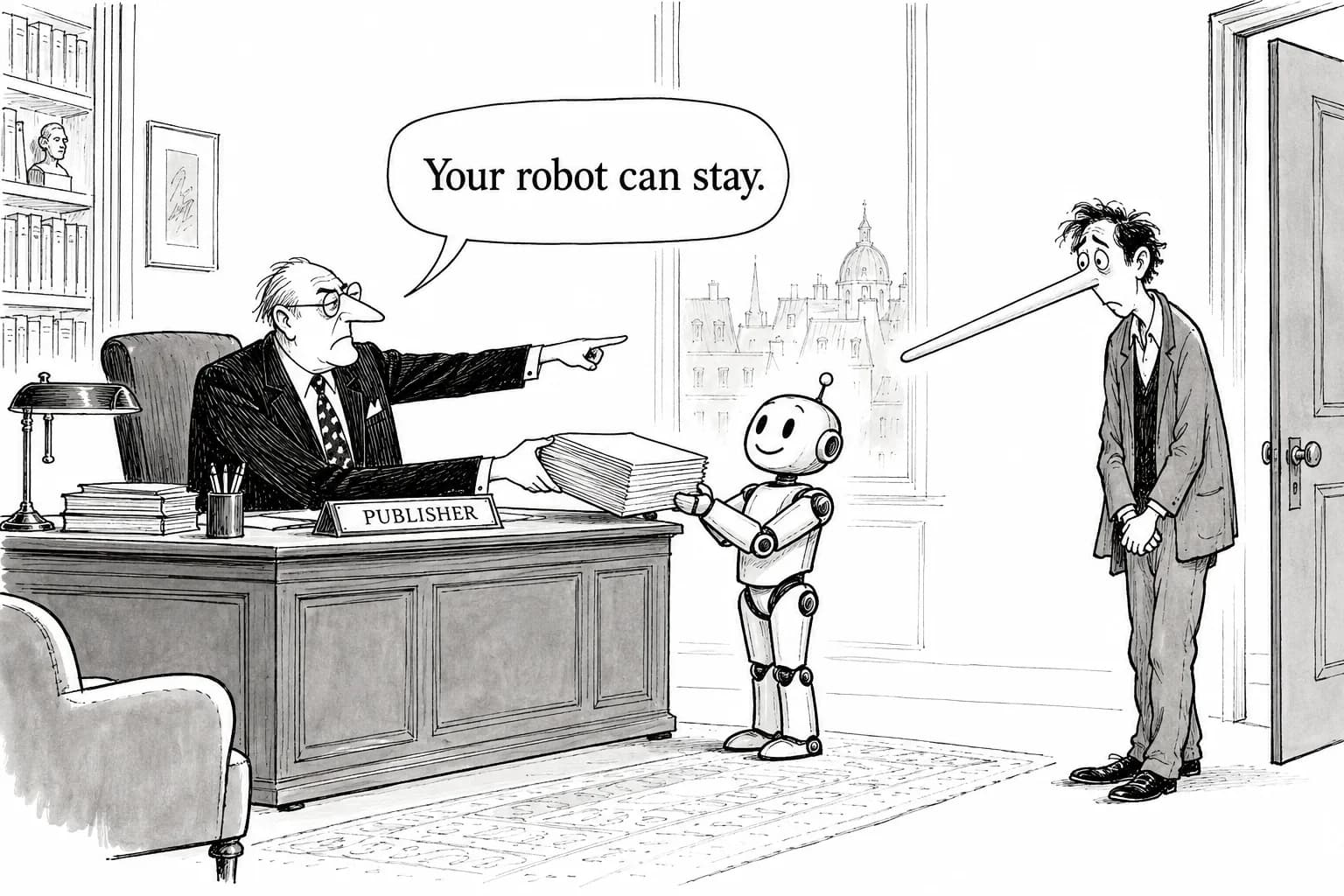
Quebec publisher Éditions du Boréal has ended its professional relationship with author Thélyson Orélien, Radio-Canada and France 24 reported. The publisher reportedly said it had confirmed that artificial intelligence was used in writing his debut novel, "C'était ça ou mourir." Exactly one week earlier, the publisher's co-director had publicly defended the author against suspicions of AI use.
So what changed in that week? Taken together, the reports suggest it was not what anyone knew about how AI was used. It was how much the author's word counted. Here is this writer's position. Boréal has never said how much AI was used. It dropped the author anyway, because his statement that he had not used it turned out to be false. In the age of AI, the line on authorship was drawn not at a machine's verdict and not at the text itself, but at what the author declared. And this writer believes that line is the most defensible one available today.
October 14: The publisher chose "the word of the human" over the machine
When the suspicions surfaced, Boréal co-director Renaud Roussel took a clear stance. According to Radio-Canada's report, Roussel said:
Today, we have a machine that has produced results, a machine whose reliability is often called into question, and we have the word of an author. Between the two, between the machine and the author, I choose the word of the human.
The "machine that has produced results" appears to be some kind of assessment that flagged the book for possible AI use. The reports this writer could access do not make clear which tool produced it or what figures it gave. The structure of the remark is clear, though. On one side was the verdict of a machine of doubtful reliability. On the other was the author's word that he had not used AI. The publisher took the author's word.
Roussel also drew a line around what a publisher's job is.
As a publisher, it is not our role to investigate his process. We are not investigators, we are not journalists, and we are not judges either.
Together, the two remarks add up to one principle. The publisher does not investigate how a book was written. The author's word is what it relies on, and a machine's verdict cannot override it. In other words, Boréal had already drawn its line at "what the author said."
October 21: What fell apart was the denial
A week later, the company reportedly issued a statement.
New information, confirmed over the past few days, indicates that artificial intelligence was used in the writing process of C'était ça ou mourir
The publisher has not said what the "new information" is. The reports do not say who confirmed it, or whether it was another machine verdict or a different kind of evidence, such as drafts or an explanation from the author himself. ActuaLitté described it as the publisher confirming AI use after the author had repeatedly denied it.
The heart of the statement is in the sentence that follows.
That claim has now been disproved. Under these circumstances, we cannot continue our professional collaboration
Look at how the reason is worded. The statement does not say "because he used AI." It says "because his claim that he did not use AI has been disproved." Which chapters it was used in, whether it was used for drafting or for revision, how much of the text it touched: as far as the reports show, none of this has been disclosed. All that has been shown is that AI was used, and that the statement "I did not use it" turned out to be false.
The line was drawn at disclosure, and it follows from the principle stated a week earlier
At first glance, Boréal seems to have reversed itself within a week. A publisher that said it would choose the human over the machine has dropped the human. But this writer reads it not as a reversal, but as the October 14 principle carried to its conclusion.
What Roussel chose was "the word of the human." Having declared that the publisher would not investigate how books are written, it had nothing to rely on but the author's word. Once that word proved false, nothing was left. So it follows naturally that the reason for ending the relationship was the collapsed denial, not the amount of AI used. From the start, the publisher had not set itself up to judge how AI was used. The only thing it judged was the trust between author and publisher.
For that reason, the case says nothing about whether a novel written with AI is the author's work. It answers a much narrower question: can a publisher keep working with an author who misrepresented his use of AI? This writer believes that, for now, the narrow question is the only one that can be answered with confidence. As Roussel himself pointed out, AI detection tools make mistakes. And nowhere in publishing is there yet a yardstick for measuring, from the text alone, how much of it is human work. The only facts left that can be checked are what the author said and whether it was true.
The strongest objections: Didn't they trust a machine after all? Does lying to the end protect you?
There are at least three strong objections to this view.
Objection 1: The "new information" may be yet another machine verdict
Since its content has not been disclosed, it cannot be ruled out that the publisher changed course under pressure from another detection result. If so, the principle of "choosing the human over the machine" collapsed within a week. The objection is fair, and this writer agrees that Boréal should disclose what kind of information it was. Still, the logic of the statement holds. The publisher gave as its reason that the information disproved the denial. It did not cite a machine's score itself. Whatever the information was, what was at issue was the gap between the author's word and the facts.
Objection 2: Drawing the line at disclosure protects those who lie to the end
This is the most serious objection. Under a system that relies on disclosure, authors who use AI and either stay silent or keep denying it without being caught are protected, and only those who are caught are punished. It looks less like rewarding honesty than punishing getting caught. This writer accepts that weakness. But the alternatives have to be weighed. Draw the line at a machine's verdict, and authors who never used AI will be dropped on the strength of false positives. Draw it at the text itself, and someone will decide arbitrarily what counts as human work. A disclosure-based line will miss some cases, but at least no innocent author is judged by a machine. As a direction for errors to run, that is the more tolerable one.
Objection 3: Dropping an author without showing how much AI was used is unfair
Some may argue that if AI was used only a little, for revision or research, ending the relationship is too harsh. That has some merit. But the criticism assumes there is a standard for how much use is acceptable. Neither Boréal nor the industry has one yet. Judging degree where no standard exists leads back to the arbitrary line-drawing rejected under Objection 2. This writer believes that asking only whether the denial was true, regardless of degree, is the most restrained approach available in the absence of a standard.
"If you used it, say so" is the norm that remains
The norm this case leaves for the industry is not "don't use AI." It is "if you used it, say so." franceinfo and others are likely still following the story because it is the first concrete case to force this norm on the literary world.
The same kind of line is already appearing outside literature. As we have reported, the collaborative project on Siegel zeros launched by Terence Tao allows AI to be used in any way but asks participants to disclose that they used it. Hexagon, which collects AI-assisted mathematical results, also accepts work written entirely by LLMs. Both allow AI use and put disclosure at the center of their norms. Whatever the field, where AI's involvement cannot be measured from the outside, the only place to draw the line is at the person's own declaration.
If so, the next step for publishers is not more detection tools. It is writing a disclosure requirement into contracts: a section where authors declare to the publisher at which stages and for what purposes they used AI. How to treat authors who disclose AI use can then be decided by each publisher. Boréal said it would choose the word of the human. To keep choosing that word, what it needs is not a better ability to detect lies, but a system in which no one has to lie in the first place.
Note: This piece is based on news reports and has not had access to primary materials such as the full text of Boréal's statement, the author's account, or the content of the "new information." The assessment may change if the author responds or offers an explanation.
Editorial cartoon
Sources
- https://ici.radio-canada.ca/nouvelle/2294673/boreal-editions-fin-collaboration-thelyson-orelien
- https://ici.radio-canada.ca/nouvelle/2292699/boreal-thelyson-orelien-reaction
- https://france24.com/en/culture/20261021-canadian-publisher-drops-author-orelien-after-confirming-he-used-ai-in-debut-novel
- https://actualitte.com/article/134793/edition/thelyson-orelien-apres-les-dementis-son-editeur-confirme-l-utilisation-de-l-ia
- https://www.franceinfo.fr/culture/livres/affaire-thelyson-orelien/
- https://www.thenation.com/article/world/france-literary-scandal-ai-authorship/