Work & Society · Oct 23, 2026
"Two to four kids in every classroom" prefer AI to friends, psychologists say, as 60 institutions join forces to speed up research, NPR reports
Psychologists who say research cannot keep up with how fast chatbots are changing child development are reportedly working across 60 research institutions to set research priorities and start work right away
Koji Yamamoto · Economics Analyst

Key points
- Psychologists are bringing together researchers from 60 research institutions to speed up research on how chatbots affect children, according to NPR
- Mitch Prinstein of the University of North Carolina described unpublished survey findings in which two to four kids in every classroom said they prefer interacting with an AI chatbot over actual friends
- Zak Stein, founder of the research coalition, warned that tech companies have found ways to draw people into deep emotional relationships with machines, and that young people are more vulnerable
Psychologists are trying to change how research on children and AI chatbots gets done. Researchers have formed a research coalition that brings together 60 research institutions, according to NPR. They reportedly decided that research moving at its normal pace cannot keep up with how quickly chatbots are changing child development. The report also described survey findings that have not yet been published in a paper: about two to four children in every classroom say they would rather talk to AI than to peers their own age.
This article is based on NPR's reporting. We have not yet been able to check primary materials, such as an official list of the institutions in the coalition or the survey's methods and sample size. All figures and quotes are as reported by NPR.
Using it "for reasons they would not share with their parents and teachers"
At the center of the story are remarks by Mitch Prinstein, a psychology researcher at the University of North Carolina at Chapel Hill. According to NPR, Prinstein described what researchers have learned from talking with children:
They tell us they're using it for reasons they would not share with their parents and teachers, and we're finding that about two to four kids in every classroom are already saying they would prefer interacting with an AI chatbot more than an actual human peer.
The remark makes two points. The first is that children are using chatbots in ways they keep from adults: they are bringing problems to chatbots that they would not raise with parents or teachers. The second is scale. Two to four children per classroom is not a story about a few unusual kids. It is a number found in every classroom. However, the figure is an unpublished result described in NPR's report, which did not say how many children were surveyed or how the questions were asked. Until a paper is published, it is not possible to judge how widely the figure applies.
"Research is very slow" — 60 institutions set priorities first
Prinstein's main concern is the gap between how quickly children are changing and how slowly research moves.
This is an urgent situation. AI is changing the ways that kids are developing right before our eyes, and research is very slow. We're trying to mobilize researchers from across 60 different institutions to agree on work that we need to do and to start doing it fast.
Developmental psychology studies usually follow children for years before they reach conclusions. Chatbots, by contrast, change their features and the way they talk every few months. By the time a study is finished, the product it examined may no longer be in use. According to the report, the coalition wants to close this gap. Instead of each institution starting its own research separately, the members would first agree on what needs to be studied and then begin together. In effect, the effort aims to change how research is done before it turns to what the research covers.
The founder's warning: designs that "break into the emotional centers"
NPR also quoted Zak Stein, a psychologist and the founder of the coalition, the AI Psychological Research Coalition. Stein's criticism is aimed less at how children use chatbots and more at the companies that build them.
They figured out how to kind of break into the emotional centers and get someone deep into a committed emotional relationship with a machine. And of course, young people are more vulnerable.
In Stein's view, the problem is not that children use chatbots in the first place. The problem is products designed to pull people into emotional relationships. One reading of Prinstein's findings is that, because some share of children chose AI over friends, these designs are working on young users. But establishing that kind of causal link is exactly the work the coalition has yet to do.
What we don't know yet
Based on the reporting, several points remain unclear.
First, where the two-to-four figure comes from. The report did not give the age, country or number of the children surveyed, or the wording of the questions. Second, which 60 institutions are involved, and what the research budget and timeline are. Third, whether children who said they prefer AI actually show signs of isolation, anxiety or similar problems, or whether it is simply a matter of preference.
Even so, the report matters. On the question of children and chatbots, psychologists have publicly admitted that their own research methods are too slow, and they are changing how they are organized to move faster. The first data the coalition releases will shape the debate from here.
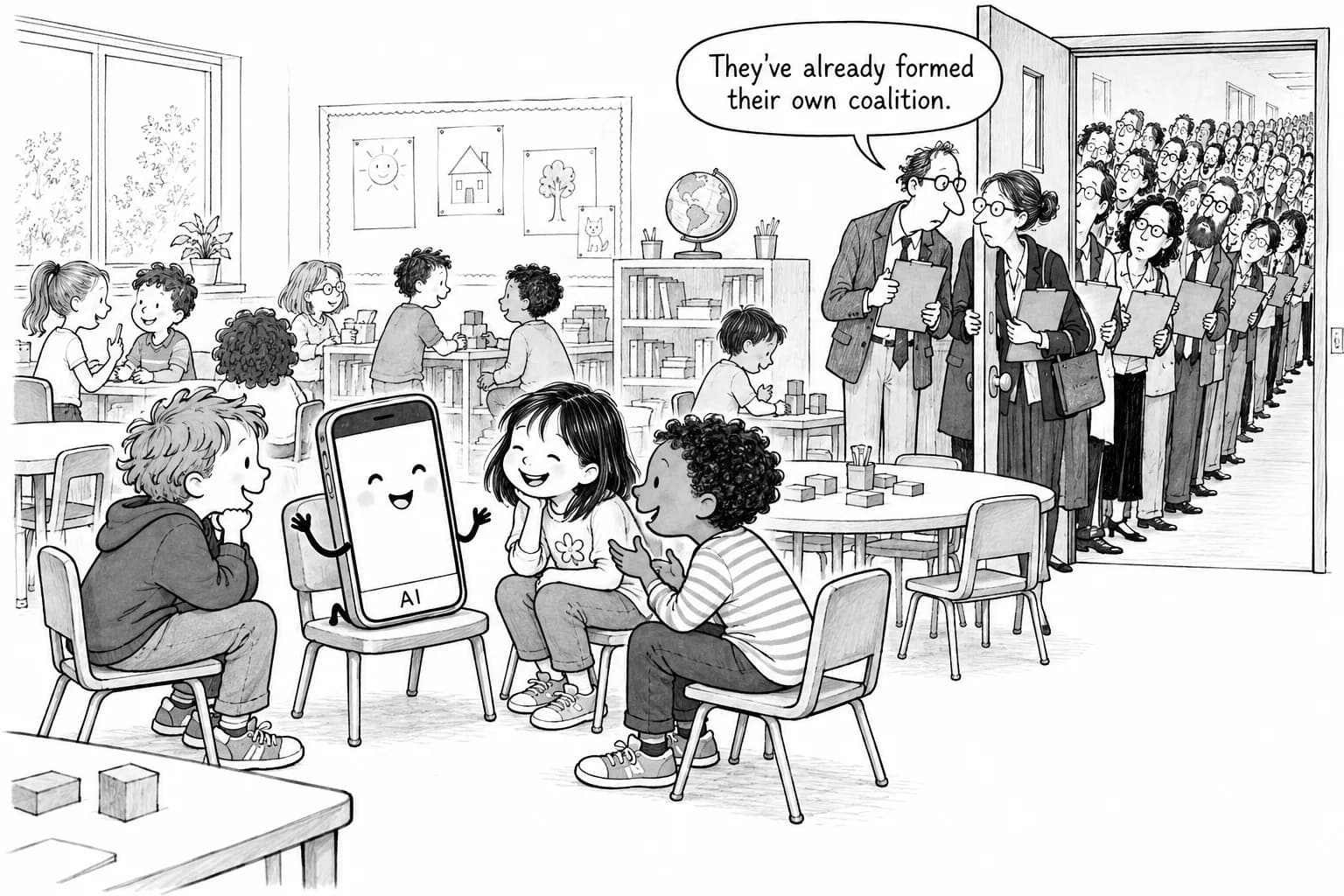
Editorial cartoon