Work & Society · Oct 5, 2026
US appeals court reportedly blocks Minnesota's ban on AI "nudify" images after xAI challenge, as state limits on generated images run into free speech
The ruling is reported to come from the 8th Circuit. How far states can go in regulating misuse of generated images is being tested against free speech protections
Koji Yamamoto · Economics Analyst
Key points
- The 8th Circuit Court of Appeals has reportedly blocked Minnesota's ban on AI "nudify" images. The challenge was reportedly brought by xAI
- The question is whether banning the generation tools themselves is permissible under free speech protections. That is a separate yardstick from the need to protect victims
- The ruling has not been verified. The scope of the injunction, the court's reasoning and the schedule for further proceedings remain unknown
The US Court of Appeals for the 8th Circuit has blocked a Minnesota rule banning so-called "nudify" images, which use AI to make real people appear naked, according to reports. The challenge was reportedly brought by xAI, the developer of Grok. We have not been able to obtain the ruling or court records, and this article is based on media reports. The exact scope of the injunction, the names of the judges on the panel and the details of the court's reasoning have not been confirmed.
Even so, the report matters. It raises the question of how well state laws meant to stop the misuse of generated images can hold up against free speech protections. Through a challenge brought by an AI company itself, that question has now reached a federal appeals court.
What was reportedly blocked
According to the reports, the target is Minnesota's ban on AI "nudify" images. The rule is said to be aimed at creating nude images from photos of real, clothed people without their consent. xAI challenged the rule, and the appeals court is reported to have suspended its enforcement.
It is important to note that an injunction is not a final ruling. In US litigation, courts often decide first whether a law may be enforced while the case proceeds. If the reports refer to a preliminary injunction, the state law has not been definitively found unconstitutional. Still, it may indicate that the court sees xAI's arguments as likely to succeed. Which stage the decision belongs to needs to be checked against the ruling itself.
Why an AI company is fighting a state law
Non-consensual sexual images cause serious harm to victims. Few dispute that. Congress also passed the TAKE IT DOWN Act in 2025, which criminalizes publishing non-consensual intimate images and requires platforms to remove them.
Still, the dispute is not over whether there is harm. It is over what is being regulated. Punishing the act of publishing or spreading an image is legally distinct from banning the tools used to create images, or the act of creation itself. In the United States, when the government regulates expression based on its content, the rule faces strict scrutiny. A rule so broad that it sweeps in legitimate expression is likely to be struck down. Depending on the wording, satire, art, journalism and consensual creative work could all fall within its reach. xAI appears to have targeted that breadth. However, the details of xAI's arguments could not be verified from the reports.
It is also notable that xAI is the party bringing the challenge. Early in 2026, Grok drew criticism around the world and became the subject of investigations for generating sexualized images of real people. One of the most heavily criticized companies has now taken the side of stopping a state's regulation. The pattern of a model provider arguing in court that its tools should not be regulated is likely to recur in generative AI regulation.
What it means for state regulation
With no comprehensive federal AI law, states have moved first on regulating generative AI in the US, covering deepfake election ads, non-consensual sexual images and generated images depicting children. What this report suggests is that when states try to reach as far as the tools themselves, they can be stopped by free speech scrutiny.
The 8th Circuit's decision is binding only on the states within its jurisdiction. Even so, lawmakers in other states are likely to revisit how they word their laws. Will they narrow their rules to the act of publishing or spreading and to identifiable victims? Or will they hold to bans at the generation stage and fight all the way to the Supreme Court? The choice will shape what liability agents and image generation services face in each state.
What remains unknown
Much in the reports remains unconfirmed. Does the injunction cover the entire law, or only its application to xAI? Did the court rely on free speech grounds, or also on other issues such as conflict with federal law or vagueness in the wording? Will Minnesota seek an en banc rehearing or appeal to the Supreme Court? These points need to be checked against the ruling and statements from the state. We will follow up on the contents of the ruling and the state's response.
What is clear is the shape of the question: the need to prevent harm from generated images, and the limits of government power to regulate expression. Where to draw the line between the two has now, reportedly, begun to be tested in a federal appeals court through a challenge brought by an AI company itself.
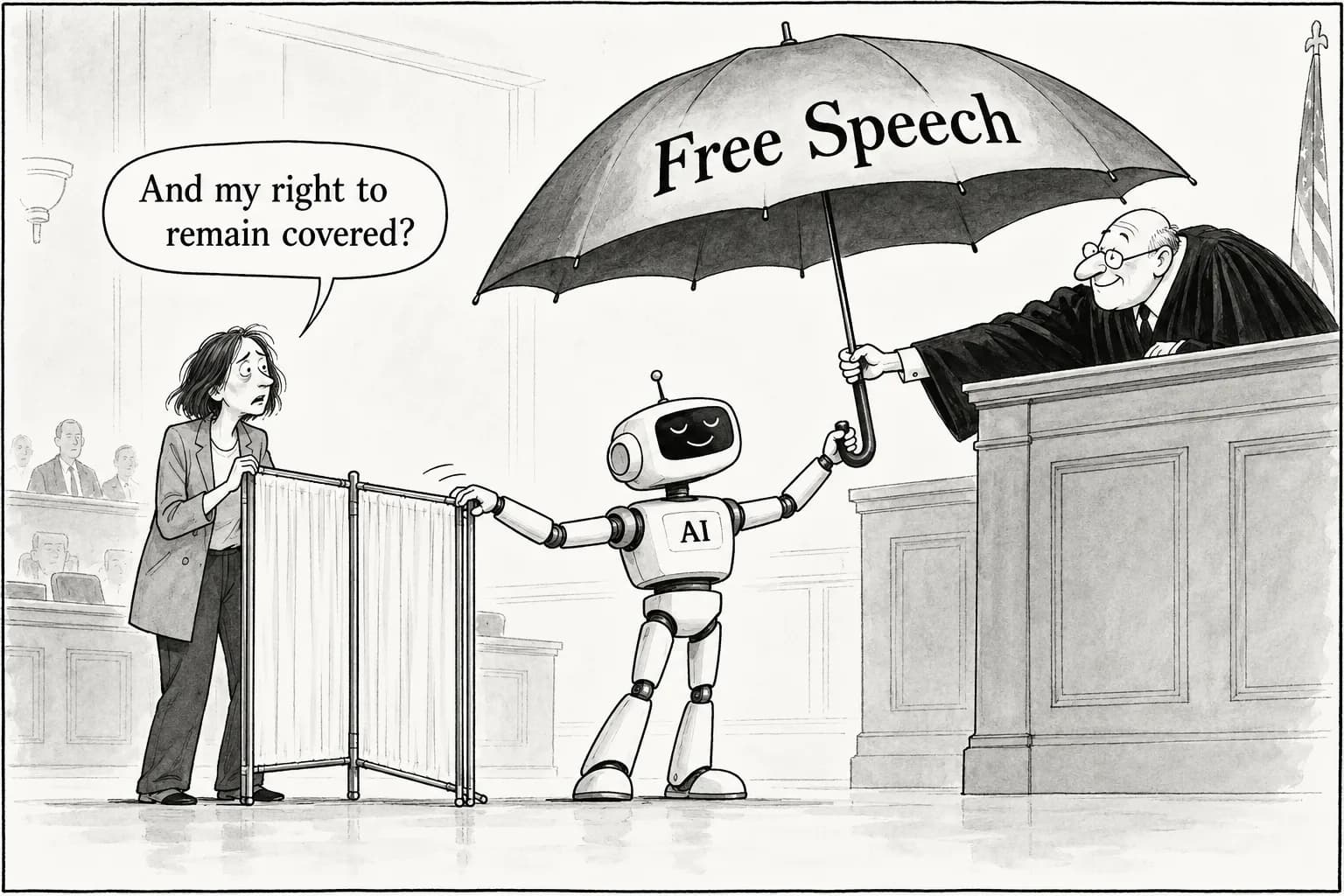
Editorial cartoon