Opinion · Oct 11, 2026
Terence Tao's 'Math 2.0': after 'recent events' prompted him to overhaul a talk, he criticizes the overemphasis on AI solving open problems automatically
After OpenAI published 722 manuscripts and retracted 3, the host of a blog that has become a forum for mathematicians' debate sets out his own views for the first time
Koji Yamamoto · Economics Analyst

Key points
- Tao wrote that "recent events" had led him to substantially change the content of a talk, and criticized the overemphasis on having AI solve open problems automatically (October 10, his own blog, primary source)
- The backdrop is OpenAI's release of 722 manuscripts on October 6, followed the next day by the withdrawal of 3 over a sign error. OpenAI has still not said which model produced the results
- The post comes after a string of contributions to the blog, including the rule changes at the Erdős problems site, Hexagon, and Hales's post on the reliability of Lean. It is the first time the blog's host has set out his own views in full
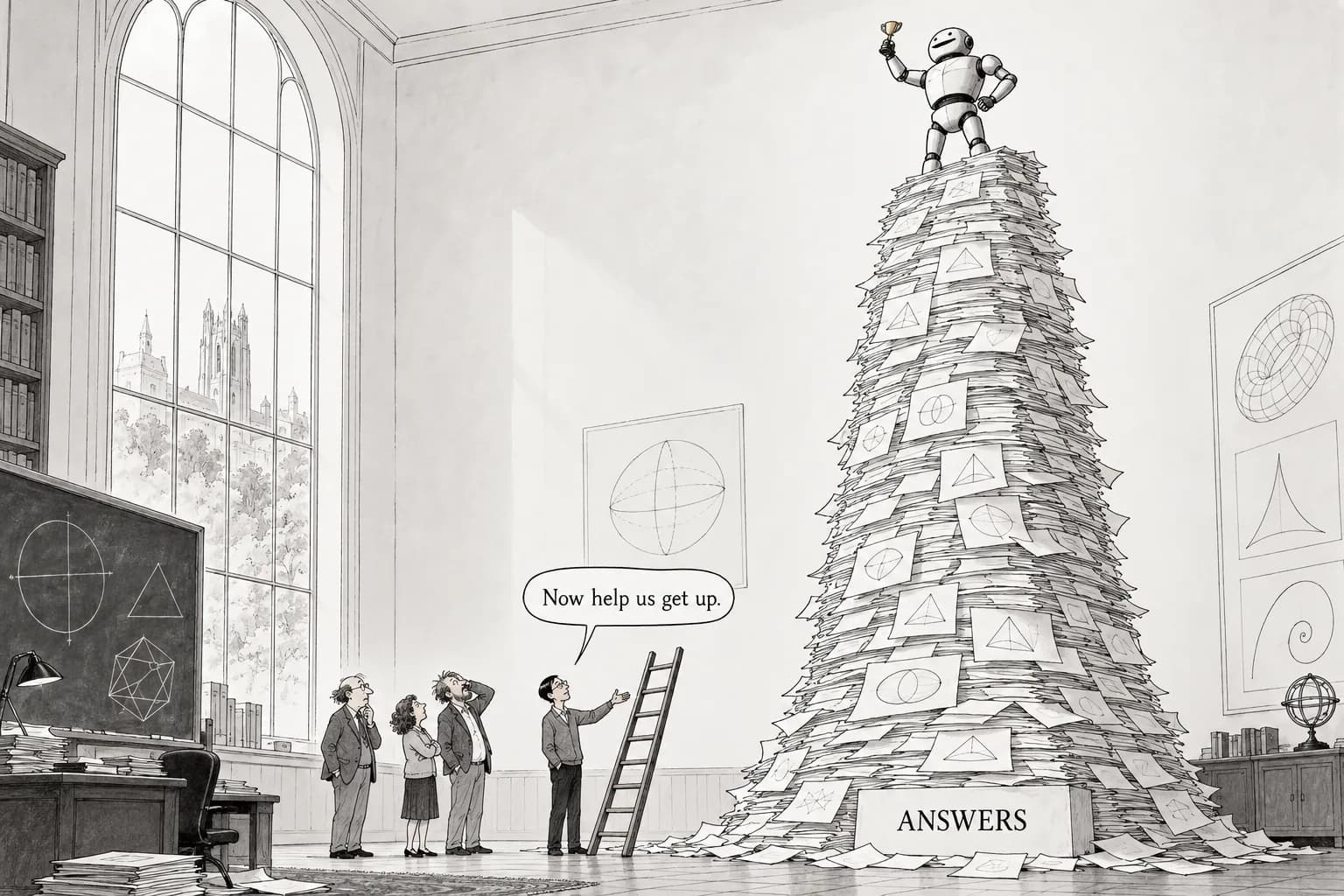
Terence Tao published "Math 2.0" on his blog on October 10 (primary source). For the past several weeks, Tao's blog has carried a series of guest posts by other mathematicians on AI and mathematics. This time, Tao himself, as the blog's host, set out his views in full. According to Tao, "recent events" led him to substantially change the content of a talk he had planned. His target is the overemphasis on having AI solve open problems automatically. Instead, Tao calls for a "Math 2.0" that supports human understanding and the mathematical community.
In short, Tao's question is not "how many problems can AI solve?" It is "as AI results multiply, can mathematics be preserved as an endeavor of human understanding?" The post can be read as a response to the mass release OpenAI began on October 6 and the retractions that followed soon after.
The 'recent events' that changed the talk
Tao refers only to "recent events," but the timing suggests the main one is OpenAI's release of its mathematical results. On October 6, OpenAI had an unnamed internal frontier model work on about 4,000 problems and published 722 manuscripts (372 clusters of results) on GitHub. The next day, October 7, it withdrew 3 of them. The trigger was a sign error in "Algebraicity of Weil classes on split abelian eightfolds," where a value that should have been −1 under the paper's own conventions came out as +1. Two manuscripts that depended on it — one on the algebraicity of the Kuga–Satake correspondence and one on the rational Hodge conjecture for products of K3 surfaces — were withdrawn along with it. OpenAI also revised 14 other proofs, and the share formalized in Lean came to about 42%. The number of published manuscripts stands at 719, and no further retractions have been made since. Which model produced the results has still not been disclosed.
Shortly after the release, Tao was reported to have described the pace as beyond all reason (secondary information, based on reporting by Scientific American and others). The new blog post is not a fragmentary reaction of that kind but a full statement of Tao's own position.
The target: treating 'automatic solving' as the yardstick of success
What Tao criticized is not the use of AI in mathematics itself. It is a trend that emphasizes almost exclusively having AI solve open problems automatically. Counting the number of problems solved as achievements and presenting them like a benchmark leaves out the part where humans understand the substance of a proof, verify it and build on it in further research. Math 2.0, as Tao presents it, places AI in the role of supporting that part.
The concern is not Tao's alone. In the Navier–Stokes case, James Maynard said that "extracting human understanding from this new AI proof has so far been very difficult" (NPR). Writing on Tao's blog, Tapio Schneider argued that a proof that is correct but cannot be understood gives only "the headline," not "the inside story." Tao's Math 2.0 can be seen as extending these points into a question about how the entire practice of mathematics should be designed.
The blog had become a forum for the community
The post carries weight because Tao's blog has itself become a place to discuss how the mathematical community should respond to a flood of AI results. In October alone, the following contributions appeared.
Contributions building infrastructure to handle the results
On October 6, Thomas Bloom wrote that he was changing the rules of the Erdős problems site. Because AI-generated proofs without explanation were being posted to claim priority, he turned off comments and dropped the "solved/open" labels and the tally of solved problems. Instead, the site will prioritize human-readable write-ups and linked Lean proofs. The same day, Ben Antieau introduced "Hexagon," a nonprofit repository collecting results obtained with the help of LLMs. Submissions will be rate-limited, starting at one per day.
Contributions shifting perspectives
On October 7, Raghu Meka argued that AI's solutions to long-neglected problems showed that many of mathematics' "barriers" had been assumptions. On October 9, Thomas Hales tackled the reliability of Lean head-on. Looking back on the "Summer of Soundness Bugs," when a series of soundness bugs was found in the Lean kernel in July and August, he proposed cross-checking proofs with independent kernels and formally verifying the kernel itself, among other measures. The issue bears directly on how far OpenAI's claim that "about 42% are formalized in Lean" can be trusted.
None of these contributions is about how many problems were solved. They deal with how humans should receive and verify results, and to whom credit should go. Tao's Math 2.0 can be read as the blog's host giving direction to this current.
A contrast with OpenAI's 'show it in numbers' approach
What OpenAI showed on October 6 was scale and speed. The compute used per result was said to be comparable to ChatGPT Pro, about 3 hours, and OpenAI said it would not release prompts, only average compute figures. It said it received advice on how to conduct the release from the Advisory Group on Mathematics and AI (AGMAI) hosted by the IAS. However, AGMAI was set up with OpenAI excluding the "pacing of internal progress" from the scope of its advice.
Release in bulk, withdraw when errors are found, and don't say which model produced the results: under this approach, the burden of verification falls on outside mathematicians. Andrew Sutherland's remark that claims by a single agent should be treated as "unverified" until the model is released points to the same problem. Tao's argument challenges this lopsided burden from the side of the mathematical community.
What to watch
The next question is how Tao's views will be reflected in actual mechanisms. Specifically: whether AGMAI issues formal recommendations on how releases should be conducted; whether OpenAI discloses the model that produced the results and sets out criteria for retractions; and how Gowers, Buzzard and others respond to the post. Mathematics is being pushed to set norms for evaluating AI results earlier than other fields. That a central figure in the field has stated plainly that human understanding and the community, rather than the number of problems solved, should be the axis offers a reference point for other research fields as they build their own ways of handling AI results.
Editorial cartoon