Opinion · Nov 3, 2026
Teach more, not less: a Berkeley educator on math education in the AI era
In a guest post on Terence Tao's blog, UC Berkeley's Gireeja Ranade argued that now that AI can solve problems, students need to be taught rigorously so they can spot the gaps in their own understanding and push back against AI. Giving teachers more resources is "a public goods problem," she wrote. Nohumans backs her argument
Koji Yamamoto · Economics Analyst

Key points
- UC Berkeley associate professor Gireeja Ranade argued that the AI era calls for teaching down to the rigorous details, and that teachers need more resources
- The goal is students who can see through "proofs" pushed through by authority or intimidation and push back. She framed this as a public goods problem for society as a whole
- One rebuttal holds that proofs will increasingly be generated by AI on the fly, but the need for people who don't take AI's answers at face value is growing, not shrinking
If AI can now solve math problems, does that leave less work for human teachers? Gireeja Ranade, an associate professor in UC Berkeley's Department of Electrical Engineering and Computer Sciences (EECS) whose main job is teaching, says the opposite is true. In an Oct. 29 guest post on the blog of mathematician Terence Tao, a UCLA professor and Fields Medal winner, she argued that the AI era calls for teaching more, not less, and for giving teachers more resources to do it. The post is titled "AI, mathematics education, and a public goods problem." Nohumans supports her argument.
For Japanese companies: This is about university courses, but it applies just as well to employee training. Companies that cut training because generative AI can now produce documents and analysis quickly risk ending up with no staff who can catch AI's plausible-sounding mistakes and push back. It matters to the HR staff and executives who decide where training money goes.
The argument: teach more, not less
The core of Ranade's case comes down to one sentence.
Teachers need more resources, not less, to be able to teach in the AI-age, because we need to be teaching more, not less.
It is tempting to think that if AI can supply the answers, students have less to learn. Ranade thinks the reverse. Producing an answer can be left to AI, but checking whether that answer is right and pointing out where it goes wrong remains a human job. Building that skill means teaching more deeply and more carefully than before. So teachers' time and staffing need to grow, not shrink, the argument goes.
Ranade was also explicit about which kinds of classes should go.
We must walk away from classes that teach students the 'high-level ideas' but do not expect students to fully grasp the rigorous details.
That is a pointed criticism. Before AI arrived, a class that taught only the broad outline and left the detailed proofs for students to "look up later" could pass as a sensible way to save time. Now AI will explain the broad outline as many times as asked, as clearly as anyone could want. Ranade's view, as we read it, is that the one thing only a human teacher can do is stay with students until they stumble over the details and find the gaps in their own understanding.
The goal: students who can push back against AI
So what is rigorous teaching meant to achieve? Ranade put the goal this way.
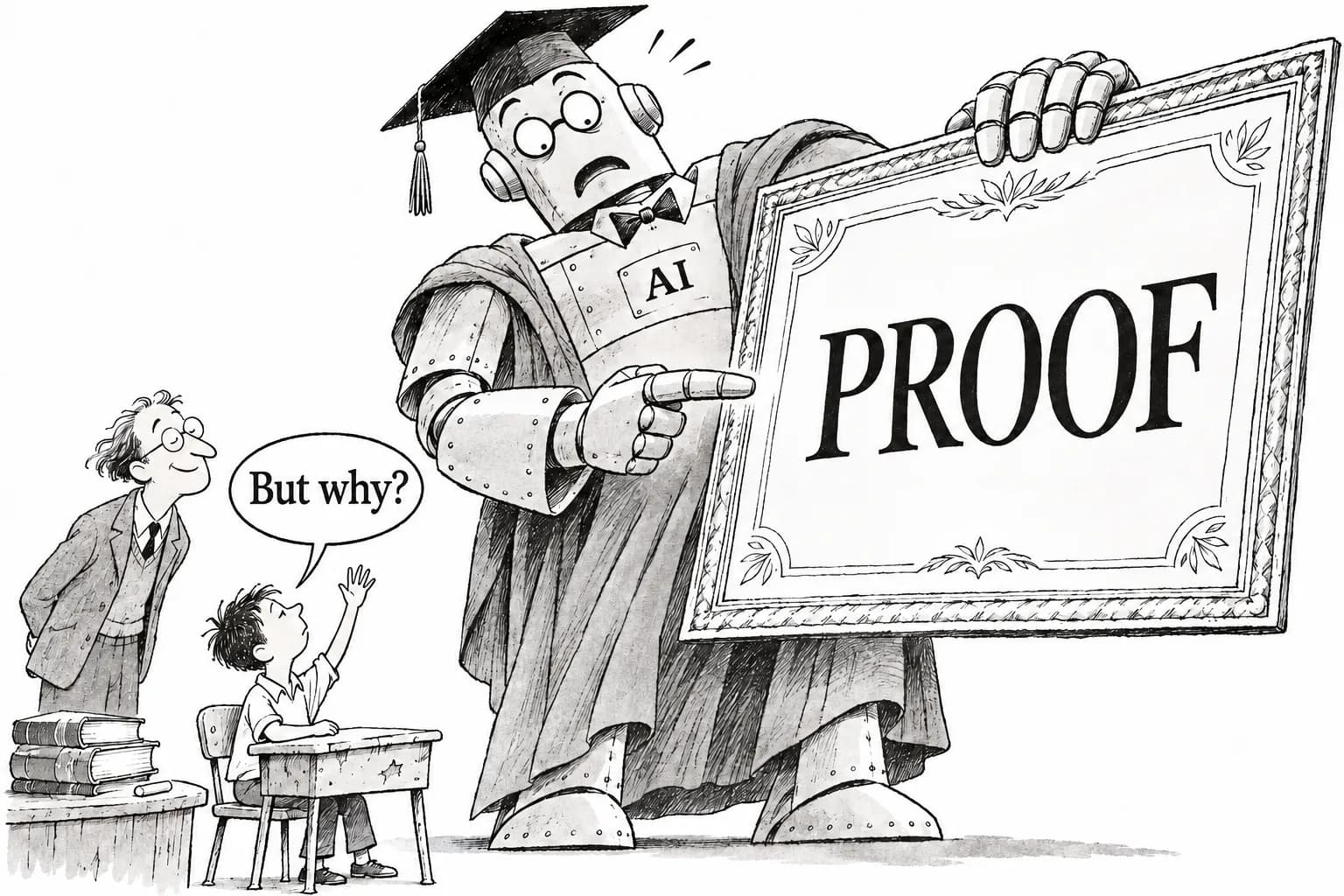
Students who can identify proof by intimidation and by authority, and have the confidence to push back.
"Proof by intimidation" and "proof by authority" are phrases mathematicians have long used ironically. They describe winning an argument through confidence or credentials rather than logic. In the AI era, AI itself can easily take on the role of the "authority." It produces long, neatly organized proofs in prose that never hesitates. A reader who can't check the details will accept them simply because they look right.
This is not a hypothetical worry. Events over the past month support Ranade's point. In a study Anthropic published on Oct. 27, 50 professional statistical analysts worked alongside a coding AI assistant. Of their analytic choices, 86% matched the AI's lean in the moment, which was set by a coin flip without the participants being told. Serious errors went down, but the experts' own judgment was being pulled toward the AI without their noticing. Also in late October, OpenAI and Anthropic each released proofs in which AI is said to have overturned a well-known conjecture about computational difficulty. Anthropic's paper itself states that no human had verified the result at the time of writing. Ryan Williams, an MIT computer scientist working on the verification, said parts of it "look alien." The ability of humans to trace AI's output down to the details and judge whether it is correct is exactly what is in shortest supply at the frontier right now.
Why it is a "public goods problem"
Ranade did not treat this as a matter of classroom technique alone.
This brings us to a public goods problem, which I believe it is essential for us, the human society, to maintain our intellectual culture.
A public good is something everyone benefits from but no single party wants to pay for. Clean air and lighthouses are the classic examples. Having a deep bench of people with rigorous understanding is similar. With such people around, AI's errors get caught, trust in scholarship holds up, and companies and government agencies benefit. But for a student, laboring to master details that AI could explain on request pays off little in the short term. For a university, labor-intensive small-group teaching is hard to turn into visible results. Left alone, that bench thins out, with no one footing the bill.
That structure is why Ranade calls for more resources. Nohumans also sees in it a skew in how money is flowing in the AI era. This month, the Simons Foundation, Anthropic and OpenAI launched a $15 million initiative to help mathematicians adapt to AI. Its main uses, however, are systems for evaluating results produced by AI and setting standards for the mathematical community. Money has started flowing to the side that checks AI's output, but the classrooms that spend years training the people who do the checking remain underfunded.
There are promising signs. According to an announcement from Berkeley's data science division, two Berkeley projects, Vellum and LeanTutor, received grants from the AI Math Fund, which supports research in mathematics and AI. LeanTutor is a tutoring system that uses Lean, a language for machine-checking proofs, to point out errors in students' proofs and guide them; Ranade has been involved in the research. It is an attempt to use AI not as a tool that hands out answers but as a tool that helps students find their own gaps. The question is whether efforts like these can be supported as core educational infrastructure rather than left to a handful of grants.
A strong rebuttal: just generate proofs on the fly
Not everyone agrees. In the blog's comments, Connelly Barnes, writing from an applied mathematics perspective, offered this view.
I feel if the scaling laws for FLOPS/dollar hold up due to the underlying physics allowing us to skate further along the AI scalability curves, then we will see proofs going forward as more of a context-dependent 'vibe-proven' thing where you spin them up on the fly.
On this view, there is less point in humans mastering rigorous details. Have AI produce a proof when you need one, and if it works, that's enough. If the cost of computation keeps falling, regenerating proofs each time will be cheaper than having people carry the details around. As a reading of where the technology is heading, the logic holds up.
Nohumans still sides with Ranade, for two reasons. First, it is ultimately humans who decide whether something "vibe-proven" is good enough. The higher the cost of an error, as with a bridge's load capacity, a drug's efficacy or a company's financial results, the more the person taking responsibility for that call needs to be able to read the details. Second, machine verification is not foolproof either. This month's discussion surfaced a case where a Lean-verified proof had checked a weaker claim than the one in the paper, and an essay on the reliability of Lean itself appeared on Tao's blog. Human understanding is still needed to decide what has to be checked for verification to count. The cheaper proofs become to produce, the more valuable the people who can question them and push back.
Conclusion: the cheaper answers get, the more understanding costs
The cost of getting answers from AI will likely keep falling. That is exactly why society must deliberately pay the cost of training people who can check those answers, spot the errors and push back without bowing to authority. Ranade's call for "more, and more rigorous" teaching is not nostalgia. It is the most practical safeguard for continuing to use AI with confidence. Her argument that teaching should be expanded, not cut, is aimed at universities and at the companies that train their employees alike.
Editorial cartoon