Money · Oct 22, 2026
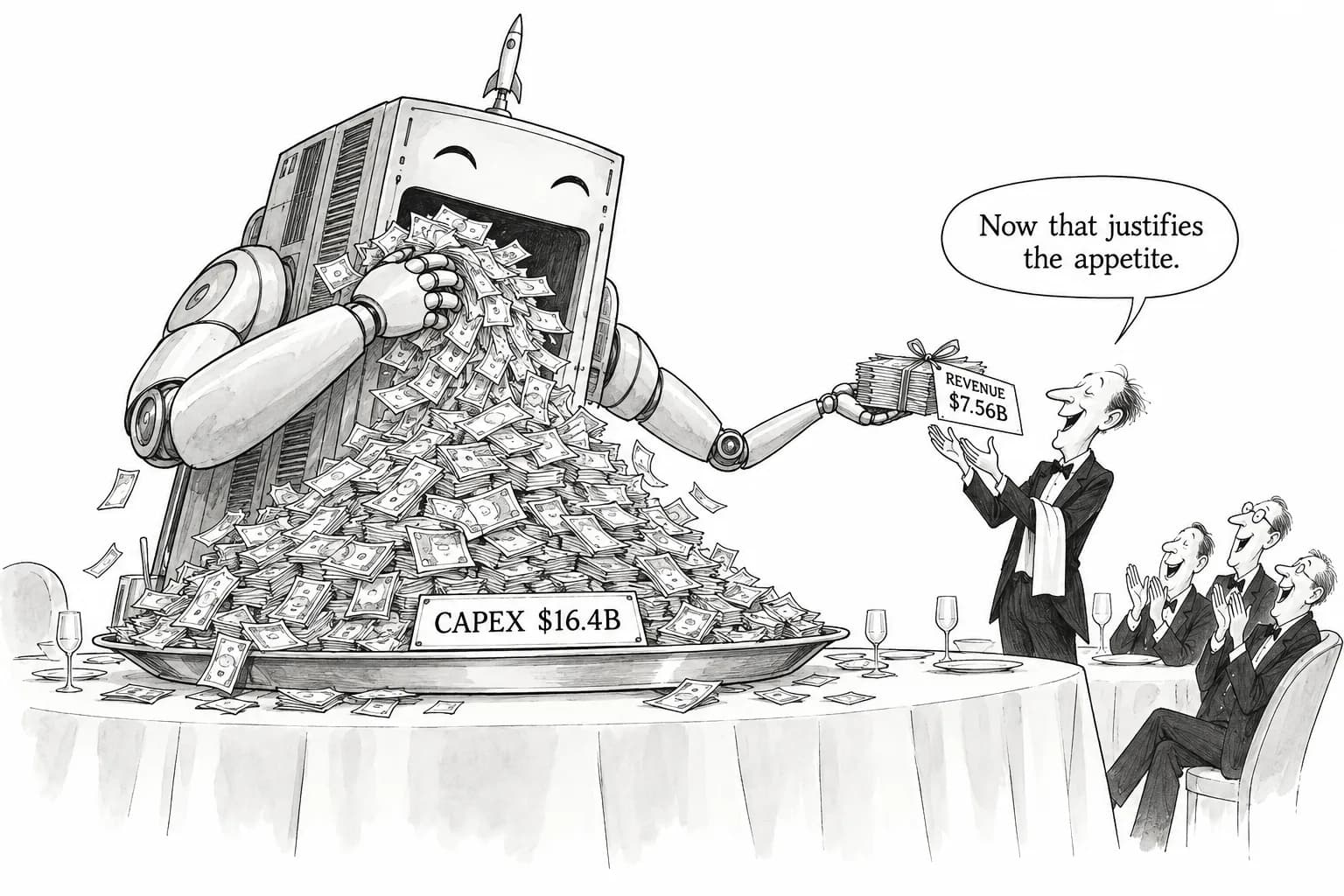
SpaceX's AI revenue jumps ninefold to $7.56 billion, backing up $16.4 billion in July–September AI capex
An SEC filing put numbers on revenue growth that matches the company's huge AI spending, and beaten-down AI stocks rebounded
Koji Yamamoto · Economics Analyst

Key points
- SpaceX's SEC filing (a primary source) shows its AI division's revenue rose about ninefold from a year earlier to $7.56 billion
- AI capital expenditure for July–September was $16.4 billion. Spending still exceeds revenue, but this is the first major company able to justify its investment with revenue growth
- AI stocks rebounded after a sell-off, during which CoreWeave bonds and Oracle CDS had signaled doubts about AI investment paying off and chip stocks kept falling
Revenue at SpaceX's AI division rose about ninefold from a year earlier to $7.56 billion, according to a filing the company submitted to the U.S. Securities and Exchange Commission (SEC filing, primary source). AI capital expenditure for July–September was $16.4 billion. It is the first time a major company spending this much on AI in a single quarter has been able to point to revenue growth to justify it. TechCrunch reported on October 20 that SpaceX's AI business is beating expectations. AI stocks that had been sold off rebounded after the filing.
The numbers: revenue up ninefold, $16.4 billion in investment
Two numbers matter. First, AI division revenue was $7.56 billion, about nine times the year-earlier level. Second, AI capital expenditure for July–September was $16.4 billion. Both figures come from the SEC filing and can be treated as fact.
The $16.4 billion is still about twice revenue. This does not mean the investment has already been recouped. But with revenue up roughly ninefold in a year, the numbers now show that the investment is turning into revenue growth. Until now, when big companies talked about AI capital spending, all they could offer was a forecast of "future demand." This time, the division's actual revenue sits alongside the spending.
Where the revenue came from
Over the past year, SpaceX has moved quickly to turn its AI business into products it can sell. Cursor came under SpaceX's ownership in August. On October 12, the company announced "The X Subscription," which bundles Grok, Grok Bot, Cursor and X Premium. Tiers range from Plus at $8 a month to Ultra at $200 a month, with Team and Enterprise plans as well. It was the first announcement since the xAI integration to clearly lay out how the business will make money.
Business customers are also using the products. When it announced Grok Voice 3.0 on October 14, the company said the system handles 20,000 calls a day at Starlink's call centers and resolves about 70% of them without a human. Cursor as a coding agent, consumer subscriptions and voice agents are three possible sources of revenue. However, a breakdown of which products the $7.56 billion came from could not be verified from the filing for this article.
Why AI stocks rebounded
For several weeks, markets had doubted whether AI investment could pay off. Yields on bonds issued by GPU cloud provider CoreWeave climbed into the 15% range, and Oracle's CDS spreads widened to about 295 bp. The semiconductor index kept falling. Investors were asking where the revenue was to justify the huge capital spending.
SpaceX's filing gave one answer. A company that spent $16.4 billion in the quarter showed AI division revenue nine times that of a year earlier. Investors could see AI capital spending turning into revenue, shown in numbers in an SEC filing rather than in forecasts. That is why the beaten-down AI stocks bounced back.
Open questions
One company's filing does not solve the industry-wide question of whether the money will be earned back. The $16.4 billion in spending still far exceeds revenue, and the figures don't show when profits will come. Grok 4.7 also used 240 million output tokens to run the Artificial Analysis index, roughly 24 times the cost of models with the same score. Even if revenue grows, heavy inference costs make it hard to keep a profit.
Two things are worth watching next. One is Meta's earnings on October 21, and how much revenue accompanies its capital spending outlook. The other is Anthropic's S-1, and how its July–September revenue compares with its spending on compute. SpaceX has set a benchmark: explain AI investment with revenue. The next companies to report will be measured against it.
Editorial cartoon