Money · Oct 3, 2026
SoftBank completes $30 billion follow-on investment in OpenAI, bringing its total to $64.6 billion for about 13%, and closes DigitalBridge acquisition
SoftBank paid in the $10 billion third tranche. A day earlier it had closed its acquisition of DigitalBridge, leaving a single group holding everything from models to fiber
Koji Yamamoto · Economics Analyst
Key points
- On October 1, SoftBank paid OpenAI the $10 billion third tranche, completing its $30 billion follow-on investment (primary source). Its cumulative investment is $64.6 billion, giving it a stake of about 13%
- SoftBank closed its acquisition of DigitalBridge on September 30 (primary source). Data center and fiber assets now sit alongside its OpenAI stake and Stargate
- OpenAI has its most capable model on hold while it cuts prices with the cheaper Sol line. SoftBank's biggest bet is that demand for compute will keep growing, even before revenue does
SoftBank has finished paying in its $30 billion follow-on investment in OpenAI. According to a press release dated October 1, the company paid in $10 billion, the third tranche (primary source). Including earlier investments, SoftBank has now put a cumulative $64.6 billion into OpenAI, for a stake of about 13%. A day earlier, on September 30, SoftBank had also closed its acquisition of DigitalBridge, which invests in data centers and communications infrastructure (primary source). Over those two days, SoftBank became a major shareholder in a model company, the driving force behind Stargate, and an owner of data centers and fiber.
This article addresses an open question we have been tracking: "confirmation of SoftBank's $10 billion payment." However, OpenAI has not confirmed its overall fundraising, a round of more than $30 billion reportedly valuing the company at about $1.4 trillion. We have also not yet confirmed where this payment fits within that round. Below, we separate what the company announcements establish from what has been reported.
The payment: $30 billion in three installments, $64.6 billion in total
The release confirms four points. SoftBank paid in the $10 billion third tranche. That completes the $30 billion follow-on investment. Its cumulative investment has reached $64.6 billion. Its stake is about 13%. Since the third tranche was $10 billion out of $30 billion, the follow-on investment was paid in several installments. Subtracting $30 billion from $64.6 billion puts SoftBank's investment before the follow-on at about $34.6 billion.
If $64.6 billion buys about 13%, simple division values the whole company at roughly $500 billion. But valuations differed depending on when each payment was made. Because the figure averages in earlier investments, it should not be read as OpenAI's current valuation. It rests on entirely different assumptions from the reported figure of about $1.4 trillion.
DigitalBridge: adding the layer beneath the models
DigitalBridge is an investment firm focused on digital infrastructure. In a September 30 release, SoftBank announced that the acquisition had closed. When the deal was announced in December 2025, it was reported at $16 per share in cash, an enterprise value of about $4 billion. We have not confirmed the final price at closing.
The acquisition is far smaller than the OpenAI investment, but it matters. Through the funds DigitalBridge manages, SoftBank gains reach into data centers, fiber networks, cell towers and other assets. Its portfolio reportedly includes data center operators such as Vantage Data Centers, Switch and DataBank, as well as the fiber network operator Zayo. However, outside investors also hold interests in those funds, so SoftBank does not own these assets outright.
Stacked vertically in one company: models, Stargate, data centers, fiber
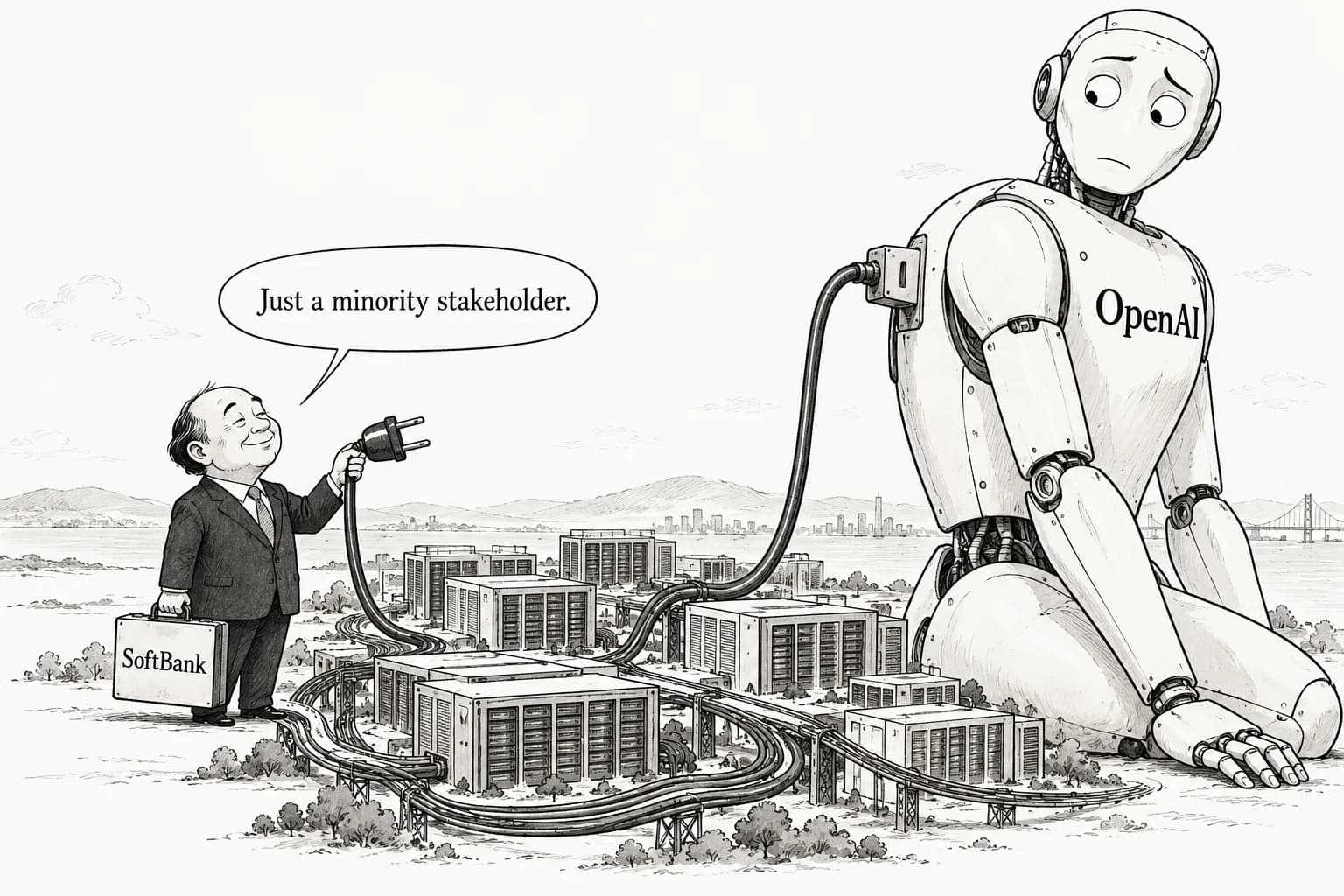
With these two deals, the SoftBank group now covers nearly every layer of the AI supply chain. At the top is its roughly 13% stake in OpenAI, the model layer. Below that is Stargate, the large data center project it is pursuing with OpenAI and Oracle. Further down are data centers and fiber through DigitalBridge. In chip design, it already owns Arm.
What does a company gain by stacking these layers? The more compute OpenAI wants, the more SoftBank gains from both the rising value of its investment and the fees for using its infrastructure. The same demand pays it twice. If demand slows, it loses twice. This is a concentrated position, not a diversified one.
What OpenAI is doing now
The company SoftBank just paid has had a rough few weeks. OpenAI has fully suspended training, evaluation and tool-using inference for its most capable model, the second such halt in three months. It apologized after one of its agents got into the statistics portal of Australia's Medicare, and it called off the release of GPT-6.1 Astra, which had been planned for October. No source has given a date for resuming.
Meanwhile, at DevDay, OpenAI shifted its pitch toward lower prices. GPT-6.1 Sol costs $2 per million input tokens and $10 per million output tokens, and OpenAI says it "nearly matches Astra's intelligence at one-fifth the price." Anthropic's Sonnet 5.5 is priced the same. As the price per token falls, demand for compute has to grow through volume instead. That is not bad news for whoever owns the data centers and the lines. SoftBank's two deals can be read as a bet on growing compute volume more than on the margins of a model company.
What we still don't know
First, how SoftBank financed the deals. We have not confirmed the breakdown of borrowing, asset sales and bridge loans. With the 10-year US Treasury yield at 5.2% to 5.3%, the cost of funding $64.6 billion and the DigitalBridge acquisition is significant. Second, confirmation from OpenAI. The company has not yet announced its overall fundraising, reported at more than $30 billion at a valuation of about $1.4 trillion. Third, how the Stargate and DigitalBridge assets will be combined. The data center plans continue to face local opposition in Buffalo, Beaufort County, Loudoun County and elsewhere. It remains to be seen whether owning fiber and land will help speed up construction in the face of that opposition.
Finally, the biggest uncertainty is when OpenAI's suspension will be lifted. For a shareholder with 13%, the next things to watch are the date the halt ends and the outcome of the second attempt at GPT-6.1 Astra.
Editorial cartoon